

What if amino acid tablets add nothing to your results? The answer to “are amino acid tablets effective” depends on your diet, training and the product’s ingredients. If your daily diet already provides enough complete protein, extra amino acids may offer little practical benefit. A targeted supplement may be worth considering when it addresses a genuine gap in your nutrition plan.
It’s easy to confuse essential amino acids, BCAAs and protein powders. They aren’t interchangeable, and a long ingredient list doesn’t guarantee an advantage. Look for a clear reason to use a product, supported by its label and relevant evidence, rather than adding tablets by default.
This guide explains what amino acid tablets can and can’t do, when they may fit a training routine, and how they compare with food and complete protein supplements. You’ll also learn what to check on a label, including the current information for products such as Muscle Works’ Beef Aminos. Make your decision based on your diet, training needs and the product details, not the hype.
Key Takeaways
- Whether amino acid tablets are effective depends on their formulation and whether they address a genuine gap in your nutrition plan.
- Compare the amino acid coverage in tablets, BCAA products, complete protein powders and protein-rich foods before choosing.
- Review your diet, training goals and current protein sources before adding another supplement.
- Assess product claims against the label and available evidence. For Beef Aminos, check the current label before deciding whether it suits your needs.
- Tablets can be convenient, but convenience alone doesn’t guarantee a meaningful benefit.
Are amino acid tablets effective, and what can they realistically do?
Are amino acid tablets effective? They can be useful when their formula addresses a specific dietary or training need. Their value depends on the amino acids they contain, what you already get from food and protein supplements, and how your training and overall nutrition are structured. If your protein intake is already adequate, adding tablets may make little practical difference.
Amino acids are the building blocks the body uses to make proteins, including muscle proteins. Tablets are a concentrated way to take particular amino acids, but the tablet form doesn’t make them physiologically stronger than the same nutrients from food or another supplement. Unlike complete protein foods or powders, a product containing selected amino acids may not provide the full range you need from your diet.
Amino acid tablets deliver selected protein building blocks in tablet form, but they don’t guarantee muscle growth or better training results. A nutrient’s role in the body does not, by itself, prove that taking a supplement will improve performance or body composition.
What does effective mean for an amino acid supplement?
Define the result you want before judging a product. A short-term change in amino acid availability is not the same as a lasting increase in strength or muscle. Long-term outcomes depend on repeated training, recovery and overall nutrition, as well as whether the supplement fills a genuine gap. Look for evidence tied to the outcome you care about, not just a claim that an ingredient supports a process in the body.
For example, a supplement might add amino acids to a meal pattern that lacks a suitable protein source. That doesn’t mean it will outperform a complete protein source for someone already meeting their needs. Both the formula and your starting point matter.
Which amino acids are commonly discussed?
Essential amino acids are those the body can’t make in sufficient amounts, so they must come from food or supplements. There are nine; you can read a foundational overview of an essential amino acid and its role. Leucine, isoleucine and valine are the branched-chain amino acids, or BCAAs, within this group. BCAAs are not the same as a full essential amino acid profile.
Check what a product actually provides rather than relying on its category name. For broader context on supplement options, see this amino acid supplements guide. Assess a product such as Muscle Works’ Beef Aminos against your needs using its current label. Don’t assume its amino acid profile or serving details without checking.
How amino acids relate to muscle protein synthesis and training
Muscle protein synthesis (MPS) is the process your body uses to build and renew muscle proteins. Amino acids supply the raw materials. As MedlinePlus explains, they are the building blocks of life, used by the body to make proteins and support growth and repair. Supplying building blocks is only one part of the process.
Resistance training gives muscles a reason to adapt. Essential amino acids provide materials for making new muscle proteins, while energy intake and your overall diet influence whether your body has the resources to support training and recovery. A supplement can contribute amino acids, but it can’t replace a suitable training stimulus or a balanced nutrition plan.
Do amino acids trigger muscle protein synthesis?
Essential amino acids are involved in MPS because the body needs them to build muscle proteins. Leucine, one of the branched-chain amino acids, is often discussed for its role in signalling the process to begin. That signal isn’t a complete supply: making muscle protein requires the other essential amino acids too. Leucine alone is not a substitute for a complete protein source.
Research findings need context. Results can differ according to a supplement’s composition, what it’s compared with and who took part in the study. A short-term change in MPS doesn’t automatically show that tablets produce greater strength or muscle gains over time. When assessing a study, check its design, participants, supplement and measured outcomes. Consider whether those details match the product and result being discussed.
Can tablets improve muscle growth or recovery?
Tablets may provide amino acids that support the body’s protein-building processes, particularly if someone’s usual diet leaves a specific nutritional gap. That’s a plausible role, not proof of extra gains. Long-term muscle growth still depends on consistent resistance training and adequate energy and total protein. If those foundations are already in place, additional tablets may have little effect on your results.
Apply the same scrutiny to recovery claims. A finding about one supplement, dose or group of participants can’t guarantee that every athlete will feel less sore or recover faster. Judge evidence by the outcome measured and how closely the study matches your situation. Don’t mistake a mechanism, such as amino acids being used in muscle, for a promise of improved performance.
Keep the fundamentals in focus. If you’re reviewing supplements alongside protein sources, you can explore sports nutrition options, then assess each product’s current label against your diet and training needs.
Amino acid tablets vs food, protein powder, and BCAAs
Choose a format based on what your diet needs to provide. Protein-rich foods such as eggs, dairy, fish, meat and soy supply protein alongside other nutrients. A varied diet can provide essential amino acids across meals. Complete protein powders offer another way to add protein, while amino acid tablets provide selected amino acids according to their formulation. The label matters more than the format name.
| Option | Amino-acid coverage | Convenience | Dietary role and key limitation |
|---|---|---|---|
| Protein-rich foods | Varies by food; a varied diet can provide essential amino acids. | Requires meal planning and preparation. | Provides protein as part of meals. Choices may be limited by dietary preferences or restrictions. |
| Complete protein powder | Typically supplies a broad range of amino acids, depending on its source and formulation. | Can be mixed into a drink or food. | Can help add protein to the diet. Check the ingredient and nutrition labels, and choose a type that suits your diet. |
| Amino acid tablets | Depends on the amino acids listed on the product label. | Portable and need no mixing. | May suit a targeted need, but selected amino acids aren’t automatically a substitute for complete dietary protein. |
| BCAA products | Provide leucine, isoleucine and valine, not the full set of essential amino acids. | Format varies by product. | Supply three specific amino acids, but don’t provide the broader coverage of complete protein. |
Are amino acid tablets better than protein powder?
Not by default. Tablets may be convenient if you want specific amino acids, but a complete protein source supplies a broader mix and can contribute to your total protein intake. Food may also bring other nutrients; powder can be a practical option when preparing a protein-rich meal isn’t convenient. Let your dietary requirements, preferences and actual intake guide the choice. For more on whey as a protein option, read the 100% whey protein guide.
Are BCAA tablets enough on their own?
BCAAs are a subgroup of essential amino acids, not all nine. That doesn’t make them useless in every context, but they shouldn’t be mistaken for complete protein. Check the label: does the product list only BCAAs, or does it provide a broader amino acid blend? If your goal is to add protein to meals, compare that coverage with food or a complete protein powder. Ask yourself: are amino acid tablets effective for a need your current diet doesn’t meet? If not, another supplement may add complexity without solving a real gap.
How to decide whether amino acid tablets suit your routine
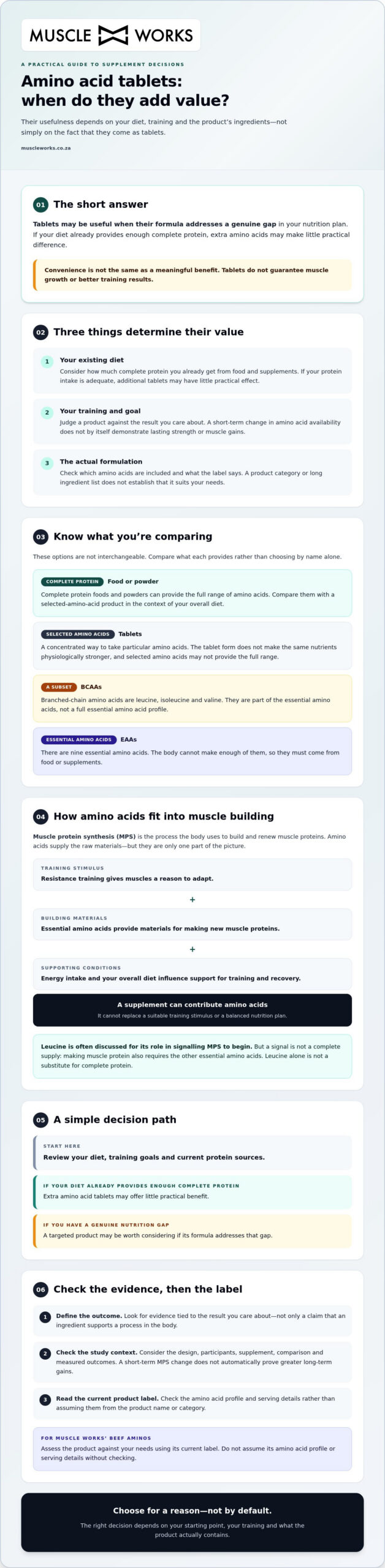
Base your decision on your actual routine, not a bold promise on a tub. Start with what you eat, what you’re training for and what your current protein sources provide. Then identify a specific gap a supplement could address. If you can’t name one, pause before adding another product.
- Review your diet. Consider the protein you get across a typical day and whether your meals include suitable protein sources. Note any dietary restrictions or practical barriers that affect your intake.
- Define your training goal. Be clear about what you want the supplement to support. A general claim about performance isn’t a specific reason to take a product.
- Check your current sources. Account for food and any protein powder you already use. Work out whether the amino acid product adds something relevant or simply duplicates what’s already in your plan.
- Assess the label. Check the listed amino acids, whether amounts are shown per serving, serving directions, warnings, allergens and manufacturer information. Treat third-party testing claims as something to verify, not as a guarantee of results.
- Track and reassess. If you decide to try a product, keep your training and food intake consistent and record relevant outcomes. This gives you a better basis for judging its usefulness than changing several things at once.
What should you check on an amino acid tablet label?
Read the current packaging before deciding. Formulations and directions can change, so don’t rely on old descriptions or assumptions based on a product’s name. Check which amino acids are listed and whether the label gives their amounts. Review warnings, allergens and manufacturer details, and look closely at any quality or testing claims to understand what they actually say.
For example, Muscle Works sells Beef Aminos, but you should check its amino acid profile and serving information against the current label. Don’t infer ingredients, directions or suitability from the product name alone.
When might supplementation be worth considering?
A tablet may be worth assessing if your eating pattern or practical constraints make it difficult to meet a specific nutrition need, and the product’s label matches that need. It’s less compelling if your diet already covers it or your reason for using it rests only on broad marketing language. If you have a health condition, take medication or follow a restricted diet, ask a qualified health professional for advice before using supplements.
Use this checklist to compare your needs with the product information. Explore Muscle Works’ protein and amino acid products, and review each current label before deciding whether it fits your plan.
Choosing an amino acid product: evidence first, claims second
The verdict is straightforward: amino acid tablets can be convenient, but convenience alone doesn’t make them useful. Their value depends on whether the formula meets a genuine need in your nutrition plan. No tablet can guarantee muscle gain, fat loss or faster recovery. Judge the product by its label, the evidence behind its claims and the role it would play alongside your food and training.
How to judge supplement claims without the hype
Make each claim specific. Ask which ingredient is linked to which outcome, and whether there’s verifiable evidence for that ingredient and outcome. Evidence about a biological process isn’t automatically proof of a lasting training benefit. Be cautious with dramatic promises and vague proprietary blends, particularly when the label doesn’t clearly show what’s included or in what amounts.
Separate what’s confirmed about the product from what research says about an ingredient in general. Check the current packaging for ingredients, amounts, directions, warnings and manufacturer details. If a claim depends on a particular formulation or study, check whether the evidence matches the product and the result being promised. Don’t fill gaps with assumptions.
Where Muscle Works Beef Aminos may fit
Muscle Works sells Beef Aminos. The name alone doesn’t establish its amino acid profile, serving information or suitability for a particular goal. Check the current label, then compare its details with your dietary needs and any protein or amino acid supplements you already use. If it doesn’t address a clear gap, there may be little reason to add it.
If you’re comparing options, you can explore Muscle Works’ supplement range and assess the product information against your plan. Keep the decision grounded: choose a product for a defined reason, not because a claim sounds powerful.
Ready to assess Beef Aminos for your routine? Review Beef Aminos and check its current label before deciding whether it fits your nutrition needs.
Make your next supplement choice count
So, are amino acid tablets effective? They can suit a specific nutrition need, but the tablet format alone doesn’t promise better results. Check what the product contains, compare it with your current food and protein intake, and be clear about what you want it to support. Essential amino acids contribute to muscle protein synthesis, but training, overall diet and consistent habits remain central to progress.
Muscle Works offers Beef Aminos alongside protein and amino acid supplements. Review the current Beef Aminos label for its ingredients and serving information, then decide whether it fits your plan. Don’t buy on bold claims alone. Choose with purpose.
Explore the Muscle Works amino acid range and compare the options with your nutrition needs. Stay focused on the fundamentals, assess the evidence, and build a plan you can stand behind.
Frequently Asked Questions
Are amino acid tablets effective for building muscle?
They may be useful if their ingredients address a gap in your diet, but they don’t guarantee muscle growth. Muscle-building results depend on consistent resistance training, adequate energy and total protein, as well as recovery. If you already get enough protein from food or complete protein supplements, extra amino acids may add little. Judge effectiveness by meaningful changes over time, not by a short-term response alone.
Can amino acid tablets replace protein from food?
Generally, don’t treat them as a replacement for protein-rich foods. Tablets may contain selected amino acids, whereas foods such as eggs, dairy, fish, meat or soy provide protein as part of a meal and may also supply other nutrients. Formulas vary, so check the label rather than assuming a tablet provides complete protein. If you’re following a restricted diet or struggling to meet your needs, seek guidance from a qualified health professional.
Are BCAA tablets enough to support muscle growth?
BCAA tablets provide leucine, isoleucine and valine, three essential amino acids, but they aren’t the full set of essential amino acids. They may suit a targeted use, but shouldn’t be confused with a complete protein source. Check whether the product contains only BCAAs or a broader amino acid profile, then consider how it fits with your food and existing supplements. Muscle growth still depends on training and overall nutrition.
When should I take amino acid tablets?
There isn’t one timing rule that suits every amino acid product. Follow the directions on the current label, and consider whether the supplement fills a clear need in your daily nutrition. Don’t assume taking tablets immediately before or after training will produce better results. The formula, your diet and your training routine all matter. If the directions or suitability are unclear, ask a qualified health professional for advice.
How do I know whether amino acid tablets are working?
Set a specific, realistic goal before you start, then track your training, food intake and relevant outcomes consistently. A change in how you feel after one session doesn’t prove the tablets caused it. Keep other routine factors steady where possible and review progress over time. If your diet already meets your needs and you notice no meaningful difference, the supplement may not be adding practical value.
Are amino acid tablets safe for everyone?
No supplement can be assumed suitable for everyone. Ingredients, amounts, warnings and allergens vary by product, so read the current label and follow its directions. If you have a health condition, take medication, are pregnant or follow a restricted diet, check with a qualified health professional before use. Stop and seek appropriate advice if you experience a concerning reaction. Don’t rely on broad marketing claims to judge personal safety.