

Leucine can stimulate muscle protein synthesis, but it cannot provide every building block your muscles need. For BCAA vs EAA for muscle growth, EAAs are the more complete option: they provide all nine essential amino acids, while BCAAs contain only leucine, isoleucine and valine. That difference matters when your goal is to support muscle growth, rather than focus on one amino acid.
Leucine has a key role in muscle protein synthesis, but the signal alone is not enough: the process also requires all the essential amino acids. Choose based on your overall nutrition needs, not just the ingredient that gets the most attention.
This guide explains how BCAAs and EAAs differ, why leucine matters and how to choose an option that fits your training and nutrition goals. It also covers when a complete protein source may be more practical than either supplement, helping you make a focused choice without the hype.
Key Takeaways
- Compare the three amino acids in BCAAs with the full essential amino acid profile in EAAs before choosing a supplement.
- Understand why leucine can stimulate muscle protein synthesis, while the process also needs other essential amino acids.
- Consider what taking BCAAs alone may leave out when you’re planning nutrition to support muscle growth.
- If a complete protein option fits your nutrition plan, explore Muscle Works 100% Whey Protein 1kg.
BCAA vs EAA: Which Amino Acid Is Better?
Choose based on what your nutrition plan needs, not the strongest label claim. The BCAA vs EAA for muscle growth decision also depends on the serving details, cost per serving and how well the product fits your routine.
EAA supplementation for muscle growth
Consider an EAA supplement if you want a dedicated amino acid product with broader coverage. Compare the ingredient panel, serving directions and servings per pack, and check that the formula suits your dietary preferences. Its practical advantage is convenience: one product can provide its listed amino acids without requiring you to combine several supplements.
BCAA supplementation for muscle growth
Current information does not establish that BCAAs produce greater muscle growth than a placebo. Treat claims about lean mass or body composition as possibilities, not guaranteed outcomes. Before buying, look for clear ingredient quantities and serving information, then consider whether the product adds anything useful to your nutrition routine.
Choosing and combining supplements
In South Africa, compare the ingredient list, serving count, directions and cost per serving. There is no single price for BCAA or EAA supplements: formulation and pack size affect the cost. Combining products makes sense only when each has a clear purpose; otherwise, their ingredients may overlap. For BCAA vs EAA for muscle growth, prioritise a clear match between your goal and the product label.
| Option | Label check | Practical consideration | Best fit |
|---|---|---|---|
| BCAA | Ingredient quantities and serving count | Focused formula | A specific amino acid preference |
| EAA | Full ingredient panel and directions | Broader formula | Seeking wider amino acid coverage |
Choose the option whose ingredients and serving details best fit your nutrition plan.
Leucine and muscle protein synthesis
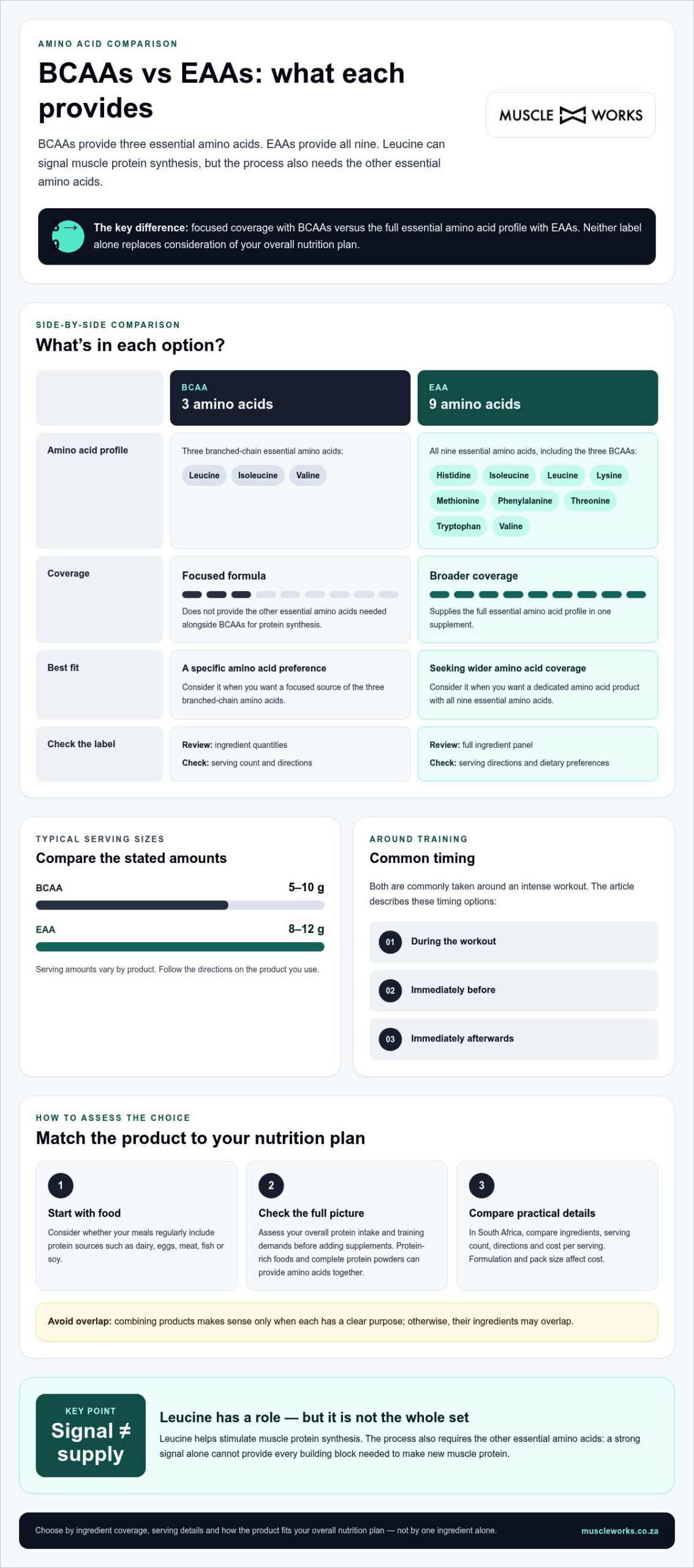
Leucine helps stimulate muscle protein synthesis, the process of building muscle proteins. Think of it as a signal, not a complete supply of building blocks. The process also requires the other essential amino acids. A strong signal alone cannot provide everything needed to make new muscle protein.
According to the National Institutes of Health, the 9 essential amino acids are:
- Histidine
- Isoleucine
- Leucine
- Lysine
- Methionine
- Phenylalanine
- Threonine
- Tryptophan
- Valine
Essential amino acids are those the body cannot make, so they must come from food or supplements. Muscle protein synthesis depends on the full set, not just leucine or another single amino acid. That is why an isolated amino acid and a complete protein serve different nutritional roles.
Can you get enough BCAAs and EAAs from food or protein powder? Yes. Protein-rich foods and complete protein powders can provide these amino acids together. Whey protein isolate contains all 20 standard amino acids, making it a whole-protein option rather than a single-amino-acid supplement.
Start with your meals. Consider whether they regularly include protein sources such as dairy, eggs, meat, fish or soy. Then assess your overall protein intake and training demands before adding supplements. If your meals already cover your needs, extra isolated amino acids may offer less practical value than maintaining a consistent intake.
Recovery depends on more than leucine. Training stress, rest and your overall diet all shape how your body responds. Fatigue after a hard session does not prove you need a specific amino acid. First consider what your meals provide, then choose a protein source or supplement that fills a genuine gap.
If a convenient whole-protein option suits your plan, explore 100% Whey Protein 1kg. Compare its role with your regular meals, and use it to support a consistent protein routine rather than treating leucine as a shortcut.
What are Amino Acids and Why Do You Need Them?
BCAAs are the branched-chain amino acids leucine, isoleucine and valine. EAAs include those three plus histidine, lysine, methionine, phenylalanine, threonine and tryptophan, giving nine essential amino acids in total.
Typical servings are 5-10 grams for BCAAs and 8-12 grams for EAAs. They’re commonly taken during an intense workout, immediately before it or immediately afterwards. Follow the serving directions on the product you use.
The main limitation of BCAAs alone is their narrow profile. They do not provide lysine or the other essential amino acids needed alongside them for protein synthesis. BCAAs may support the process, but they cannot supply every amino acid required to build muscle protein. Consider how your whole diet supports growth and recovery, rather than focusing on one supplement.
During exercise, BCAAs can serve as fuel for muscles. This may make them relevant to athletes training intensely, particularly if they want amino acids around a session. However, an energy role is not proof of improved performance or prevention of muscle breakdown. Judge the supplement by its contents and how it fits your wider nutrition plan.
BCAAs may also affect brain chemicals, including serotonin, which is linked with fatigue. This is one proposed reason for using them around workouts, but it does not make them a guaranteed fix for fatigue. Training demands, meals and recovery habits all affect how a session feels.
BCAAs may suit your routine if you want a focused source of three branched-chain amino acids. Choose EAAs if you want all nine essential amino acids in one supplement. If your meals already include protein sources that provide amino acids, assess your intake before adding either. The practical question is whether you need a focused source or broader EAA coverage.
BCAA composition and role in muscle growth
BCAAs are three branched-chain amino acids: leucine, isoleucine and valine. Their shared name describes their chemical structure, while their roles in nutrition differ. Leucine can stimulate muscle protein synthesis, the process that builds muscle tissue. Isoleucine and valine also contribute to the amino acid pool, but none works alone as a complete muscle-building formula.
Many BCAA supplements use a 2:1:1 ratio of leucine to isoleucine to valine. That makes leucine the largest share, not the only useful ingredient. Check the ratio and the amount of each amino acid on the label. Then compare those details with your workout nutrition and the protein already present in your meals.
The key limitation is coverage. BCAAs provide three amino acids, while muscle protein synthesis also uses other essential amino acids. BCAAs can interact with those amino acids to help maintain the synthesis response over time, but a BCAA product cannot supply what it does not contain. A strong leucine signal is only one part of the process.
During a workout, BCAAs can serve as fuel for muscles, giving them a different role from protein consumed across meals. Their usefulness depends on your training routine and overall nutrition, not just the intensity of a session. If your meals already provide adequate protein, adding BCAAs may not address a meaningful gap.
BCAA supplements may help increase lean muscle mass and decrease body fat, but these outcomes are not guaranteed. Training, food intake and recovery remain central to your plan. Do not mistake a product’s amino acid ratio for proof that it will independently change your body composition.
Use BCAAs when a focused source of leucine, isoleucine and valine fits your routine. Choose broader protein nutrition when your priority is supplying muscle tissue with a wider range of amino acids. For a practical next step, explore sports nutrition options that fit your training and daily protein plan.
Muscle Works: 100% Whey Protein 1kg
Muscle Works 100% Whey Protein 1kg is a protein option for readers who want to build their daily nutrition around whole protein rather than focusing only on isolated amino acids. Consider it when your meals need a convenient protein addition, while keeping your overall food intake and training goals in view.
BCAAs and EAAs have different profiles, but neither replaces a consistent nutrition plan. If you are comparing amino acid supplements with protein powder, start with what your meals provide and choose the format that best fits your routine. Keep your decision practical and aligned with your muscle growth goals.
Visit muscleworks.co.za to explore Muscle Works’ sports nutrition range.
Make your next nutrition choice count
Let your food intake and training routine guide your next move. The BCAA-versus-EAA choice for muscle growth is one part of a wider plan, so focus on the nutritional gap you want to address rather than adding supplements by habit. Keep your approach consistent, review how it fits your routine, and adjust with purpose.
Muscle Works offers options including 100% Whey Protein 1kg, SUPER PROTEIN ICE COFFEE – 450g and the 21 Day Grow Stack. Explore them in the context of your nutrition goals, then choose what best fits your plan.
Contact Muscle Works for supplement advice and take your next step with focus.
Frequently Asked Questions
What are BCAAs?
BCAAs are amino acids with a branched chemical structure: leucine, isoleucine and valine. They occur naturally in protein-containing foods and are also sold as standalone supplements. Check whether a product supplies only these three amino acids or forms part of a complete protein source. That distinction helps you assess its place in your daily nutrition plan.
Do You Really Need EAA and BCAA Supplements?
No. Supplements are not automatically necessary. Start by considering whether your usual meals provide enough protein to support your training. Someone who struggles to fit regular protein-containing meals into their schedule may value a convenient supplement; someone already meeting their needs through food may have less reason to add one. Treat supplements as an option, not a replacement for balanced meals.
What are the primary differences between EAAs and BCAAs?
The main difference is coverage. BCAAs contain leucine, isoleucine and valine, while EAAs include those amino acids and the other essential ones. Compare the ingredient panel with your goal: a BCAA product is a narrower choice, while an EAA product provides a wider selection. A longer ingredient list does not automatically mean a product is necessary for your routine.
Are EAAs Worth It If You Eat Enough Protein?
If your regular diet already provides enough protein, EAAs may add little to your plan. Review your meals across your training routine, including convenient options such as eggs, dairy, beans or protein powder. If those sources consistently cover your needs, focus on maintaining that routine. An EAA supplement is more relevant when you want a specific amino acid source, not simply because you train hard.
Are there any additional health benefits of EAAs?
EAAs supply amino acids used in the body for more than muscle-related processes, but a supplement is not a general health product. Tryptophan, one of the essential amino acids, is involved in producing serotonin, which is linked with mood and sleep. This does not mean taking EAAs will improve mood or sleep. Consider the supplement for its nutritional contents, not as a remedy.
EAA vs BCAA: What’s the Verdict?
If you are choosing specifically for muscle-building nutrition, EAAs offer broader coverage. BCAAs may suit a focused preference, but they do not replace complete dietary protein. Check what your meals already provide, then choose a supplement only if it addresses a real gap. If your intake is already well covered, neither option needs to be an automatic addition.