

Carbohydrates may help more creatine enter muscle, but they’re not required for creatine to work. The benefits of creatine with carbohydrates are often summed up as “insulin boosts uptake”. That mechanism is plausible, but greater uptake does not automatically mean better strength or performance. If you’ve been advised to reach for a sugary drink, it’s reasonable to ask whether the extra energy fits your diet and training.
The short answer is that combining creatine and carbohydrates is an option, not a rule. This article explains how insulin may affect creatine uptake, what research says about performance, and why creatine monohydrate can still fit a routine without a carbohydrate source.
You’ll also learn how loading differs from steady daily use, why online dosing advice can overstate the case, and how to choose an approach that suits your diet and training. No forced sugar or magic timing window, just a practical look at the evidence.
Key Takeaways
- Taking creatine with carbohydrates may support muscle creatine uptake, but that doesn’t guarantee greater strength or muscle growth.
- An insulin response could influence creatine transport, but a possible effect on uptake is not proof of a performance advantage.
- Studies use different participants, protocols and outcomes. Interpret findings on repeated-sprint performance with care.
- Let your training, usual meals and fuelling needs guide whether you pair them. Consistent creatine use matters more than a narrow post-workout window.
- Carbohydrate co-ingestion is optional. Keep creatine monohydrate distinct from carbohydrate foods and plan each around your needs.
Benefits of creatine with carbohydrates: what the combination may do
Co-ingestion means taking creatine and carbohydrates during the same meal or drink. For example, you might take creatine with a meal or mix it into a drink that contains carbohydrates. The proposed advantage is that carbohydrate can prompt an insulin response, which may support creatine uptake into muscle. That is a possible effect on delivery, not proof of extra strength or muscle growth. The benefits of creatine with carbohydrates are easier to assess when you keep those outcomes separate.
What creatine and carbohydrates each contribute
Creatine helps your muscles maintain phosphocreatine stores. During short, intense efforts, such as a heavy lift or a sprint, phosphocreatine helps rapidly regenerate ATP, the immediate energy currency used for muscular work. Creatine supports this rapid energy-recycling system. It is not a carbohydrate substitute, and taking it with a sugary drink does not turn it into a different fuel.
Carbohydrates have a separate role. They’re digested into glucose, which the body can use for energy, and can help replenish muscle glycogen, the stored carbohydrate that supports exercise. How much this matters depends on your session, overall diet and training demands. A high-volume workout places different demands on fuel availability than a brief strength session. Even when you consume both nutrients together, their roles remain distinct.
Why lifters consider taking them together
The proposed link is insulin. After carbohydrate intake, insulin levels rise, and insulin may influence how creatine moves from the bloodstream into muscle. That gives lifters a reason to consider pairing the two, particularly if they’ve heard that a larger insulin response could increase uptake. The Creatine overview explains its role in the body, including its connection to phosphocreatine and muscle energy systems.
However, a plausible effect on uptake doesn’t establish that the combination produces better long-term training results. It also doesn’t mean creatine needs a large amount of sugar to be useful. Taking creatine with an ordinary meal can be practical without engineering that meal around an insulin spike. The important question is whether any added uptake translates into a meaningful training outcome, not simply whether a mechanism is possible.
Carbohydrate is optional, not a prerequisite for creatine. If you already eat carbohydrates with a meal or after training, taking creatine at the same time may be convenient. If you don’t, there’s no need to add a carbohydrate source solely to make creatine work. Creatine supports rapid energy recycling; carbohydrate provides exercise fuel. Keep those roles separate when weighing the evidence and choosing what suits your diet.
How carbohydrates could influence creatine uptake in muscle
The proposed link begins with digestion. Carbohydrates are broken down into glucose, which enters the bloodstream. In response, the body releases insulin, a hormone involved in managing nutrients, including glucose. Researchers have examined whether this insulin response can also encourage more creatine to move from the blood into muscle. It may influence uptake, but it isn’t a switch that makes creatine work or fail.
Insulin, glucose and the proposed transport effect
After a carbohydrate-containing meal, insulin helps direct glucose into tissues. It may also support creatine transport into muscle, which is why researchers study the two together. The response can vary with the amount of carbohydrate and what else is in the meal. A meal containing carbohydrate and protein, for example, is not the same as taking creatine with a carbohydrate-only drink.
That distinction matters. Findings from one supplement protocol don’t automatically apply to every food, serving or person. Digestion, the amount consumed and individual physiology all affect the response. There’s no need to treat a large sugar intake as the price of creatine uptake. A usual meal can be a convenient time to take creatine without turning your diet into a strategy for chasing an insulin spike.
Uptake is not the same as better results
Even if insulin increases creatine accumulation in muscle under certain conditions, that’s a biological measure, not a direct performance result. It doesn’t show on its own whether someone will lift more, complete more repetitions or build more muscle over time. Those outcomes need to be measured directly in studies designed to assess training performance or body composition.
Mechanistic evidence can explain how a nutrient might affect creatine uptake; it can’t, by itself, prove better training outcomes. This distinction is central to judging the benefits of creatine with carbohydrates. To establish a practical advantage, research needs appropriate comparisons over a suitable period, with training and diet accounted for and outcomes measured that matter to lifters. A short-term change in muscle creatine levels is not interchangeable with long-term progress.
Your results also depend on the wider routine: training quality, overall diet and consistent use all matter. If you already eat carbohydrate around training, taking creatine with that meal may be straightforward. If you don’t, adding a sugary drink solely to influence uptake may not suit your needs. Keep your approach practical and choose a creatine monohydrate option that fits a routine you can follow consistently.
What research says about creatine with carbohydrates
Research on creatine and carbohydrates examines different questions. Some studies look at anaerobic performance; others test performance during a specific repeated-sprint protocol. Participants, supplementation periods and outcome measures vary, so the findings can’t be treated as interchangeable. A short test also can’t establish that the combination builds more muscle or produces lasting strength gains.
The 2017 anaerobic-performance study
A 2017 study examined combined carbohydrate and creatine supplementation in relation to anaerobic performance. It included 20 male physical education students, a small and specific group that does not represent all lifters or athletes. To judge whether co-ingestion improved performance, it’s important to consider the study methods and results, including the supplementation protocol, comparison groups and measured outcomes.
Without those details, it would be misleading to claim a particular performance benefit or quote an effect size. Even a positive result in this group would need cautious interpretation: the sample size and participant characteristics limit how confidently it can be applied to people with different training backgrounds. The study is relevant to the question, but the participant count alone can’t settle it.
The 2026 repeated-sprint study
A 2026 paper in Scientific Reports examined 60 male participants completing repeated Wingate tests after a four-day supplementation period. The study had four groups and reported changes in mean-power measures, including comparisons involving creatine alone, creatine with carbohydrates, and creatine with carbohydrates and protein. These findings relate to the study’s particular protocol and test conditions.
Read the reported power changes in context. A change within one group from before to after supplementation doesn’t, by itself, show that the group outperformed another. The key question is whether differences between groups were statistically and practically meaningful. Without effect sizes and full methodological detail, that judgement is difficult. Treat the result as specific to the study, not as a promise that combining creatine and carbohydrates improves repeated-sprint performance for everyone.
Repeated Wingate tests assess performance in a demanding, specific test setting, and four days is a short supplementation period. These findings can’t establish muscle growth, lasting strength gains or what happens over months of normal training. The male-only sample also limits how broadly the results can be generalised.
The evidence on the benefits of creatine with carbohydrates depends on the outcome measured. Muscle uptake, short-term mean power and long-term training progress are different endpoints. To judge a practical advantage, look for clear between-group comparisons, complete methods and outcomes measured over a period suited to the claim. The studies raise useful questions, but they don’t prove that everyone needs to pair creatine with carbohydrates.
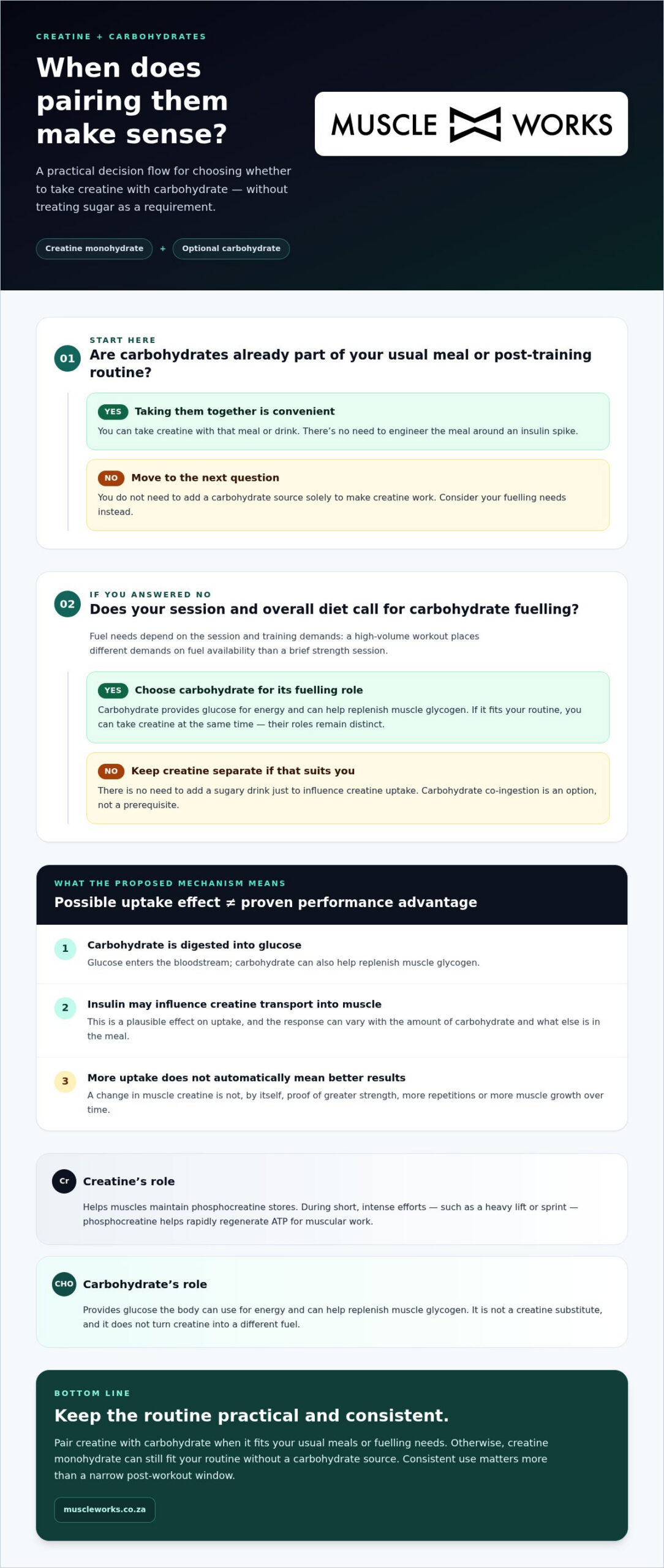
How to decide whether to pair creatine with carbohydrates
Base your decision on your training and usual meals, not a fixed supplement ratio. Consistent creatine use matters more than hitting a narrow post-workout window. Use this simple sequence:
- Consider your session. Repeated intense efforts or a high-volume workout may make overall fuelling more important. That doesn’t mean you must add carbohydrates specifically for creatine.
- Check what you already eat. If a carbohydrate-containing meal or snack is part of your usual training routine, take creatine with it if that’s convenient.
- Keep your nutrition goal in view. Base carbohydrate portions on your energy and training needs, not on a mandatory creatine-to-carbohydrate ratio.
When combining them may fit your routine
Pairing creatine and carbohydrates can be an easy option if your post-training meal already contains carbohydrates or you have a carbohydrate-containing drink as part of your fuelling plan. After a demanding session with repeated efforts, for example, your meal may already support your broader recovery and energy needs. Taking creatine with it is convenient. There’s no need to add a sugary drink solely to make creatine work.
When a separate carbohydrate serving may not be useful
If your regular meals already cover your carbohydrate needs, a separate serving just to take creatine may add energy you don’t need. That may not suit every body-composition goal. If you have a medical condition, specific dietary requirements or uncertainty about your fuelling needs, seek advice from a suitably qualified health professional. Keep your supplement routine aligned with your individual circumstances.
There’s no requirement to take creatine immediately after training. Choose a time you can stick to, such as breakfast or another regular meal, and make consistency the anchor. If you train at different times, let your daily routine guide when you take it instead of chasing a precise post-workout window. Carbohydrates can be part of that occasion if they already fit your plan, but they aren’t a compulsory extra.
The potential benefits of creatine with carbohydrates may be relevant if the pairing suits your fuelling routine, but the evidence doesn’t make it a universal rule. Muscle Works offers creatine monohydrate. Explore Muscle Works creatine monohydrate and build a straightforward routine around the training and meals you can maintain.
Put the evidence into a simple creatine routine
The takeaway is simple: taking creatine with carbohydrates is a possible strategy, not a requirement. Research into uptake doesn’t establish that everyone needs a carbohydrate drink or a particular food pairing. Your routine should fit your training, diet and daily schedule, without forcing extra sugar or a complicated timing ritual.
Keep the routine practical and consistent
Choose a regular time that’s easy to remember, such as breakfast or a meal you often have after training. If that meal already contains carbohydrates, you can take creatine with it. If it doesn’t, there’s no need to add a carbohydrate serving just to create a pairing. No specific food or fixed carbohydrate-to-creatine ratio is essential.
Keep the roles clear. Creatine monohydrate is a form of creatine; carbohydrate foods are a separate part of your diet. Taking them in the same meal doesn’t make them the same thing, and a supplement routine shouldn’t dictate your whole fuelling plan. Base food choices and portions on your overall training demands and nutrition needs.
Most of all, make the habit repeatable. A complicated schedule can be harder to maintain than taking creatine at a convenient time each day. Don’t judge your routine by a single workout or expect an instant transformation. Track whether you’re following it consistently alongside your training, then assess progress over time.
Know when to get individual guidance
Study findings describe group results under specific conditions; they can’t predict exactly how every individual will respond. If you have a medical condition, take medication or have particular dietary needs, speak with a suitably qualified health professional before changing your supplement or nutrition routine. Individual guidance matters more than copying a study protocol.
The evidence doesn’t make carbohydrate co-ingestion a universal rule. Creatine monohydrate can be used without deliberately adding carbohydrates, while carbohydrate intake can be planned around your broader fuelling requirements. Keep the approach straightforward: choose a routine that fits your life, stick with it, and assess it through consistent training and progress rather than a narrow post-workout window.
For a broader grounding in creatine fundamentals, read this creatine monohydrate guide.
Build a routine that holds up under pressure
Make your next step simple: choose a creatine routine that fits your real training week, then give yourself room to follow it without turning every meal into a calculation. Note what you take and how your sessions feel. Use that record to spot patterns, rather than expecting one drink or one workout to transform your results.
The benefits of creatine with carbohydrates are worth understanding, but your decisions should support your wider nutrition plan. Focus on habits you can sustain and progress you can assess over time. Muscle Works offers creatine monohydrate as part of its sports supplement range.
Explore Muscle Works creatine monohydrate and choose a straightforward starting point for your routine.
Frequently Asked Questions
Do carbohydrates improve creatine absorption?
Carbohydrates may support creatine uptake into muscle by prompting an insulin response, but that doesn’t necessarily mean more noticeable training results. “Absorption” can also refer to digestion, so it’s useful to distinguish uptake into muscle from absorption through the gut. The benefits of creatine with carbohydrates are mainly discussed in relation to muscle uptake, not as proof that carbohydrates make creatine more effective for everyone.
Can I take creatine without carbohydrates?
Yes. You can take creatine without adding carbohydrate foods or drinks. For example, mix it with water or take it alongside a meal that contains little or no carbohydrate. Choose an approach that suits your diet and is easy to repeat. If a routine causes discomfort or doesn’t fit your nutrition needs, adjust it rather than forcing a food pairing you don’t want.
Should I take creatine before or after a workout with carbs?
There’s no need to organise your routine around a strict pre- or post-workout window. Take creatine at a time you can remember, whether before training, afterwards or with another regular meal. If you already eat a carbohydrate-containing meal after your session, you can take them together for convenience. Prioritise a routine you can maintain over precise timing around one workout.
Do I need sugar to make creatine work?
No. Sugar isn’t required for creatine to be useful, and you don’t need to add a sugary drink just to take it. If you prefer a sweet drink, that’s a personal choice, not a condition for using creatine. Consider whether anything you add fits your overall nutrition plan, especially if you’re limiting added sugars or managing your energy intake.
Can I mix creatine with a protein shake?
Yes, you can mix creatine into a protein shake if that makes your routine easier. The shake’s carbohydrate content depends on its ingredients and preparation, so don’t assume every shake provides the same nutrient combination. You can also take creatine separately. Follow the preparation directions for the products you use and choose a convenient method that fits your diet and usual meals.
Will taking creatine with carbohydrates cause weight gain?
Not automatically. Carbohydrate foods contribute energy, so adding them on top of your usual intake may affect your overall energy balance. Creatine use can also change scale weight through increased water stored in muscle, which isn’t the same as gaining body fat. If body composition is a priority, look at longer-term trends in weight, training and diet rather than reading too much into a single weigh-in.
Is a 4:1 carbohydrate-to-creatine ratio necessary?
No. A 4:1 ratio isn’t a universal requirement for taking creatine, and you don’t need to calculate a fixed amount of carbohydrate for every serving. Base carbohydrate portions on your overall fuelling needs and food preferences, not on a ratio presented as a rule. If you’re considering a specific protocol for a health or training reason, seek advice from a suitably qualified professional.