

The scale can climb after you start creatine without your body fat climbing with it. So, does creatine make you gain fat? Creatine itself doesn’t directly add body fat. An early increase is more likely to come from extra water stored inside your muscles, but the number can still catch you off guard.
If your weight has jumped, it’s fair to question whether creatine is changing your body composition. Don’t let one weigh-in make the decision for you. Scale weight alone can’t tell you whether a change comes from water, fat or muscle.
This guide explains the difference between temporary water-weight changes and fat gain, and what creatine does in your body. You’ll learn what to track beyond the scales, how to assess your progress over time and when to seek advice from a healthcare professional. Get the facts first, then decide whether to continue, adjust your routine or stop.
Key Takeaways
- Does creatine make you gain fat? Learn what creatine can change on the scales, and what that increase may represent.
- See how creatine supports short, intense efforts and why changes in muscle water aren’t the same as body-fat gain.
- Compare weight trends and waist measurements, while recognising that no single home measure can diagnose a change in body fat.
- Use a consistent tracking routine to assess weight averages, waist measurements, training performance and changes to your routine.
- Know what to check on a creatine monohydrate label before choosing a product.
Does creatine make you gain fat, or change the number on the scales?
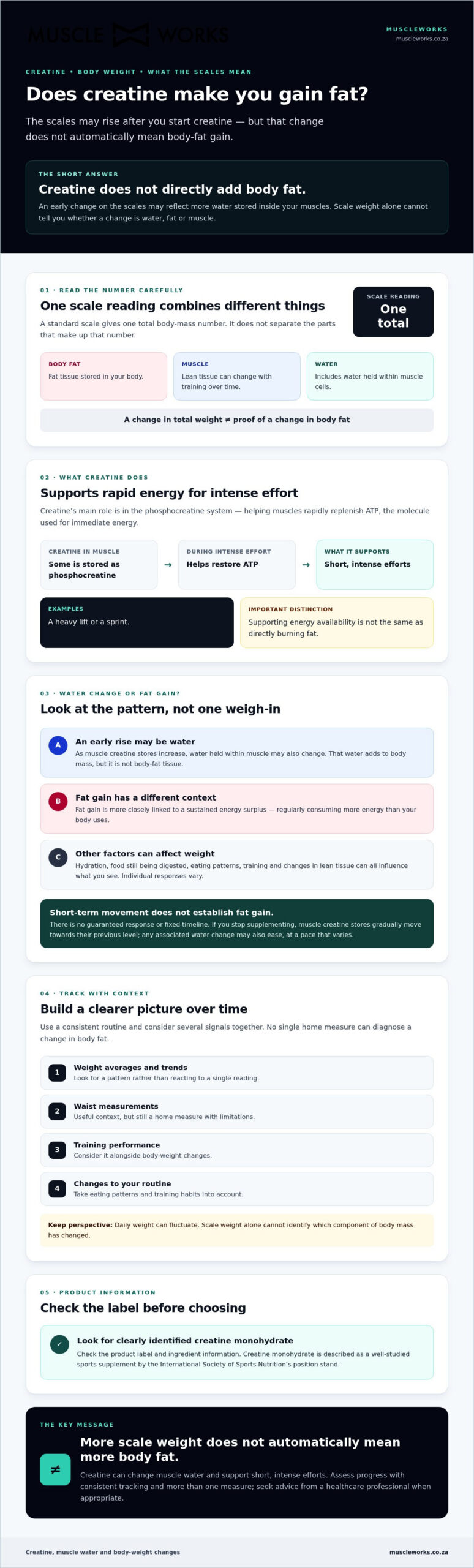
Short answer: Creatine does not itself add body fat. It can increase scale weight, partly because more water may be stored inside muscle. A change on the scales alone cannot show whether you’ve gained fat, muscle or water.
Body fat is the fat tissue stored in your body. Body mass is your total weight, including fat, muscle, bone, organs and water. Water weight is the water in and around your body, including water held within muscle cells. These are different components of your weight, even though a standard scale combines them into one number.
What does the evidence say about creatine and fat gain?
Creatine’s direct role is not to add fat. It supports the body’s phosphocreatine system, which helps replenish energy for short, intense efforts. The International Society of Sports Nutrition’s position stand describes creatine monohydrate as a well-studied sports supplement and discusses its effects on exercise performance and lean mass. Those effects are different from gaining body fat.
So, does creatine make you gain fat? The evidence points to no direct fat-gaining effect. Fat gain is more closely linked to a sustained energy surplus, when you regularly consume more energy than your body uses. Changes to appetite, food portions or training habits could affect weight independently of creatine. Individual responses vary, so don’t assume everyone will see the same change.
Why can the scales move after starting creatine?
One possible reason is increased water stored inside muscle cells. That water contributes to body mass, but it isn’t body fat. For a plain-language overview of creatine’s biological role, see Creatine.
A scale can’t separate water, fat and muscle. A quick rise soon after starting supplementation may reflect fluid shifts, while longer-term changes can also be influenced by eating patterns, training and changes in lean tissue. Daily weight can fluctuate for other reasons too, including hydration and food still being digested.
Look for a pattern, not a verdict from one weigh-in. Short-term movement doesn’t establish that you’ve gained fat. Longer-term body-composition trends need more context than scale weight alone, and even home measurements have limits. Track consistently, considering weight alongside waist measurements, training performance and changes to your routine. Focus on the signals you can monitor rather than reacting to a single number.
How creatine affects muscle water, energy, and body weight
Creatine’s main job is to support rapid energy supply, not burn fat. In skeletal muscle, some creatine is stored as phosphocreatine, a compound that can donate a phosphate group to help rebuild adenosine triphosphate (ATP), the molecule muscles use for immediate energy. This system matters most during short, intense efforts, such as a heavy lift or a sprint, when muscles need to regenerate ATP quickly.
What happens to creatine inside skeletal muscle?
Muscle takes up creatine from food and supplements, then stores some of it as phosphocreatine. During repeated high-intensity exercise, phosphocreatine helps restore ATP so working muscles can keep contracting. It supports energy availability; it doesn’t directly make the body use fat as fuel. A review of scientific evidence on creatine and body composition discusses creatine’s role alongside exercise and changes in lean mass.
That distinction matters. If training performance or muscle mass changes over time, those effects are separate from a direct fat-burning action. Creatine’s role in the energy system also helps explain why changes in body weight can’t automatically be labelled fat gain.
Is creatine-related water retention permanent?
Muscle creatine storage and muscle water are connected. As muscle creatine stores increase, water held within muscle may also change. This can contribute to an early rise on the scales, but it’s not the same as adding body-fat tissue. The amount and timing of any weight change differ between people, so there’s no guaranteed response or fixed timeline.
If you stop supplementing, muscle creatine stores will gradually move back towards their previous level. Any associated change in stored water may also ease, though the pace varies. Don’t mistake that possible shift for fat loss or muscle loss. It reflects a change in body mass, and the scale alone can’t tell you precisely which component has changed.
So, does creatine make you gain fat? Its role in phosphocreatine and ATP supply doesn’t directly add body fat. The scale can still move as muscle water changes, while longer-term body composition is also shaped by training and eating habits. If you’re considering supplementation, check the label and ingredient information on a clearly identified creatine monohydrate product, then assess your progress using more than one measure.
Water weight or fat gain: how to tell the difference
A sudden change on the scales can feel like a clear signal. It isn’t. Body weight is not a body-fat measurement. Your total weight includes water, muscle, bone, food being digested and fat. A scale records the combined number, not what caused it to change.
To assess a pattern, compare measurements taken under similar conditions over time. A single weigh-in or waist measurement can’t diagnose a change in body fat. Home body-composition devices estimate rather than directly measure it, and their readings can shift with hydration.
Which signs point towards a temporary weight fluctuation?
Day-to-day weight can move with hydration, meals, bowel contents and hard training. Starting creatine may coincide with a change in muscle water, but other routine changes can affect the reading too. A short-lived rise that varies across weigh-ins is different from a steady trend accompanied by other changes.
Weigh at a consistent time and in similar conditions, then compare weekly averages rather than reacting to one result. Measure your waist consistently too, but treat it as another clue, not a verdict.
- Weight: Look at the direction of the average, not the highest reading.
- Waist: Use the same position and measuring method each time.
- Context: Note changes in hydration, meals, training and supplement use.
What patterns may suggest an overall calorie surplus?
Body-fat gain is associated with sustained energy intake above what your body uses. If weight and waist measurements trend upwards over time, review eating habits, activity and training before blaming creatine alone. Larger portions, extra snacks or a drop in daily movement may matter. These patterns can’t confirm the cause for one person, and they don’t allow you to assign an exact amount of change to a supplement.
So, does creatine make you gain fat? A change after starting it doesn’t prove that it has. Consider the whole pattern and the routine around it. If the change continues or concerns you, a registered dietitian or healthcare professional can help assess it in context.
What to do if your weight changes after taking creatine
Don’t let one reading dictate your next move. Use a simple tracking routine to see whether the change persists and what else is happening in your training and daily habits. The aim isn’t to monitor every fluctuation. It’s to make a measured decision based on a consistent pattern.
How should you track progress without fixating on weight?
For a useful comparison, keep the conditions steady. Weigh yourself at the same time, on the same scales and in similar clothing. If frequent weigh-ins cause stress, choose a schedule you can stick to and compare averages across weeks rather than individual readings.
- 1. Record your weight consistently. Note each reading and review the trend average, not a single high or low number.
- 2. Measure your waist. Use the same measuring point and method each time. Treat it as one indicator, not a diagnosis.
- 3. Log training performance. Record relevant changes in strength, repetitions or session quality alongside your measurements.
- 4. Add context. Note changes in meals, hydration, activity, training or supplement use that could affect the trend.
This wider view helps you judge whether a change is brief or continuing. Avoid abrupt diet changes in response to one weigh-in. If you’re concerned about food intake, consider getting individual advice rather than making a severe restriction on your own.
When should you review your creatine routine?
Check the product label so you know what you’re taking, how much each serving contains and what directions the manufacturer gives. Don’t assume a loading phase is mandatory, or change your intake based on online claims. If you’re unsure whether a product or routine suits you, ask a qualified healthcare professional.
Seek professional advice before using creatine if you have a medical condition, take medicines that may be relevant, or have concerns about persistent changes or symptoms. A healthcare professional can consider your individual circumstances.
If you’ve tracked your progress and decided creatine still fits your routine, review the creatine monohydrate options and check the label before choosing. The question “does creatine make you gain fat?” can’t be answered by one scale reading. Use consistent tracking, assess the full picture and make your next move deliberately.
Choosing creatine with confidence: evidence first, product second
Creatine may change the number on the scales without adding body fat. Keep that distinction clear as you make your decision. If you’re comfortable with the possible scale change and creatine suits your training goals, choose based on the product information, not claims that promise a particular physique or result.
What should you check on a creatine product label?
Read the actual label before buying. Check that the ingredient is clearly identified as creatine monohydrate, review the serving information and follow the product directions. If it’s a blend, check each listed ingredient rather than assuming the extras are necessary. More ingredients don’t automatically mean a better fit.
Keep it straightforward. If you have a medical condition, take medicines or aren’t sure whether creatine is appropriate for you, ask a qualified healthcare professional before using it. Their advice should take priority over general guidance or online claims.
How does creatine fit into a wider training plan?
A supplement is only one part of the picture. Progressive training, suitable nutrition and consistent recovery remain central to body-composition goals. Creatine isn’t a substitute for those foundations, and it shouldn’t be treated as a fat-loss product. If your broader goal includes maintaining muscle while managing body composition, read this whey protein isolate cutting guide for related considerations.
Muscle Works sells creatine monohydrate, but the right choice still depends on your needs and the label in front of you. There’s no need to buy a complex formula simply because the scale has shifted. Review your tracking, consider your training priorities and choose only if the product fits your plan.
For a closer look at creatine monohydrate and how to assess it, explore the creatine monohydrate guide. Use the evidence to make the call, then judge your progress by more than scale weight alone.
Make your next move with the full picture
Does creatine make you gain fat? Creatine itself doesn’t directly add body fat, but it can affect scale weight as muscle water changes. A scale reading can’t tell you whether weight comes from water, fat or muscle, so look at trends alongside waist measurements, training performance and changes in your routine.
Don’t make an abrupt decision based on one weigh-in. Track consistently, check the product label and seek advice from a qualified healthcare professional if you have a medical condition or ongoing concerns. Then decide whether creatine fits your training plan.
Muscle Works sells creatine monohydrate. If you’re ready to review your options, explore creatine options from Muscle Works and check the product information before choosing.
Keep your focus on steady progress, informed choices and the work you can control.
Frequently Asked Questions
Does creatine make you gain fat?
No, creatine doesn’t directly cause body-fat gain. It can increase the amount of water stored within muscle, which may raise scale weight without adding fat tissue. Fat gain is more closely linked to a sustained energy surplus, when you regularly consume more energy than your body uses. If your weight changes, assess the pattern alongside your eating habits, activity, waist measurement and training, rather than assuming creatine is the cause.
Can creatine make you gain weight without gaining fat?
Yes. Creatine may increase scale weight through changes in water stored within muscle, without a corresponding increase in body fat. Changes in muscle mass can also affect total body weight over time, particularly alongside resistance training. A standard scale combines all these components into one reading, so it can’t identify what has changed. Track consistent weight trends alongside other measures, such as waist size and training performance.
How much weight can creatine make you gain?
There’s no fixed amount, because people respond differently. Some users may see an early increase of around 1-2 kg, often attributed to extra water stored in muscle, whilst others notice little change. The increase isn’t guaranteed and isn’t a measure of fat gain. Compare weigh-ins taken under similar conditions over time, and consider your waist measurement, training and changes in food intake before drawing conclusions.
Does creatine make you look bloated?
Creatine may make muscles look fuller if more water is stored within them, but that isn’t the same as fat gain. It doesn’t cause noticeable bloating in everyone. If you experience abdominal discomfort or digestive symptoms, consider the timing, amount taken and other recent changes in your routine. Check the product directions, and speak with a healthcare professional if symptoms persist or concern you.
Should I stop taking creatine if the scales go up?
Not necessarily. One higher reading doesn’t tell you whether you’ve gained fat, and an increase may reflect water, food still being digested or other normal fluctuations. Track weight consistently and compare averages, alongside waist measurements and training records. Check the product label and avoid making abrupt diet changes in response to one reading. If you have a medical condition, ongoing symptoms or concerns, ask a healthcare professional for individual advice.
Does creatine help you lose fat?
Creatine isn’t a fat burner and shouldn’t be used with the expectation that it will directly reduce body fat. It supports rapid energy supply during short, intense exercise. In a training plan, improved performance may help support training adaptations, but fat loss depends on wider factors such as sustained energy balance, nutrition and activity. Keep those foundations central, and judge progress using more than scale weight alone.
Is creatine-related water weight permanent?
No, changes in muscle creatine stores and associated water aren’t necessarily permanent. If you stop taking creatine, stored levels gradually move towards their previous state, and related water changes may ease. The pace and scale of change vary, so there’s no guaranteed timeline. A lower scale reading after stopping doesn’t automatically mean you’ve lost body fat or muscle. Continue to assess your progress using consistent measurements and training context.