

What if the fastest route to muscle recovery isn’t another supplement? Fast muscle repair supplements can complement your routine, but they can’t replace suitable training, enough food and proper rest. No powder can promise instant repair.
It’s sensible to question bold claims about soreness and rapid recovery. When products promise different results, start by identifying the need you want to address. A protein powder, for instance, may be a convenient way to add protein when a meal doesn’t fit your schedule. That is a practical nutrition choice, not a guarantee of faster repair.
This guide explains how protein powders, creatine monohydrate and amino-acid products fit into a considered routine, and why food, training consistency and sleep still matter. Muscle Works sells these product categories for different needs, but no single supplement suits everyone. Compare labels, match the product to your diet and follow its directions. Keep expectations realistic.
Always consult your physician before use. Do not use if breast feeding or lactating or if you have high blood pressure or a medical condition.
Key Takeaways
- Muscle recovery is your body adapting after training, not an instant effect from a supplement. Soreness, recovery and muscle growth are related, but they aren’t the same thing.
- Build recovery around training you can manage, enough food, fluids and sleep before considering supplements.
- Compare fast muscle repair supplements by their nutritional role and whether they address a real need, not by bold promises.
- Review your diet and read the product label before choosing. Follow the directions for that product rather than assuming one timing or dose suits everyone.
- Protein powders, creatine monohydrate and amino-acid products have different roles. Treat them as support, not guaranteed repair solutions.
Fast muscle repair supplements: what recovery really depends on
A hard session challenges your body to adapt, but it doesn’t switch on instant repair. Training places stress on muscle as it contracts against resistance. Afterwards, your body responds over time, supported by food, sleep and the way your training is structured. For a plain-language overview of how muscles generate force, see Understanding Muscle Contraction.
Recovery support means supplying useful conditions or nutrients for the body’s normal adaptation. It is not a promise of faster repair, less soreness or more muscle. Keep that distinction in mind when comparing fast muscle repair supplements. A confident label or dramatic before-and-after claim doesn’t guarantee a quicker return to training.
What happens to muscles after a demanding training session?
Training stress is the challenge. Recovery is the period in which your body responds and adapts. The process depends on more than the session itself: how demanding or unfamiliar the workout was, whether your diet provides enough energy and protein, how well you sleep, and your individual circumstances all matter. The same session can feel manageable one day and leave you more fatigued another.
Don’t confuse three different signals. Soreness is a feeling, often noticed after a challenging or unfamiliar workout. Recovery is broader: it includes being ready to perform again, not just whether a muscle feels tender. Muscle growth is an adaptation that develops through repeated training and adequate support over time. Soreness alone can’t tell you whether a workout was productive or whether muscle has grown. Less soreness doesn’t prove that repair happened faster either.
Consider the whole picture: your energy, performance and ability to complete planned sessions, as well as soreness. If discomfort is severe, persistent or unusual, don’t treat it as a routine supplement problem.
Can a supplement make muscle repair happen faster?
No supplement guarantees faster muscle repair or replaces the basics. A supplement may be useful when it helps you meet a nutritional need or makes a practical choice easier. For example, protein powder can be a convenient way to add protein when a meal doesn’t fit your schedule. That supports your nutrition plan. It doesn’t prove an instant effect on sore muscles or provide a shortcut around rest.
Judge the role, not the promise. Ask whether the product addresses a real gap in your diet or routine. If it doesn’t, adding it may not provide useful value. Individual needs and suitability differ, and a supplement is not automatically appropriate for everyone. Read the product label and seek professional advice if you have health concerns, take medication or are unsure whether a product suits you.
Always consult your physician before use. Do not use if breast feeding or lactating or if you have high blood pressure or a medical condition.
How nutrition, hydration and rest shape muscle recovery
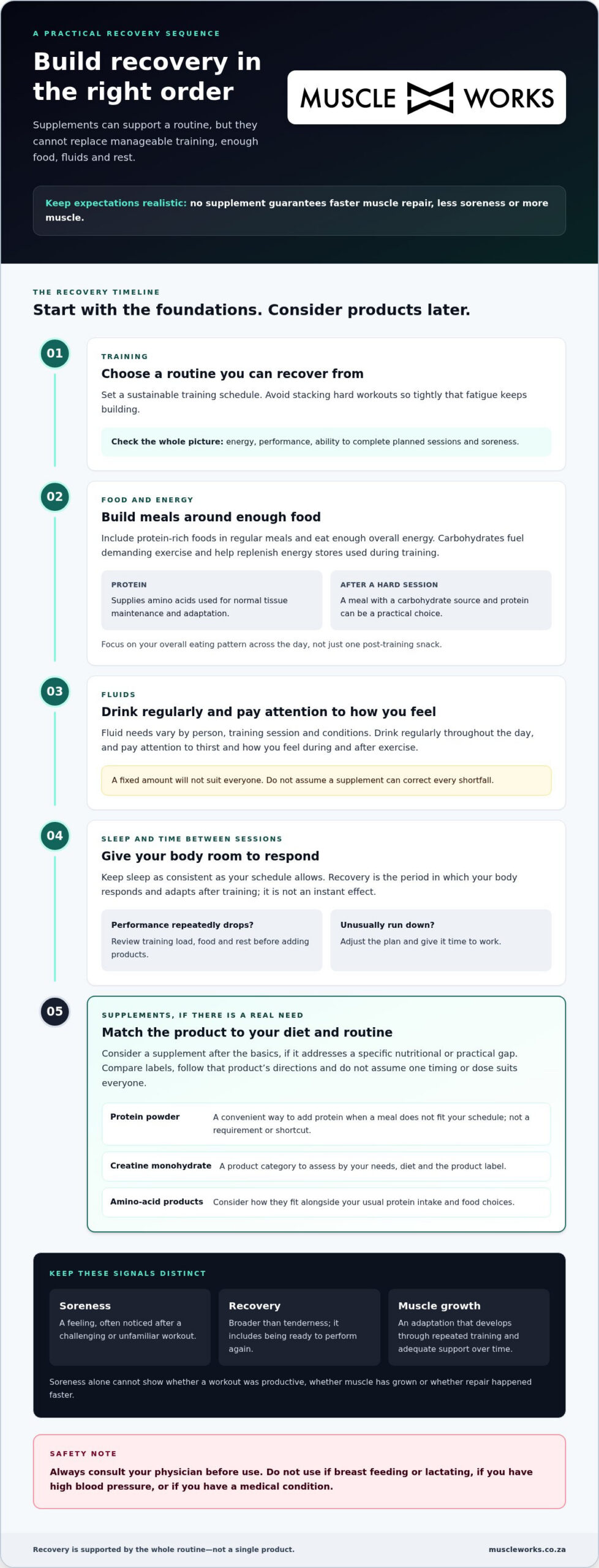
Build recovery in the right order. Start with training you can recover from, then consider your daily food, fluids and sleep. Supplements come later, if they solve a specific nutritional or practical gap. Searching for fast muscle repair supplements won’t make up for a routine that consistently underfuels you or leaves too little time to rest.
Supplements can complement recovery basics, but they can’t compensate for neglected food, fluids, sleep or sensible training. Before adding a product, look at the habits that shape your recovery day after day.
Why protein and overall food intake matter
Protein supplies amino acids, which the body uses for normal tissue maintenance and adaptation. Include protein-rich foods in regular meals, alongside a varied diet that provides enough overall energy. A shake may be useful when a meal is impractical or you find it difficult to meet your needs through food. It’s a convenient option, not a requirement or shortcut.
Carbohydrates provide fuel for demanding exercise and help replenish the energy stores used during training. After a hard session, a meal with a carbohydrate source and protein can be a practical choice. The exact meal depends on your preferences, schedule and the rest of your diet. Focus on the overall pattern across the day, not just one post-training snack.
If you’re considering amino acid supplements, first work out how they fit alongside your usual protein intake and food choices. Choose a product category for a clear reason, not just because its name sounds compelling.
Where hydration, carbohydrates and sleep fit
Fluid needs vary with the person, training session and conditions. Drink regularly throughout the day, and pay attention to thirst and how you feel during and after exercise. A fixed amount won’t suit everyone. For longer or more demanding sessions, consider how your usual food and fluid routine supports your training rather than assuming a supplement can correct every shortfall.
Recovery also depends on what happens between sessions. Keep sleep as consistent as your schedule allows, and avoid stacking hard workouts so tightly that fatigue keeps building. If performance is repeatedly dropping or you feel unusually run down, review your training load, food and rest before adding products. Adjust the plan and give it time to work.
- First: Set a training schedule you can sustain.
- Next: Eat enough, including protein and carbohydrate sources.
- Then: Keep fluids and sleep in view.
- Finally: Consider a supplement only if it serves a defined need.
Muscle Works sells protein powders and amino-acid products. If a convenient option could fill a gap in your routine, browse the Muscle Works supplement range and use the product label to guide your choice.
Always consult your physician before use. Do not use if breast feeding or lactating or if you have high blood pressure or a medical condition.
Comparing fast muscle repair supplements without falling for hype
Compare products by the role they can reasonably play, not by promises of instant repair. A supplement may help you meet a nutritional need or make your routine more practical. That doesn’t mean it guarantees less soreness or a faster return to training. More ingredients, a bigger stack or a louder claim don’t automatically mean better recovery.
Use this comparison as a filter. First identify what your diet or routine needs, then consider whether a category fits. If a product has no clear role, it’s an extra rather than a recovery strategy.
| Category | Intended nutritional role | May be relevant when | Key caveat |
|---|---|---|---|
| Protein powder | A convenient source of dietary protein | Food alone doesn’t suit your schedule or make it easy to meet your needs | It complements meals; it isn’t a separate repair shortcut |
| Creatine monohydrate | A sports-nutrition ingredient used in exercise contexts | You’re considering a targeted supplement to complement training | Performance research doesn’t prove faster muscle repair |
| Amino-acid products | A source of amino acids or a targeted addition to a nutrition routine | You have a specific reason to add one after reviewing your diet | Don’t assume it outperforms adequate protein from food |
Protein powders and amino-acid products
Protein powder is best understood as a convenient food supplement. It can make protein intake more practical, but it doesn’t repair muscle instantly or replace a balanced diet. If your regular meals already provide enough protein, adding more products may not address a meaningful gap.
Muscle Works sells 100% Whey Protein 1 kg, Beef Aminos and L-Glutamine. These are different products, not interchangeable promises. Check each product’s label and consider its role in your overall routine rather than assuming every amino-acid product will produce the same result. KEEP OUT OF REACH OF CHILDREN.
Creatine and other recovery-related supplements
Creatine monohydrate has an established place in sports nutrition, particularly in discussions of exercise performance. That context matters, but it is not proof that creatine makes muscle repair happen faster. Muscle Works sells creatine monohydrate. Make a label-led decision and keep performance goals distinct from claims about soreness or tissue repair.
Separate evidence about a supplement’s intended role from marketing language that promises rapid recovery. A claim about performance, for instance, shouldn’t be stretched into a claim about faster repair. Compare the label with your actual needs, and avoid buying a stack simply because it contains more ingredients.
Always consult your physician before use. Do not use if breast feeding or lactating or if you have high blood pressure or a medical condition.
How to choose and use recovery supplements thoughtfully
Make the decision in sequence, not on impulse. Start with a clear need, then assess whether a supplement belongs in your routine. If a product promises fast muscle repair, treat that as a claim to examine, not a result to expect. Focus on its practical role, the information on its label and whether it suits you.
A practical checklist before choosing a product
- Name the need. Be specific. You might want a convenient protein source for days when preparing a meal is difficult. “I want faster repair” isn’t a clear nutritional need, and a product can’t guarantee that outcome.
- Review your diet first. Check what you already get from meals and whether there’s a practical gap. Avoid adding a supplement simply because it is popular or part of a large stack.
- Read the full label. Review the ingredient list, serving information, directions, allergens, warnings and storage instructions. Don’t assume products with similar names or ingredients are interchangeable. Follow the directions for that product rather than applying a dose or timing rule you’ve seen elsewhere.
- Check the claim. Look for current, credible research that supports the specific benefit being advertised. Evidence for an ingredient in one context doesn’t automatically prove a claim about soreness or faster muscle repair. If the label or marketing promises dramatic results, consider what evidence supports that exact outcome.
- Assess suitability. Consider your health circumstances and any other products you use. If you’re unsure, get professional advice before use.
Warnings, suitability and responsible use
Check allergen statements and warnings before using a product, especially if you have a relevant sensitivity or health concern. Don’t assume a product suits you because someone else uses it. Use the allergen information and warnings stated for the specific product rather than relying on assumptions.
Use products only as directed. Follow the storage instructions on the product: “Store in a cool dry place. Keep container closed and store below 25 °C.” KEEP OUT OF REACH OF CHILDREN. This is not a medicine.
Always consult your physician before use. Do not use if breast feeding or lactating or if you have high blood pressure or a medical condition.
Once you’ve identified a genuine need, compare categories and choose according to the label, not hype. Browse the Muscle Works supplement range to find a category that fits your routine, then read its product information carefully before use.
Muscle Works recovery supplements: match the product category to your routine
Choose by need, not by the promise of fast repair. Muscle Works sells protein powders, creatine monohydrate and amino-acid products as additions to a wider nutrition routine. Their role depends on your diet, preferences and training goals. None should be treated as a guaranteed muscle-repair solution.
Which Muscle Works product category may fit your approach?
If you want a convenient protein option, compare 100% Whey Protein 1 kg and Iso-Tech Whey with your food routine and the information on each label. If you prefer plant-based protein, Plant Protein 1.2 kg is another option. Choose according to your dietary preferences and needs rather than assuming one protein powder suits everyone.
Creatine monohydrate, Beef Aminos and L-Glutamine are also part of the range. They’re distinct products, so don’t treat them as interchangeable or assume that adding one will speed muscle repair. If you’re weighing up amino acid supplements, first identify why you’re considering them and how they fit alongside your usual diet.
Keep the decision grounded in your routine:
- Need a practical protein option? Compare protein powders with the food you already eat.
- Prefer a plant-based protein option? Consider Plant Protein 1.2 kg and read its label.
- Considering creatine or an amino-acid product? Identify its intended role and assess whether it fits your needs.
Product names alone don’t tell you everything you need to know. Review each product’s information for ingredients, directions, allergens, warnings and storage instructions. Follow the directions for that specific product, and don’t transfer serving instructions or ingredient claims from one product to another. KEEP OUT OF REACH OF CHILDREN.
Make the next step evidence-led
Before choosing, compare product information with your food and training routine. Check whether the category addresses a genuine practical or nutritional need, and be cautious of claims that promise instant results. A supplement can complement your plan; it can’t guarantee a particular recovery outcome. If you have health questions or are unsure about suitability, get professional advice before use.
Compare product labels and choose the category that fits your routine. Keep the decision simple: one clear reason, a careful label review and no reliance on exaggerated promises. That’s more disciplined than adding products without a defined purpose.
Always consult your physician before use. Do not use if breast feeding or lactating or if you have high blood pressure or a medical condition.
Nothing Works like Muscle Works!
Choose your next step with purpose
Your next move doesn’t need to be a bigger stack. Pick one clear need, make sure it fits your routine, then give your training and recovery habits room to do their work. That’s more useful than expecting fast muscle repair supplements to deliver a guaranteed shortcut.
Muscle Works is a South African supplement brand serving customers nationally, with whey protein, plant protein, creatine monohydrate and amino-acid products. Compare product labels and focus on the option that makes sense for your needs. Keep the decision grounded in product information, not promises of instant results.
Progress is built through consistent effort, considered choices and patience. Keep your routine practical and move forward one session at a time.
Always consult your physician before use. Do not use if breast feeding or lactating or if you have high blood pressure or a medical condition.
Frequently Asked Questions
What helps muscles recover the fastest after exercise?
No single tactic guarantees the fastest recovery. Match your training load to your current capacity, eat regular meals, drink to suit your needs and prioritise consistent sleep. After an unusually demanding session, allow enough time before repeating the same hard effort. If you’re still unusually fatigued, adjust the next workout rather than trying to push through with a supplement. Your readiness matters more than chasing a fixed recovery schedule.
Do fast muscle repair supplements actually work?
Fast muscle repair supplements don’t guarantee that muscles will recover faster. Some may be useful for a specific purpose, such as making it easier to include protein in your day, but that’s different from proving an instant repair effect. Judge a product by its intended role and evidence for that particular claim. Be sceptical of wording that promises rapid results without explaining what was measured or who the research applies to.
Which supplement is best for muscle recovery?
There isn’t one supplement that’s best for everyone. The right category depends on what you eat, your training aims and the practical gap you’re trying to address. Someone who struggles to get enough protein from meals has a different consideration from someone looking at creatine for a training-related goal. Start with your own routine, compare labels and avoid buying a multi-product stack without a clear reason for each item.
Can protein powder help with muscle recovery?
Protein powder can help you add protein to your diet when preparing or carrying a meal isn’t practical. It’s a convenient option, not a special repair treatment, and it may be unnecessary if your usual food already meets your needs. For example, it might suit a busy day when arranging a protein-containing meal is difficult. Check the product label for ingredients, allergens and directions before deciding whether it fits.
Should I take creatine for muscle recovery?
Consider creatine in its sports-nutrition context, not as a guaranteed way to repair muscle faster. Evidence about exercise performance should not be treated as proof of a direct effect on soreness or recovery speed. If you’re considering creatine monohydrate, read the specific product label and follow its directions. Discuss suitability with a physician if you have health concerns, take medication or are unsure whether it belongs in your routine.
When should I take a recovery supplement?
Follow the directions on the specific product label rather than relying on a universal post-workout timing rule. If a supplement’s purpose is convenience, choose a time that fits your day and helps you use it as directed. Missing an immediate post-training shake doesn’t mean you’ve lost the chance to recover. Consider your overall eating pattern and routine, and don’t take more than the label instructs.
Can supplements replace sleep, food or rest days?
No. Supplements can’t make up for repeatedly short sleep, inadequate meals or a training plan that leaves too little time to recover. If your schedule is tight, protect the basics first: plan meals ahead, make time for sleep and adapt training when fatigue is accumulating. A product may be convenient, but it can’t stand in for those habits. Use it to complement your routine, not to justify ignoring what your body needs.
Are Muscle Works supplements medicines or approved by SAHPRA?
Muscle Works supplements are not medicines and are not approved by SAHPRA. “This is not a medicine.” Read product labels and warnings, and don’t use supplements as a substitute for medical advice or treatment. Always consult your physician before use. Do not use if breast feeding or lactating or if you have high blood pressure or a medical condition. KEEP OUT OF REACH OF CHILDREN.