

The amino acid your body depends on may not be the recovery shortcut some supplement claims suggest. Glutamine for muscle recovery and immunity has a sound biological basis, but taking more does not reliably help healthy, well-nourished athletes recover faster or avoid illness.
The distinction matters. Glutamine has roles in muscle tissue and immune function, and intense physical stress can affect the body’s needs. But a nutrient’s role in the body does not prove that a supplement delivers meaningful results. Research in athletes is mixed, so it helps to separate what glutamine does from what L-glutamine supplementation has been shown to do.
This article explains glutamine’s roles, reviews the evidence for recovery and immune support, and compares supplementation with established recovery basics such as adequate protein, sleep and training management. You’ll also find a practical way to assess whether L-glutamine fits your circumstances, which claims to question and what to check before adding it to your routine.
Key Takeaways
- Glutamine has important roles in the body, but that alone doesn’t prove a supplement will improve recovery or immunity.
- Assess claims about glutamine for muscle recovery and immunity against evidence from healthy, active people.
- Compare glutamine with protein, sleep, training management and hydration to identify recovery priorities first.
- Use a practical checklist to define your goal, review your routine and consider whether your health or training demands affect the decision.
- Check the current product information before considering Muscle Works L-Glutamine, without assuming a particular outcome.
What Is Glutamine, and What Does It Do for Muscle Recovery and Immunity?
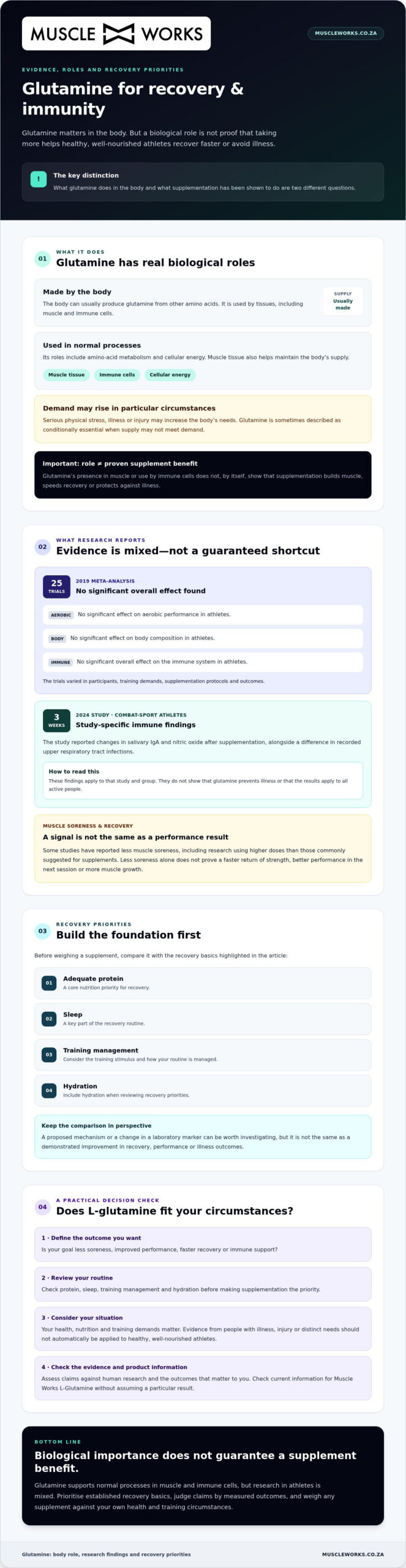
Glutamine is an amino acid made by the body and used by tissues, including muscle and immune cells, in processes such as amino-acid metabolism and cellular energy. The body can usually produce it, although demand may rise during serious physical stress, illness or injury. That role is important, but it doesn’t prove that taking extra glutamine improves recovery or protects you from illness.
Glutamine is often described as conditionally essential, meaning that in some circumstances the body’s supply may not meet demand. For a foundation on its structure, production and functions, see What Is Glutamine. The key distinction is between how the body uses an amino acid and whether supplementation changes an outcome that matters.
How does glutamine relate to muscle tissue?
Muscle contains and uses glutamine as part of normal amino-acid metabolism. The body can make glutamine from other amino acids, and muscle tissue helps maintain the body’s supply. These processes support normal physiology, but they don’t mean glutamine alone drives muscle growth, repairs training damage or speeds a return to performance.
Recovery after training depends on several factors, including the training stimulus, overall nutrition and rest. A supplement claim needs to show a measurable benefit in people, not simply point to glutamine’s presence in muscle. That’s why research on glutamine for muscle recovery and immunity should be judged by the outcomes studies measure, rather than by biological explanations alone.
What is glutamine’s role in immune function?
Some immune cells use glutamine as a fuel source and in processes involved in cell activity. This gives glutamine a clear role in immune biology. It does not make glutamine a stand-alone immune booster or show that supplementation prevents or treats infections.
Immune function is shaped by many interacting systems, alongside factors such as health, nutrition and physical stress. A plausible mechanism is a reason to investigate a supplement, not proof that it works in healthy, active people. Look for human studies measuring relevant outcomes, such as immune markers or illness incidence, and consider whether their findings are consistent and relevant to people like you. The next step is to distinguish measured effects from glutamine’s established role in the body.
What Does Research Say About Glutamine for Recovery and Immunity?
Glutamine has established roles in the body. The separate question is whether taking it as a supplement improves outcomes that matter to athletes. A proposed mechanism, such as supporting fuel use or affecting a laboratory marker, is not the same as evidence of less soreness, better performance or fewer illnesses.
A review of glutamine in sports nutrition discusses possible mechanisms, including glycogen synthesis and ammonia handling. These ideas help explain why researchers study glutamine, but they don’t establish that supplementation produces a reliable performance or recovery benefit. Read the review of glutamine in sports nutrition alongside studies that measure real-world outcomes.
Can glutamine supplementation speed up muscle recovery?
Results depend on what researchers measure. Some studies of muscle soreness have reported benefits, including research using higher doses than those commonly suggested for supplements. But less soreness alone doesn’t prove that athletes regain strength sooner, perform better in the next session or build more muscle.
A 2019 meta-analysis of 25 clinical trials found no significant effect on aerobic performance or body composition in athletes. The trials varied in participants, training demands, supplementation protocols and outcomes, so no single result applies to every training routine. Changes in markers of muscle damage or metabolism should be treated as clues, not proof of better training results.
Does glutamine supplementation improve immunity?
Immune cells use glutamine, but that biological fact cannot establish that supplementation improves immune outcomes. A 2024 study in combat-sport athletes reported changes in salivary IgA and nitric oxide after three weeks of supplementation, alongside a difference in recorded upper respiratory tract infections. Those findings apply to that study and group. They don’t show that glutamine prevents illness or that the results apply to all active people.
The 2019 meta-analysis found no significant overall effect on the immune system in athletes. Evidence from people with illness, injury or other distinct health needs also shouldn’t be assumed to apply to healthy, well-nourished athletes. Study design, duration and choice of immune marker matter. A change in one marker is not automatically a meaningful improvement in health.
Evidence summary: Human research does not establish that glutamine supplementation reliably improves muscle recovery, athletic performance or immune function in healthy athletes, although some specific studies report signals that need cautious interpretation.
If you’re weighing up supplementation, compare the evidence with your own needs and check current product information before deciding. You can review Muscle Works supplement information as part of that assessment.
Glutamine vs Protein and Other Recovery Strategies: What Should You Prioritise?
Recovery isn’t a single-supplement problem. Match each strategy to its purpose, then check whether you’ve covered the basics before adding another product. Evidence for glutamine for muscle recovery and immunity is mixed, so don’t treat it as a replacement for food, rest or a training plan that allows you to recover.
| Approach | Intended role | Evidence strength | Key limitation |
|---|---|---|---|
| Adequate dietary protein | Provides amino acids, including essential amino acids, needed to build and maintain body tissues. | Strong foundation for meeting protein needs. | A supplement won’t compensate for an overall diet that doesn’t meet your needs. |
| Glutamine | Supplies an amino acid involved in normal body processes. | Supplement benefits for healthy athletes remain uncertain. | It isn’t a complete protein source or a proven shortcut to recovery. |
| Sleep | Supports normal recovery and readiness for training. | Essential part of a recovery routine. | A supplement can’t make up for consistently inadequate rest. |
| Training management | Balances training stress with time to adapt and recover. | Core part of sensible programming. | Needs to reflect your training load, experience and response. |
| Hydration | Supports normal bodily function, particularly around exercise and fluid loss. | Important for maintaining normal function. | Drinking more than needed doesn’t guarantee faster recovery. |
Glutamine or protein: which supports recovery priorities?
Protein supplies a range of amino acids, including those the body can’t make and must obtain from food. Glutamine is one amino acid, so it shouldn’t be treated as a substitute for protein or as a complete protein source. If you’re considering a convenient protein option, explore 100% whey protein. For a broader look at supplement categories, see this guide to amino acid supplements.
How do training, sleep and nutrition fit into recovery?
Start with enough food to support your training, regular sleep and a workload you can recover from. If you’re repeatedly training hard without enough rest, adding glutamine won’t address the underlying mismatch. Hydrate in line with your activity and conditions, but don’t mistake hydration for a guarantee of faster recovery. Build a consistent routine first, then assess whether a supplement has a clear purpose.
How to Decide Whether Glutamine Fits Your Recovery Routine
Make the decision around a clear goal, not a bold label claim. Evidence for glutamine for muscle recovery and immunity doesn’t point to the same answer for everyone. Health status, diet and training demands can all affect which questions matter. Use this checklist before considering an L-glutamine supplement.
- Define the goal. Be specific. Are you looking for help with a particular recovery outcome, or hoping to support immune function? Ask whether supplementation has been shown to improve that outcome in people with a similar health and training profile.
- Review the fundamentals. Check your overall food intake, protein, sleep, hydration and training load. If these are inconsistent, address them first. A supplement shouldn’t stand in for suitable nutrition, rest or a manageable programme.
- Assess the evidence. Look for relevant human research, not just explanations of how glutamine works in the body. Check who took part, what outcome researchers measured and whether the finding has been repeated. A change in a laboratory marker doesn’t automatically mean a noticeable improvement in recovery or health.
- Check suitability. Consider your health, medication and circumstances. If you’re pregnant, managing a medical condition or taking medication, discuss supplementation with a qualified healthcare professional before using it. People with liver or kidney disease should also seek medical advice.
What should you check before considering an L-glutamine supplement?
Read the product label before deciding. Check the stated ingredients, directions for use, warnings and storage information. Follow the label directions, and don’t assume a dose from a study applies to you or to another product. If anything is unclear, ask a qualified professional rather than guessing.
Look for independent quality information where available, and distinguish it from claims about health benefits. Quality checks may tell you something about a product’s testing or manufacture, but they don’t prove that it will deliver a specific recovery or immune outcome.
Which glutamine claims deserve extra scrutiny?
Pause at promises of guaranteed gains, rapid recovery or illness prevention. Ask whether the claim cites human studies in a relevant group and whether those studies measured outcomes you care about. Mechanisms and testimonials can prompt questions, but they aren’t substitutes for balanced evidence. Confirm that health guidance is current and comes from a credible source.
Muscle Works lists L-Glutamine as a product, but check its current product information for the details that matter to you. Review Muscle Works supplement information and assess the label against your goal, the evidence and your individual circumstances.
Muscle Works L-Glutamine: Make an Informed Next Move
If you’re considering glutamine for muscle recovery and immunity, let the evidence set your expectations. Research doesn’t establish reliable benefits for every healthy, active person. A supplement may be worth investigating if you have a specific reason to consider it, but it isn’t a guaranteed route to faster recovery or protection from illness.
Muscle Works offers L-Glutamine as one of its sports supplements. That identifies the product category, not a particular formulation, dose, serving size, testing standard or outcome. Keep product facts separate from general research on glutamine. Before deciding, review the current product information and check whether it answers the questions relevant to your needs.
What can readers confirm about Muscle Works L-Glutamine?
Use the current product page and label as your source for product-specific details. Confirm the listed ingredients, directions, warnings and any quality information provided. Don’t infer these details from the product name, and don’t assume that research on glutamine in general proves this product will produce a particular result. If information you need isn’t clear, seek clarification before buying.
What is a sensible next step before buying?
Run through the decision again: define the outcome you want, check whether the evidence supports that outcome, and consider whether a supplement is suitable for you. Follow the product’s label directions. If you’re managing a health condition, taking medication, pregnant or unsure about suitability, ask a qualified healthcare professional first.
Keep the bigger picture in view. Consistent nutrition, adequate protein, sleep and training that allows for recovery remain central; L-glutamine shouldn’t displace them. If the product information fits your needs and you’re comfortable with the limits of the evidence, review it without expecting a guaranteed effect.
Explore Muscle Works supplements and review the available product information before making your decision.
Build Your Recovery Routine on Evidence
Glutamine has important roles in the body, but those roles don’t prove that a supplement will reliably improve recovery or immunity. Evidence for glutamine for muscle recovery and immunity in healthy athletes remains uncertain, so keep expectations grounded and consider whether it fits your needs.
Start with the fundamentals: suitable nutrition, enough protein, consistent sleep and training that allows you to recover. Supplements should support a considered routine, not replace its foundations. If you have a health condition, take medication or are unsure whether glutamine is suitable for you, speak with a qualified healthcare professional.
Muscle Works offers L-Glutamine among its sports supplements through its online store. Check the current product information, review the label and compare the details with your goal before deciding. Make the call based on evidence, suitability and what your routine actually needs.
Explore Muscle Works supplements and take your next step with a clear plan. Strong decisions start with solid information.
Frequently Asked Questions
Is glutamine good for muscle recovery?
Glutamine has roles in the body, but that doesn’t prove supplementation improves recovery for every healthy athlete. Check what a study measured: soreness, performance, muscle-damage markers or another outcome. A change in one measure doesn’t guarantee better training results or faster repair. Before deciding whether glutamine fits, prioritise appropriate training, nutrition and sleep, then review current human evidence relevant to your circumstances.
Can glutamine improve immunity?
Immune cells use glutamine, but this alone doesn’t establish that supplements improve immune outcomes. A 2019 meta-analysis found no significant overall effect on athletes’ immune systems, while a 2024 study in combat-sport athletes reported changes in selected immune-related markers. These findings don’t show that glutamine prevents or treats illness. If you have health concerns, take medication or have specific medical needs, ask a qualified healthcare professional before using supplements.
How much glutamine should I take for recovery?
There’s no universal amount that can be recommended for everyone. Needs, product directions and personal suitability can vary, and taking more doesn’t automatically make a supplement more effective. Read the current product label and follow its directions rather than borrowing a dose from a study or another product. If you’re unsure, particularly if you have a health condition or take medication, get advice from a qualified healthcare professional.
When should I take glutamine for muscle recovery?
No specific timing should be treated as a proven recovery shortcut unless relevant research supports it. Check the current product label and follow its directions, but don’t assume there’s an essential post-workout window. Focus first on consistent training, suitable nutrition and enough sleep. If you have a medical condition or take medication, speak with a qualified healthcare professional before adding a supplement to your routine.
Is glutamine better than protein for recovery?
Glutamine and dietary protein aren’t interchangeable, so neither is universally “better”. Protein provides a range of amino acids, including essential amino acids the body must obtain through food; glutamine is one amino acid with specific roles in the body. The right priority depends on your needs and goal. Focus on meeting your overall nutrition needs before considering an additional supplement, and don’t use glutamine as a substitute for protein.
Can you take glutamine every day?
Whether daily use is suitable depends on the product directions and your individual circumstances. Check the current label and don’t exceed its instructions; daily use doesn’t guarantee better recovery or immune benefits. If you’re pregnant, managing a health condition or taking medication, ask a qualified healthcare professional before using a supplement. If the label or your suitability is unclear, get advice before starting rather than setting your own routine.
Does glutamine have side effects or interact with medication?
Glutamine may not be suitable for everyone, and potential risks or interactions depend on the individual. Check the product label and speak with a qualified healthcare professional about your health, medicines and whether supplementation is appropriate. Don’t assume a supplement is safe for you based on general claims or another person’s experience. If you notice unexpected symptoms after use, stop and seek prompt professional advice.