

Chugging endless litres of water won’t force creatine into your muscle tissue; it will only flood your gut and flush out vital electrolytes. If you’ve ever stood over the sink wondering exactly how much water to drink with creatine without wrecking your stomach, you aren’t the only one. Most serious lifters recognise that creatine monohydrate demands adequate fluid to trigger optimal cell volumisation. Yet the vast majority still guess their numbers, trapped between the fear of painful muscle cramps and the dread of subcutaneous bloat.
Hydration during supplementation isn’t about mindless glugging. It demands calculating cellular demand with surgical precision. In this guide, you’ll discover the exact, bodyweight-adjusted daily fluid targets required to maximise creatine absorption, eliminate digestive distress, and drive explosive power output in the gym. We lay out the definitive hydration protocol across both loading and maintenance phases, giving you the clear blueprint needed to stay saturated, banish headaches, and dominate every session.
Key Takeaways
- Understand the science of intracellular fluid shifts to drive water straight into muscle fibres rather than holding sluggish subcutaneous bloat.
- Calculate your bodyweight-adjusted baseline to know exactly how much water to drink with creatine for sustained cellular saturation.
- Scale your daily fluid targets between high-dose loading cycles and maintenance phases to eliminate headaches and unnecessary digestive stress.
- Harness sodium and liquid temperature dynamics to activate the cellular transporter mechanism and bypass stomach cramps entirely.
- Pair uncompromising hydration discipline with high-calibre Creabolic or pure Creatine monohydrate to translate cellular volumisation into pure lifting power.
The Osmotic Shift: Why Creatine Demands Relentless Hydration
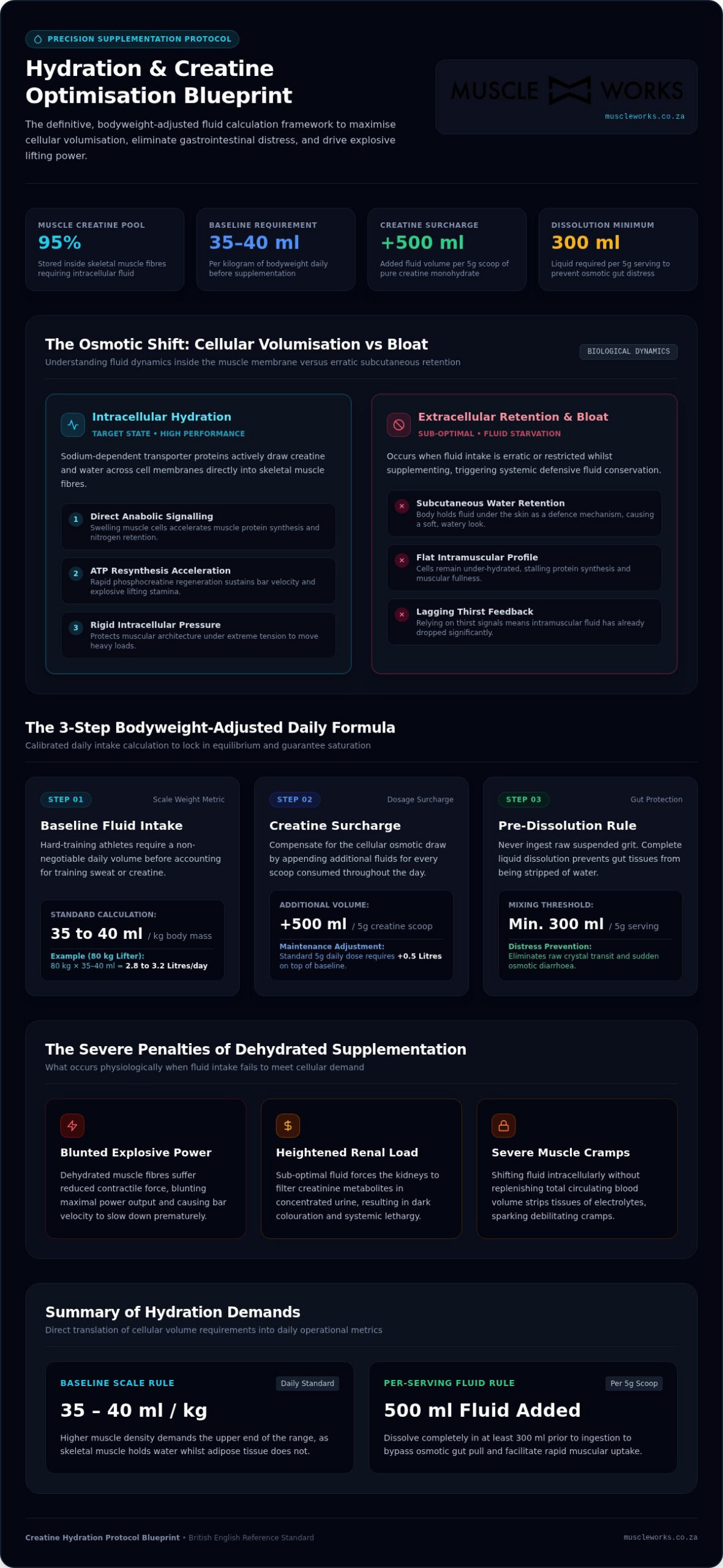
Creatine is an osmotic compound. When you supplement with it, you alter the concentration gradient inside your muscle cells. Skeletal muscle stores roughly 95% of the body’s total creatine pool. Introducing concentrated doses forces muscle fibres to draw water across their cell membranes to maintain equilibrium. This biological event, known as cellular volumisation, swells individual muscle cells. It is not cosmetic. It triggers direct anabolic signalling, accelerates muscle protein synthesis, and creates the rigid intracellular pressure required to move heavy loads. Knowing exactly how much water to drink with creatine determines whether this osmotic shift builds dense muscle or stalls out entirely.
Passive thirst signals fail the moment you saturate your tissues with Creatine monohydrate. Thirst is a lagging metric. By the time your mouth feels dry, your intramuscular fluid has dropped, blunting phosphocreatine resynthesis between working sets. Deprived cells cannot rapidly regenerate adenosine triphosphate (ATP). Power output drops, bar velocity slows down, and training stamina evaporates before you finish your primary compound lifts.
Intracellular Hydration vs Extracellular Bloat
Most athletes confuse intramuscular fullness with soft subcutaneous bloat. They are polar opposites. Cellular hydration occurs when specific sodium-dependent transporter proteins actively pull creatine and water into the muscle fibre. This increases cell volume, promotes nitrogen retention, and protects muscle architecture under extreme tension. Extracellular bloat happens when your systemic hydration is erratic. Restricting fluid while taking creatine signals your body to hold water under the skin as a defence mechanism. Drink sufficient fluids, and water enters the muscle belly. Starve your system, and you end up looking watery, flat, and soft.
The Physical Cost of Dehydrated Supplementation
Skipping your fluid targets carries severe performance penalties:
- Blunted Explosive Power: Dehydrated muscle fibres suffer reduced contractile force, making maximal lifts feel sluggish.
- Heightened Filtration Load: The kidneys filter creatinine, the natural metabolic breakdown product of creatine. Sub-optimal fluid intake forces your renal system to process these metabolites in concentrated urine, causing dark colouration and systemic lethargy.
- Severe Muscle Cramping: Shifting fluid into the intracellular space without replenishing total blood volume strips working tissues of circulating electrolytes, triggering debilitating cramps during intense training.
If you take high-potency compounds like pure Creatine monohydrate or Creabolic without locking in your fluid intake, you waste powder and sabotage output. Dialling in precisely how much water to drink with creatine is the baseline price of admission for real size and power.
How Much Water to Drink with Creatine: The Exact Daily Formula
Generic hydration advice fails serious lifters. Drinking a flat two litres or downing an arbitrary gallon ignores your physical mass and training expenditure. Determining precisely how much water to drink with creatine comes down to simple, non-negotiable mathematics. Calculate your intake through a calibrated three-step formula that locks in systemic equilibrium and forces rapid muscle absorption.
Step 1: Establish Your Baseline Bodyweight Requirement
Start with your scale weight. Hard-training bodies need between 35 and 40 millilitres of water per kilogram of body mass each day, before factoring in supplements or training sweat. For an 80-kilogram athlete, that means an absolute baseline of roughly 2.8 to 3.2 litres. If you carry exceptional muscular density, push straight to the top end of that range. Muscle tissue holds water; fat tissue does not. More muscle demands greater baseline volume.
Step 2: Add the Creatine Fluid Surcharge
Every 5-gram scoop of creatine requires an immediate fluid surcharge. Add 500 millilitres of water to your daily total for each serving. Medical consensus confirms that creatine is safe when taken as directed, yet poor dissolution sparks unnecessary stomach cramps. Dissolve each 5-gram serving in at least 300 millilitres of liquid before drinking. Chugging partially suspended grit forces your gut to pull water from surrounding tissues to process the raw crystals, causing sudden osmotic diarrhoea. For absolute cellular saturation, check our complete blueprint for creatine monohydrate to dial in your daily dosing structure.
Step 3: Factor Daily Sweat Loss and Environmental Heat
Heavy lifting strips hydration through intense respiration and perspiration. Add 750 to 1000 millilitres for every hour spent under heavy iron. When training in hot or humid environments, scale fluid reserves higher. Keep a close eye on your urine colour. Aim for a clear, pale straw shade throughout the day. Anything darker indicates compromised blood volume and stalled nutrient transport.
Locking in your daily totals ensures high-grade supplements from Muscle Works deliver their full ergogenic impact. Stop guessing how much water to drink with creatine. Run the calculation, hit your marks, and keep your muscular engine running at full power.
Hydration Demands: Loading Phase vs Daily Maintenance Protocols
Your hydration target is not static. Shoving 20 grammes of powder into your system across five days triggers an acute physiological shift compared to running a steady daily scoop. Loading accelerates muscle phosphocreatine stores by 20% to 40% in under a week, but it also creates massive osmotic demand across your gut, bloodstream, and renal system. Dialling in how much water to drink with creatine requires adjusting your fluid reserves based on where you stand in your training cycle.
The Loading Phase: Navigating the 20-Gram Fluid Surge
The standard loading protocol calls for roughly 0.3 grammes per kilogram daily, split into four 5-gramme doses for five to seven days. Never neck 20 grammes in one sitting. Single megadoses pull water directly into the intestinal lumen, causing violent cramps, nausea, and immediate diarrhoea. Spacing out your servings blunts hyperosmolarity while demanding a severe fluid spike. You must push your total intake to 4.5 to 5.0 litres daily. This high-volume intake keeps plasma volume stable and drives rapid cellular uptake.
The Maintenance Protocol: Sustaining Peak Cellular Fullness
Once your muscle fibres reach complete saturation, downshift straight to a daily maintenance dose of 3 to 5 grammes. Heavy lifters carrying exceptional lean mass may require up to 10 grammes. At this stage, your total fluid requirement settles between 3.5 and 4.0 litres each day. As detailed in guides analysing How Much Water to Drink with Creatine, fluid control during maintenance focuses on strict regularity rather than force-feeding extreme volume. Maintain this intake every day. Missing your mark deflates cell volume and bleeds top-end strength.
| Supplementation Phase | Daily Dosage | Recommended Fluid Volume | Physiological Objective |
|---|---|---|---|
| Loading (5-7 Days) | 20g (4 x 5g doses) | 4.5 – 5.0 Litres | Rapid intramuscular saturation and acute cell expansion |
| Maintenance (Ongoing) | 3 – 5g (Single dose) | 3.5 – 4.0 Litres | Sustained phosphocreatine stores and stable cellular volume |
| Gradual Saturation (3-4 Weeks) | 3 – 5g (Single dose) | 3.5 – 4.0 Litres | Steady saturation without acute renal or digestive surges |
Whether you choose an aggressive load or a slow build, fluid discipline dictates your outcome. Match your intake to your dosing protocol, keep your cellular reservoirs full, and train without compromise.
Timing, Electrolytes, and Eliminating Gastrointestinal Distress
Gulping litres of plain water without an absorption strategy is a rookie mistake. Water volume alone cannot force nutrients into muscle tissue if your mineral balance is broken. When calculating how much water to drink with creatine, you must account for electrolyte transport and liquid temperature. Ignoring these two factors leads directly to stomach cramps, sluggish digestion, and wasted compounds.
Sodium and Potassium: The Cellular Transport Gatekeepers
Creatine uptake across muscle cell membranes is not passive. It relies entirely on sodium-dependent transporter proteins known as CreaT. These cellular doorways require two sodium ions to shuttle a single molecule of creatine into the muscle fibre. Flooding your body with pure, mineral-free water dilutes circulating plasma sodium. This halts the transport mechanism, leaves creatine stranded in the bloodstream, and triggers painful muscle spasms. Add a pinch of sea salt or an unflavoured electrolyte blend to your shaker to ensure these cellular gates remain wide open.
Solving the Solubility Problem: No More Sludge
Grit left sitting at the bottom of your shaker bottle guarantees gastric misery. Cold water keeps creatine crystals bound tightly together. When undissolved powder hits your stomach, it pulls water from surrounding tissues directly into the gut lumen through osmosis. The result is sudden abdominal pain and immediate nausea. Solve this instantly by using room-temperature or slightly warm water. Swirl the mixture until the liquid turns completely clear. Total dissolution ensures rapid gastric emptying and eliminates gut irritation before it starts.
Strategic Fluid Timing Across the Training Window
Slamming an entire day’s fluid allowance in two sittings accomplishes nothing. Regulate your intake across three targeted operational windows:
- Pre-Workout: Drink 500 millilitres of water 45 minutes before stepping onto the gym floor to prime blood volume.
- Intra-Workout: Take steady, measured sips between working sets. Heavy gulping causes stomach distension and dulls central nervous system drive.
- Post-Workout: Flood recovering muscle beds by combining your creatine with 400 millilitres of liquid, fast-digesting carbohydrates, and a high-grade formula like 100% Whey Protein 1kg. The carbohydrate-induced insulin surge accelerates creatine and amino acid shuttling directly into exhausted muscle fibres.
To maximise your results and build a dominant physique, order premium supplements from Muscle Works and secure the raw materials your body needs to grow.
Executing the Complete Performance Blueprint: Pure Supplements and Relentless Discipline
Top-tier sports nutrition means nothing if your daily execution is sloppy. You can buy the purest compounds on the market, but without disciplined hydration, you are simply flushing money and potential down the drain. Knowing how much water to drink with creatine gives you the mathematical target. Actually hitting that target every single day separates dedicated lifters from chronic underachievers. Treat fluid volume as a mandatory training variable, not an afterthought.
Zero Excuses: The Daily Hydration Checklist
Eliminate guesswork through structured daily routines. Precision beats memory every time:
- Fill Dedicated Containers Early: Fill your water jugs every morning. Knowing your exact container volume guarantees you never wonder where your intake stands at 16:00.
- Isolate Your Base Water Quota: Never count caffeinated pre-workouts or commercial energy drinks toward your primary fluid quota. High caffeine loads alter fluid dynamics and do not replace clean water.
- Track Millilitres Like Macronutrients: You measure grams of protein, carbohydrates, and fats with obsessive precision. Apply the exact same rigor to every litre of water you drink.
Unlocking Maximum Power with Muscle Works
High-calibre athletes demand uncompromised ingredients. When you load your system with high-purity Muscle Works Creatine monohydrate or tactical formulations like Creabolic, you are supplying your body with the gold standard of strength nutrition. These compounds are engineered specifically for athletes who push past standard limits and demand explosive power under heavy loads.
Take your physique transformation further by combining your foundational creatine protocol with the hardcore 21 Day Grow Stack. Pairing elite supplement formulations with an uncompromising hydration standard creates the ultimate anabolic environment. Muscle fibres stay hyper-hydrated, cellular swelling remains constant, and force production climbs session after session.
Stop overcomplicating your routine and stop guessing how much water to drink with creatine. Calculate your fluid requirement, dissolve your powder completely, and execute your hydration strategy with ruthless consistency. The iron doesn’t lie, and neither does the scale when your cellular hydration is locked in.
Lock in Your Hydration Protocol and Unleash Raw Power
You now possess the exact blueprint. Dialling in how much water to drink with creatine isn’t a guessing game; it’s an exact science that dictates whether your muscle cells expand with explosive power or stall out in digestive distress. Calculate your bodyweight baseline, apply your per-dose fluid surcharge, and dissolve every gramme completely. Maintain this cellular saturation daily, and your body will respond with relentless force.
Pure effort demands uncompromised sports nutrition. Whether you rely on high-potency Creabolic or pure Creatine Monohydrate, our formulations are engineered specifically for elite bodybuilders and competitive strength athletes who refuse to settle for second best. With trusted sports nutrition delivered directly across South Africa, you have everything required to convert brutal training into dense muscle. Step up, master your daily hydration, and dominate your strength goals with Muscle Works sports nutrition.
Frequently Asked Questions
How much water should I drink with 5g of creatine?
When calculating how much water to drink with creatine, allocate at least 300 to 500 millilitres of water specifically for a standard 5-gram serving. Mix the powder until it dissolves completely to prevent stomach cramps. This dedicated amount forms part of your broader daily target, which should sit between 3.5 and 4.0 litres to keep your muscle cells saturated and fully volumised.
What happens if you do not drink enough water whilst taking creatine?
You compromise strength output, stall recovery, and trigger sudden digestive distress. Creatine actively pulls fluid into skeletal muscle tissue. Starving your body of water forces muscle fibres to scavenge moisture from circulating plasma and your digestive tract. This causes painful abdominal cramps, persistent headaches, sluggish bar speed, and concentrated urine. Your training performance will suffer almost immediately.
Can drinking too much water on creatine cause health issues?
Yes, excessive water intake without proper electrolyte replenishment risks hyponatraemia. Chugging massive volumes beyond your body’s processing capacity dilutes plasma sodium levels. This can trigger brain fog, nausea, severe fatigue, and cellular swelling. Never force down seven or eight litres mindlessly. Stick to your calculated bodyweight formula, adjust for training sweat, and balance fluid intake with dietary sodium.
Does creatine make your face hold puffy water weight?
No, high-purity creatine does not cause facial puffiness. Creatine draws fluid into intracellular skeletal muscle tissue, not into subcutaneous fat layers under your skin. Facial bloating usually stems from excess processed sodium, high carbohydrate binges, or dirty formulations packed with cheap fillers. Pure Creatine monohydrate keeps fluid locked strictly inside working muscle fibres, enhancing density rather than soft puffiness.
Should you drink your creatine shake immediately or sip it slowly?
Drink your creatine shake within ten to fifteen minutes of mixing. Creatine suspended in water is chemically unstable over long periods and slowly degrades into inactive creatinine waste. Dissolve your scoop in room-temperature fluid, stir until the solution turns clear, and drink it down steadily. There is no need to down it in a single choking gulp, but don’t leave it standing on your desk.
Do coffee, pre-workouts, and tea count towards your daily water intake?
No, caffeinated drinks should never replace your core hydration quota. While hot beverages supply modest fluid, high caffeine dosages increase renal filtration and elevate your heart rate. When figuring out how much water to drink with creatine, count only clean water and mineral-rich electrolyte beverages. Enjoy your morning coffee, but keep it strictly separate from your foundational daily litres.
How do I know if my body is properly hydrated on creatine?
Check your urine colour and monitor muscle fullness during training. Your urine should display a pale, straw-like tint throughout the day. Clear urine signals that you are flushing out critical electrolytes, whilst dark yellow warns of immediate intracellular dehydration. You should also experience tight, dense muscle pumps in the gym, stable energy between heavy sets, and zero dry-mouth symptoms.