

More supplements don’t automatically mean better results. With supplement stacking for beginners, start with one or two products for a single goal, then add only what suits your routine. A stack combines two or more supplements, but the right mix depends on your needs, ingredients and timing.
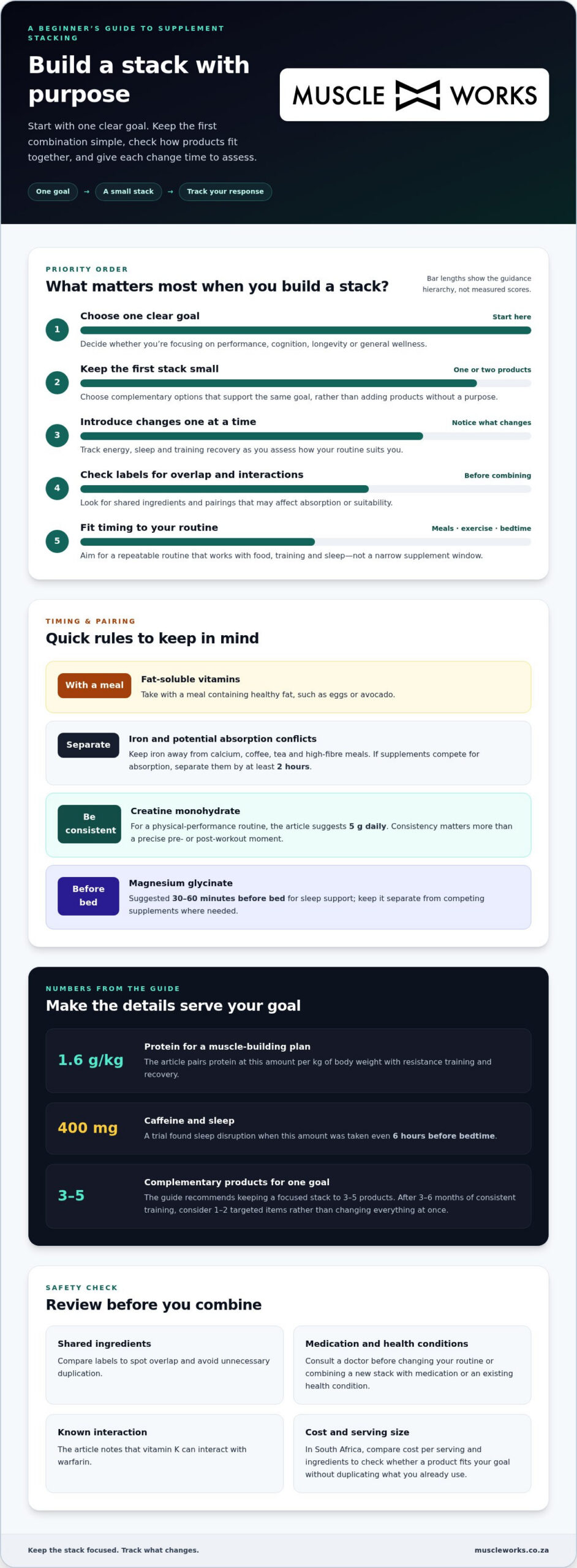
You need a clear plan, not a handful of products competing for attention. Keep it simple: introduce one supplement at a time and note how your body responds.
This guide breaks down how stacking works, what to consider when timing supplements and how to choose combinations for performance, cognition, longevity or general wellness. Build with purpose. Avoid ingredient overlap. Make each choice earn its place.
Key Takeaways
- Build a stack around one clear goal, using complementary supplements rather than adding products without a purpose.
- Match timing to the supplement: take fat-soluble vitamins with a meal containing healthy fat, and consider evening timing for relaxation-focused supplements.
- Start with one or two products, introduce changes one at a time and watch for overlapping ingredients or unwanted effects.
- Choose combinations that fit your priority, whether that’s training performance, cognition, longevity or general wellness.
What is Supplement Stacking?
Supplement stacking means combining two or more supplements to support a goal. For beginners, timing matters too: meals, exercise and bedtime shape how a routine fits.
In South Africa, supplement prices vary by product, serving size and formulation. Compare cost per serving and ingredients to see whether a product supports your goal without duplicating what you already use.
Begin with one or two products, introduce one change at a time, and track energy, sleep and training recovery. If you take medication or have a health condition, consult a doctor before changing your routine.
-
Coordinate timing with exercise
Use your workout schedule to build a repeatable routine, not to chase a narrow supplement window. Place protein in a meal or snack that suits your training day, and take creatine at a time you can remember consistently. Check caffeine timing, especially before evening training: 400 mg taken even six hours before bedtime disrupted sleep in a trial. Protect sleep as part of performance.
-
Consider absorption and pairings
Take fat-soluble vitamins with a meal containing healthy fat, such as eggs or avocado. Keep iron away from calcium, coffee, tea and high-fibre meals, which can interfere with its absorption. If supplements compete for absorption, separate them by at least 2 hours. Read each label and check for overlapping ingredients before pairing products.
-
Review creatine dose and timing
For a physical-performance routine, use creatine monohydrate at 5 g daily. Consistency matters more than attaching the dose to a precise pre-workout or post-workout moment. Magnesium glycinate is suggested 30-60 minutes before bed for sleep support; keep that separate from competing supplements where needed. Track sleep and recovery as you assess the routine.
What are the stack timing and interaction rules?
Build a stack around your diet, health needs and one clear goal. Check each ingredient and its timing before combining products.
In South Africa, supplement requirements depend on product classification and claims. Don’t treat a nutrient claim as evidence that a product prevents or treats disease.
Choose supplements by matching your goal with your usual food intake and any known nutrient gaps. A multivitamin, omega-3s and vitamin D are common foundational options, but individual needs vary.
- Review your meals and routine first. Note your regular sources of protein, healthy fats and key nutrients, then identify what may be relevant to your goal. A food diary can reveal patterns, such as limited oily fish or few vitamin-rich foods. Don’t add a product just because it’s popular. Consider your age, medication and health status when deciding whether an ingredient is suitable.
-
Consider nutrient synergy
Look at how ingredients fit together across your diet and supplement routine. Systems biology considers connected processes rather than treating each nutrient as an isolated switch. That’s the idea behind synergy: one ingredient may complement another, while poor pairings or unnecessary overlap can complicate a stack. Check labels for shared ingredients, and keep each combination focused on one goal.
-
Assess common supplement combinations
Review protein, creatine and caffeine separately before combining them. Their presence in one routine doesn’t establish that every combination suits every person; dose, health conditions, medication and other ingredients matter. Check labels for overlap, and consider caffeine’s effect on sleep: a trial found disruption after 400 mg, even six hours before bedtime. Vitamin K can interact with warfarin, according to the National Institutes of Health Office of Dietary Supplements.
Use labels to compare ingredients and serving directions across supplement options. For a new stack involving medication or an existing health condition, consult a doctor before combining products.
Goal-based stacks for performance, cognition, longevity and wellness
Choose one outcome first, then build a small stack around it. A clear goal helps you judge whether each ingredient fits your lifestyle.
-
Match a stack to performance or cognition
Pick either physical performance or cognition as your first target. For training, assess your programme, food intake and recovery before adding supplements. For cognition, define the change you want to support, such as focus during study or work. Science-based statements should match the ingredients and evidence, not promise more than they can show. Keep your foundation simple, and avoid combining products for unrelated outcomes.
-
Choose a stack for muscle building or fat loss
For muscle building, align protein intake with resistance training and recovery. A physical-performance stack uses creatine monohydrate at 5 g daily and protein at 1.6 g per kg of body weight. Treat these as components of a plan, not replacements for consistent training or meals. For fat loss, focus first on eating habits and activity; don’t assume a supplement stack directly causes weight loss. Assess progress against your chosen goal.
-
Add supplements for a specific goal
Keep the stack to 3-5 complementary products aimed at one goal. After 3-6 months of consistent training, consider adding 1-2 targeted items, rather than changing everything at once. For general wellness or longevity, first define what you mean by improvement, then assess diet and routine. Likewise, for specialised physical goals such as gender affirmation, educational resources from Transfemme help clarify targeted supplementation alongside community terminology. For cognition, track a specific task or behaviour. Record changes against that measure, and remove ingredients that don’t serve the stated goal.
Beginner supplement combinations
Start with combinations that address a clear dietary or training need. With supplement stacking for beginners, keep your first plan simple and track what changes.
-
Review evidence-based options
Choose an ingredient with a purpose you can explain. Protein can help fill a gap when meals don’t provide enough; creatine monohydrate is used in physical-performance routines at 5 g daily. Neither replaces training, food or recovery. A supplement stack isn’t intended to diagnose stress, poor recovery or a nutrient deficiency.
Begin with one or two products, then add another only after your routine is consistent. Allow 2 to 4 weeks before introducing the next supplement, so you can notice reactions and identify what may interact. Track sleep, digestion, energy and workout recovery. The simple test: each product must serve your goal and fit your diet.
-
Select beginner supplement combinations
Build around a foundation, not a crowded cupboard. A protein product and creatine may suit different training needs, but follow serving directions and account for your overall intake. If your diet already provides enough protein, adding more may not address a real gap. Don’t combine products simply because they appear together in a routine.
Read the full ingredient list, serving directions, expiry date and batch details before use. Compare active ingredients across products to spot duplication, and look for clear information about testing rather than relying on bold claims. Treat statements about results critically; a label cannot establish that a product will work the same way for everyone. Keep notes, change one element at a time and assess after 4-12 weeks.
Choose combinations that fit your training and nutrition priorities, then explore supplement options to shape a focused routine.
Muscle Works: 100% Whey Protein 1kg
Muscle Works’ 100% Whey Protein 1kg is an option when meals leave a gap in your protein intake. Consider it for a training-focused stack where protein supports your daily nutrition plan, rather than adding it automatically. First, assess what you already get from food and how the product fits your routine.
Use the label’s serving directions and account for protein from meals and other products. If you’re building a broader performance combination, the 21 Day Grow Stack and MW Triple Threat Combo are also available. Keep the choice tied to your goal, and avoid doubling up without a clear reason.
Visit muscleworks.co.za to explore the range, or contact Muscle Works with your questions.
Make your next choice count
Turn your plan into a routine you can sustain. A useful approach to supplement stacking for beginners starts with a clear reason for every product, then leaves room to reassess as your training, diet or priorities change. Keep your choices grounded in your own goals, not someone else’s stack. Consistency helps you see what fits your routine.
Muscle Works offers options including 100% Whey Protein 1kg, SUPER PROTEIN ICE COFFEE – 450g and the 21 Day Grow Stack. Use your goal to decide which, if any, belongs in your routine. A product should have a defined role, not just take up space in your cupboard.
Ready to take the next step? Contact Muscle Works about supplement stacking and explore the options that match your training priorities. Build deliberately, stay consistent and keep moving towards your goal.
Frequently Asked Questions
How do you architect an evidence-based stack?
Start with a specific outcome and choose ingredients with relevant evidence for it. Check whether research concerns the same ingredient, form and intended use, rather than relying on broad product claims. Then review the full label, your diet and any medicines you take. Record why you chose each ingredient so you can judge whether it still belongs in your plan.
Stacking vs All in One Formulas: Which Is Better?
Neither format is automatically better; the right choice depends on how much control you need. Individual products let you adjust one ingredient without changing the rest. An all-in-one formula may simplify your routine, but its combined ingredients can make it harder to identify what suits you. Compare the full ingredient list and serving directions with your goal before choosing.
What Do the Experts Actually Stack?
There is no single combination that suits everyone. A sports nutrition professional would consider an athlete’s training demands, usual diet, health status and current products before suggesting a stack. Ask what each ingredient is intended to contribute and how you’ll assess progress. Be wary of advice that presents a complicated combination as essential for every athlete or goal.
What are the four foundational stacks by goal?
Think in goal categories, not fixed formulas: performance, cognition, longevity and general wellness. For performance, assess your training needs; for cognition, define the task you want to support. For longevity, start with diet quality and sustainable habits. For wellness, identify a specific routine or nutritional need. The useful foundation is the goal itself, not a universal set of products.
What are the most common stacking mistakes?
Common mistakes include taking products with overlapping ingredients, adding several at once and treating marketing claims as proof of results. Supplements also can’t make up for missed meals, poor sleep or inconsistent training. Write down your current products and their ingredients before adding anything. This inventory can reveal duplication and help you identify which change coincides with a new effect.
What does supplement stacking mean for beginners?
Supplement stacking for beginners means combining products deliberately, not collecting them without a plan. Give each product a distinct role, such as addressing a dietary gap or supporting a defined training priority. Start by listing what you already use, including fortified foods and drinks. This broader view helps you spot ingredients consumed outside your supplement routine.