

The cheapest tub isn’t always the best value. To learn how to save money on supplements, divide the total price by the number of servings and compare the cost per serving. A lower shelf price can still mean paying more for each use.
Supplement costs can add up, especially when you buy several products at once. Make each purchase earn its place. Compare serving costs and ingredient labels, identify products you may not need, and weigh bulk buying against the risk of stock you won’t use.
You’ll also learn how to assess loyalty offers, subscriptions, coupons, sales and free shipping without letting a deal push you into an unnecessary order. The aim is simple: control your supplement spending while staying focused on what supports your training.
Key Takeaways
- Compare the total price with the number of servings to see what each use really costs.
- Read ingredient labels and serving amounts side by side; a lower shelf price is not automatically better value.
- Review your routine and cut products that don’t meet a clear need before buying more.
- Check loyalty rewards and subscription terms against your usual buying habits before committing.
- Compare the final basket total after coupons, sale offers and delivery costs, not just the advertised discount.
1. Buying supplements in bulk and calculating cost per serving
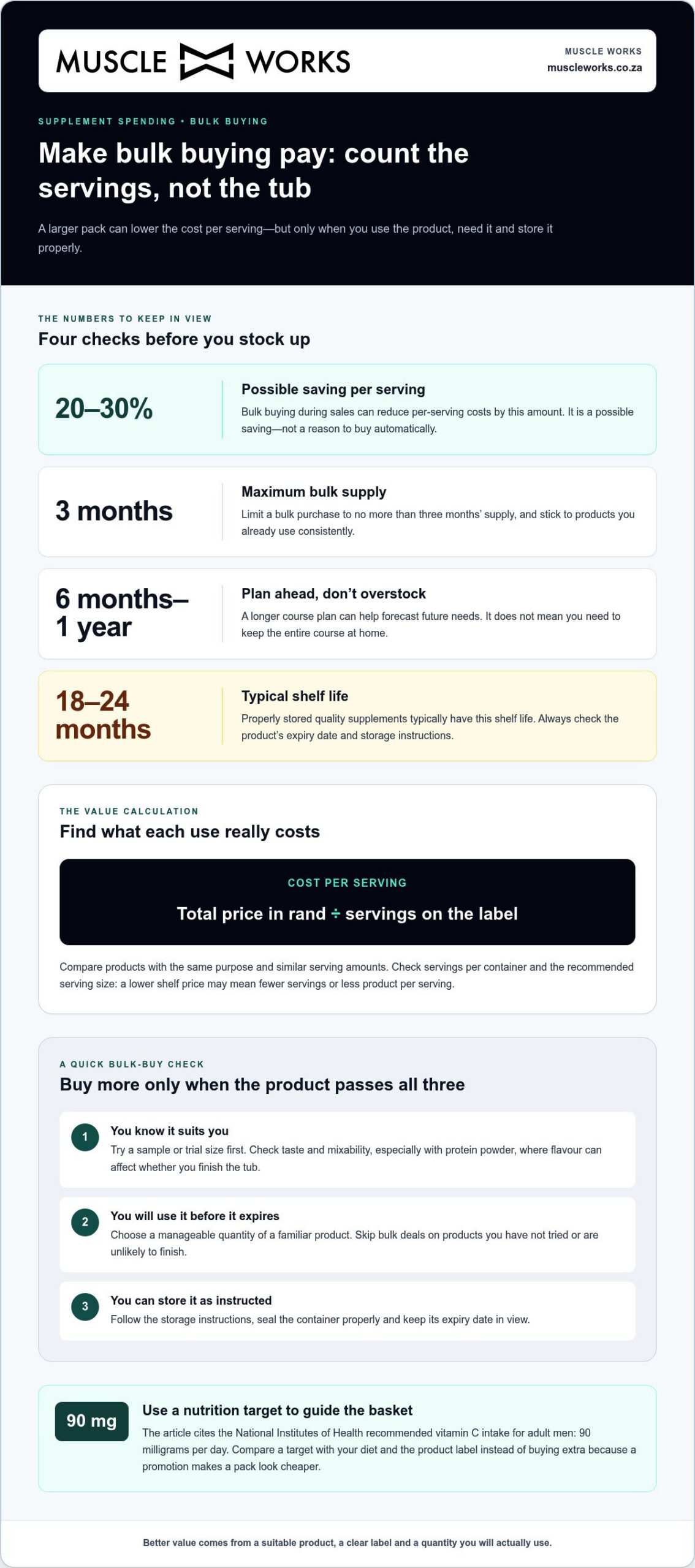
If you’re learning how to save money on supplements, start with the serving, not the tub. Divide the price in rand by the number of servings on the label. This gives you the cost per serving, a sharper comparison than shelf price alone. A larger container can save money, but only if you use it before its expiry date and the product suits your routine.
Check servings per container and the recommended serving size. Then compare products with the same purpose and similar serving amounts. A lower price may hide fewer servings or a smaller amount per serving. Compare like with like, and check the label before deciding which option offers better value.
Buying supplements in bulk during sales can reduce per-serving costs by 20-30%. Treat that as a possible saving, not a reason to stock up automatically. Limit bulk purchases to no more than three months’ supply, and choose products you already use consistently. A longer course plan, such as six months to a year, can help you forecast future needs. It doesn’t mean you must store the entire course at home.
Test first. A sample or trial size lets you assess taste, mixability and how a supplement fits your routine before buying a larger container. That matters with protein powders, where flavour can affect whether you finish the tub. Read the storage instructions, seal the container properly and note its expiry date. Properly stored quality supplements typically have an 18-24 month shelf life, but they still need to suit your needs.
Can buying supplements in bulk save money, and how can I avoid waste? Yes, a lower cost per serving can mean savings. Buy a familiar product in a manageable quantity, use it as directed and store it as instructed. Skip bulk deals on products you haven’t tried or are unlikely to finish.
Can medical aid or tax benefits cover supplements in South Africa? Medical aid cover depends on your scheme’s benefits. Tax treatment depends on the applicable rules and whether the expense qualifies, so don’t assume a routine supplement purchase is covered.
Bulk buying can work for food staples, too. Rice, oatmeal, beans and lentils can support meal planning without adding another supplement to your cupboard. Plan meals first, then buy ingredients you’ll use. A practical food plan can reduce reliance on powders for everyday nutrition.
Use a specific nutrition target when reviewing your basket. According to the National Institutes of Health, the recommended vitamin C intake for adult men is 90 milligrams per day. Compare that target with your diet and product label instead of buying extra vitamins because a promotion makes the pack look cheaper. This kind of label-led check is central to how to save money on supplements without letting a bulk offer dictate your basket.
2. Comparing value alternatives and ingredient labels
To learn how to save money on supplements, compare products by purpose, serving size and active ingredients, not packaging or brand claims. Prices vary between companies, but a high price doesn’t automatically mean higher quality, and a low price doesn’t prove poor quality. Check the amount of each active ingredient per serving, then compare options with similar amounts.
A multivitamin may suit general nutritional coverage, but it won’t always replace a targeted supplement. For targeted life-stage support, brands like Evabiotic focus on specialised multivitamin blends rather than one-size-fits-all options. Someone with an iron or vitamin D deficiency may need up to 10 times the amount found in a multivitamin. A broad formula can cost less upfront yet provide too little of the nutrient needed. Match the product to the specific nutrition need, and avoid paying for ingredients that don’t serve that purpose.
Dosage matters. Compare a pre-workout providing 150mg of caffeine with one providing 400mg. Those servings deliver different amounts, so the higher dose isn’t automatically better value or the right fit. For creatine, compare the amount per serving: 3 grams is less than 5 grams and may be underdosed for the intended use.
Research each supplement company’s history, manufacturing practices and nutrient sourcing. A proprietary blend can make ingredient-by-ingredient comparisons difficult. Clear label details help you assess what you’re buying. That kind of focused comparison is a practical way to understand how to save money on supplements without choosing on price alone.
What are the cheapest places to buy supplements in South Africa? The lowest total depends on the product, basket size, delivery charge and current offers. Compare the final rand amount, including shipping, rather than relying on the displayed product price.
Which South African supplement brands offer good value for money? Judge each product by serving cost, active ingredient amounts, label clarity and company information. A brand name alone doesn’t prove value; compare the label with your nutrition needs.
Use the same label-led approach to compare supplement options: match the ingredients and dosage to your needs, then assess the total cost.
Treat price as a starting point for comparison, not a verdict on a product. Vitamins and supplements vary widely in price, so consider the cost alongside the product’s purpose and ingredient details. A high price doesn’t necessarily mean a supplement is high quality, and a low price doesn’t necessarily mean it’s poor quality. Base your decision on suitability and clear label information, not on cost alone.
3. Avoiding unnecessary supplements and proprietary blends
Cut waste before you reach the checkout. Healthy adults generally don’t need dietary supplements, so start by listing what you take and why. Match each product to a specific nutrition need, training goal or professional recommendation. If two products cover the same ingredients, compare their labels and remove overlap rather than paying twice for a similar combination.
Food matters. If a balanced diet already supplies what you need, consider whether you need your usual multivitamin amount. One approach described for people whose food covers their nutritional needs is taking one vitamin per day instead of two. Don’t change a prescribed supplement routine based on a cost-cutting idea; focus your spending review on products you choose for yourself.
Read every ingredient panel, especially the serving size and amounts. A proprietary blend may show only the combined weight, hiding how much of each ingredient it contains. For example, a label listing a 500mg proprietary energy blend could reveal that it contains 50mg of caffeine, without showing the quantities of its other ingredients. Compare transparent labels where possible; if you can’t assess the individual ingredients, you can’t make a precise value comparison.
Are there South African rules or registrations to check when buying supplements? Read the South African product label and regulatory information relevant to its category, rather than assuming a registration from another country applies locally. Distinguish products presented as supplements from those making medicine-like claims, and read the wording carefully.
How can I check supplement quality, ingredients and safety before buying cheaper products? Read the full ingredient list, serving directions, storage instructions and expiry date. Check that the packaging is sealed, batch and product details are legible, and the seller provides clear product information. These checks can help you avoid expired or questionable stock.
Use a simple pre-purchase screen: identify the purpose, check for duplicate ingredients, inspect the dose, then check the seal and expiry date. A quality supplement stored properly typically has an 18-24 month shelf life, but that doesn’t make an unsuitable product a smart buy. Buy only what fits your routine and can be used before its expiry date.
Keep your decision disciplined. A discount can’t make an unnecessary product useful, and an impressive front label can’t replace clear ingredient amounts. Review your cupboard before ordering; if a product has no defined role, remove it from your spending plan.
For someone whose healthy, balanced diet supplies nutrients, consider half the usual multivitamin dosage; this keeps supplement use aligned with dietary needs.
4. Loyalty programmes and subscription discounts
Loyalty rewards can lower supplement spending, but only when they match products you already buy. An estimate puts potential loyalty-programme savings at 8-12% annually. Treat the percentage as a benchmark, then calculate your own return from actual rewards earned and redeemed. Points with no useful redemption value don’t reduce your basket total.
Start with the programme rules. Check how points accrue, what they can buy, whether they expire and whether a minimum spend applies. Then compare the reward with the ordinary price of a planned purchase. A discount that requires extra products can increase spending instead of reducing it. Track your balance and redemption dates so earned value doesn’t go unused.
When do South African retailers offer supplement sales, discounts or loyalty rewards? Retailers run promotions and rewards periodically, with timing and terms varying by seller. Follow the brands and retailers you already buy from, and compare each offer with your normal shopping list before ordering.
Combining offers can improve value when the terms allow it. Check whether a loyalty reward can be used alongside a sale price or coupon, then calculate the final rand total at checkout. Include delivery charges and any minimum-spend condition. A reward is useful only if the combined offer lowers the cost of planned items without adding unwanted products.
Subscriptions suit repeat purchases when your use is predictable. Before enrolling, check the renewal frequency, delivery charge, discount conditions and cancellation process. Compare the subscription total with buying the same quantity as needed. A lower unit price may not help if deliveries arrive before you’ve used your previous order or lock you into unwanted stock.
Keep control of timing. Choose a delivery interval that reflects your actual consumption, and set a calendar reminder before each renewal. Review the next order against your cupboard, routine and budget. Pause or cancel before an unwanted shipment is processed, and don’t subscribe to a product just because the first order includes a discount.
Before committing, identify the product you planned to buy, calculate the loyalty value or subscription saving, add delivery costs, then compare the final total. Repeat the calculation for a sale price and any eligible reward. If the offer changes your basket or buying schedule, assess the full commitment, not just the advertised discount.
Make brands earn repeat business through clear value. Keep one simple record of purchase dates, rewards, subscription renewals and final totals. After several orders, compare that record with buying only when needed. The strongest programme is the one that cuts costs on your regular routine, not the one with the loudest promotion.
5. Online shopping, coupons and free shipping
Online shopping makes it easier to compare supplement offers, but the checkout total matters more than the banner. Search for promo codes and coupons before ordering, then check whether the code applies to your chosen products. Compare the discounted basket with the usual price, delivery charge and any minimum-spend condition. A code is useful only if it lowers the cost of items you planned to buy.
Check retailer emails and social media pages for current coupon codes. Read the offer details, including eligible products, expiry conditions and whether the code can be combined with another promotion. Before paying, enter the code and confirm that the displayed total changes. Don’t assume a code applies to protein powder just because the headline advertises supplement savings.
Retailers periodically run offers such as 20% off vitamins and supplements, buy-one-get-one-free deals, or products at half off. Treat these as examples of promotion types, not a reason to fill your basket. A two-for-one offer only makes sense if both products fit your routine and you can use them. Compare the deal’s effective cost with buying the quantity you actually need.
Free shipping can change which online order offers better value. Compare the final total, including delivery, across the sellers you’re considering. If a retailer sets a minimum spend, calculate whether adding a needed item costs less than paying delivery. Don’t add an unnecessary product just to unlock shipping. The saving is real only if your total outlay falls.
Retailer rewards can complement coupons. Some shopping clubs award points that can be exchanged for gift cards, while others offer cashback on purchases. Check how rewards are earned, when they can be used and whether exclusions apply. Count points or cashback as value only once they reduce a future purchase or return money to you.
Combining discounts takes a quick check. Apply an eligible coupon to a sale item, then see whether loyalty rewards also apply. Read the terms for exclusions, minimum basket requirements and delivery fees. If a code removes a better automatic discount, compare both checkout totals and choose the lower price for the same planned products.
Keep a simple shopping record. Note the product, usual basket total, coupon used, delivery charge and final amount paid. Comparing these details across repeat orders shows which offers genuinely reduce your supplement spend. It also helps you spot a promotion that looks strong but costs more after shipping or extra items.
Ready to compare your next supplement order? Browse supplement options and assess the products against your needs, basket total and available offers before checkout.
The cheapest place is the online seller with the lowest final checkout total for the products you need, after eligible coupons, rewards and delivery charges. Compare the same planned basket across retailers, rather than relying on displayed prices or promotion headlines.
Muscle Works: 100% Whey Protein 1kg
Muscle Works 100% Whey Protein 1kg gives you a protein powder option to assess against your nutrition routine and budget. Before buying, compare its label, serving information and ingredients with your needs. Calculate the cost per serving from the current price and number of servings, then weigh that figure against other suitable options. If whey protein has a clear place in your plan, this focused comparison helps you make a deliberate choice rather than buying on impulse. If you’re considering other options, Muscle Works also offers Plant Protein 1.2kg and the 21 Day Grow Stack. Choose according to your intended use and review each product on its own merits. Visit muscleworks.co.za to explore the range.
Make your next supplement choice count
Make your buying routine a deliberate part of your training plan. Decide what role a supplement needs to fill before browsing, then choose only what fits your needs and budget. That’s a practical way to apply what you’ve learned about how to save money on supplements: buy with purpose, not just because an offer looks appealing.
Muscle Works offers 100% Whey Protein 1kg, SUPER PROTEIN ICE COFFEE – 450g and the 21 Day Grow Stack. Compare each option with your intended use and the product information, then choose the one that makes sense for your routine. A focused decision beats adding another product without a clear reason.
Need help considering your options? Contact Muscle Works for supplement advice. Keep your goals clear, make each purchase count and stay disciplined with your spending.
Frequently Asked Questions
How can I compare supplement prices per serving or per dose?
Compare the cost of the labelled amount you’ll actually take, not simply the tub or bottle. If directions call for several capsules or scoops per serving, count them together. Then compare products that provide similar amounts of the same active ingredient. Check whether the label’s serving size matches your intended use, as a smaller serving can make a product appear cheaper than it is.
Are generic or store-brand supplements as effective as premium brands?
A generic or store brand may offer value, but the label matters more than the branding. Compare active ingredients, amounts per serving, ingredient forms and additional components. For example, two creatine products aren’t directly comparable if their labelled amounts per serving differ. Look for clear ingredient information and details about the company’s manufacturing practices and sourcing. A premium price alone doesn’t establish quality, and a generic label alone doesn’t establish poor quality.
Which supplements are worth paying for, and which may be unnecessary?
Prioritise supplements that address a clear dietary gap or fit a defined training need. A product that duplicates ingredients in your multivitamin or another formula may add little value to your routine. Healthy adults don’t automatically need dietary supplements; assess your diet and purpose before buying. Be cautious with proprietary blends that conceal individual ingredient amounts, since it’s harder to judge what each component contributes.
How do supplement prices compare across pharmacies, health stores, and online retailers in South Africa?
Prices vary by product, basket size, delivery charge and current offers. Compare the final rand total across pharmacies, health stores and online retailers, including shipping.