

Faster weight loss isn’t always better fat loss. Cut calories too aggressively and your strength, training quality and muscle can suffer along with the number on the scale. If you’re asking how to lose fat without losing muscle, focus on a measured calorie deficit, consistent resistance training and enough protein, not crash dieting or endless cardio.
Getting leaner doesn’t have to mean getting weaker. The aim is to reduce body fat while giving your body a reason to retain muscle. This guide explains how to set a realistic pace, structure your nutrition and keep training consistently, with recovery built into the plan. You’ll also learn where cardio fits and why protein supplements are optional conveniences, not shortcuts or requirements. If you choose to use a supplement, Always consult your physician before use.
Key Takeaways
- Learn how to lose fat without losing muscle by choosing a measured, sustainable approach rather than chasing rapid changes on the scale.
- Use body weight as one progress signal, not a precise measure of how much fat or muscle has changed.
- Build your routine around resistance training, balanced meals and recovery, then fit cardio around your schedule.
- Set a practical weekly plan and review your progress consistently before making changes.
- Protein supplements can be optional conveniences when they suit your routine; they don’t replace food, training or rest. Always consult your physician before use.
What does losing fat without losing muscle actually involve?
Muscle-preserving fat loss means reducing body fat while using sensible nutrition, resistance training and recovery to minimise the loss of muscle and strength. Minimise is the key word. No plan can promise zero muscle loss for everyone. Outcomes depend on factors such as starting body composition, training experience, diet and the size of the energy deficit.
Fat loss and weight loss aren’t the same thing. Fat loss means reducing stored body fat. Weight loss means the number on the scale has gone down, but that change can come from fat, lean tissue, body water or a mix of all three. Lean mass is everything that isn’t body fat. It includes muscle, but also water, bone and organs, so a change in lean mass doesn’t automatically mean the same amount of muscle has been lost.
That distinction matters because the scale shows a change in total body weight, not exactly which tissues account for it. Body-composition assessments also estimate rather than directly reveal every change in your body. Use several progress signals instead of treating one number as a verdict.
Why can a calorie deficit affect muscle as well as fat?
A calorie deficit means taking in less energy than your body uses over time. Your body draws on stored energy, but weight loss can also involve changes in lean tissue and water. The proportions vary between people. An aggressive deficit may leave you with less energy for lifting and make recovery harder, reducing your ability to maintain training quality. Aim for a manageable deficit, not the fastest possible drop on the scale.
What progress should you track beyond the scales?
Track the trend, not a single weigh-in. Body weight can shift in the short term with hydration, food still being digested, changes in carbohydrate or salt intake, and other normal fluctuations. Those changes don’t prove you’ve gained or lost muscle or fat.
Use a consistent set of measures:
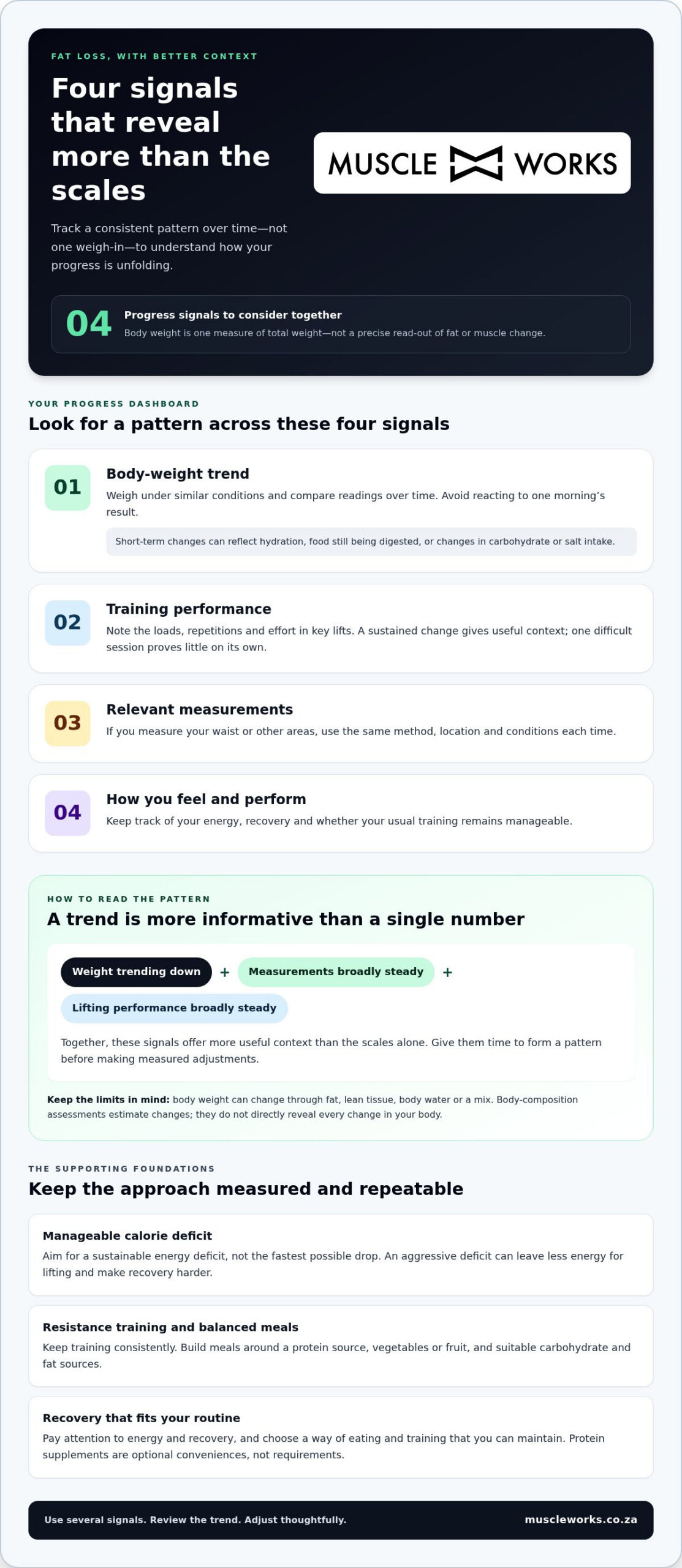
- Body-weight trend: Weigh under similar conditions and compare readings over time, rather than reacting to one morning’s result.
- Training performance: Note the loads, repetitions and effort in key lifts. A sustained change is useful context, although one difficult session proves little on its own.
- Relevant measurements: If you measure your waist or other areas, use the same method, location and conditions each time.
- How you feel and perform: Keep track of energy, recovery and whether your normal training remains manageable.
Give these signals time to form a pattern. If weight is trending down while your measurements and lifting performance remain broadly steady, that offers more useful context than the scale alone. This is the practical starting point for how to lose fat without losing muscle: assess progress consistently, then make measured adjustments instead of reacting to daily fluctuations.
How nutrition supports fat loss whilst helping preserve muscle
Fat loss requires an energy deficit: over time, your body must use more energy than you get from food and drink. The size of that gap matters. A moderate deficit leaves more room for satisfying meals and productive training, which can make consistency easier. Severe restriction may look decisive on paper, but it can leave you hungry, drained and struggling to recover.
A sustainable deficit is one you can maintain while eating balanced meals and supporting your training; severe restriction sacrifices those foundations for faster short-term change.
Build meals around foods you enjoy and can keep eating. Include a protein source, vegetables or fruit, and suitable carbohydrate and fat sources. Carbohydrates can help fuel training, while dietary fats belong in a balanced eating pattern too. You don’t need a rigid meal timetable. Some people prefer regular meals; others do better with a different rhythm. Choose a pattern that helps you manage hunger, meet your nutrition needs and train well.
Make the plan workable in real life. If you often miss meals on busy days, prepare a simple option ahead of time. If strict tracking makes eating feel unmanageable, start with repeatable meal choices and review your progress rather than imposing rules you can’t sustain. The aim is structure, not punishment.
How should you think about protein during a cut?
Protein is part of a balanced diet and supports the body’s maintenance and repair of tissues via amino acids and cellular signalling. While researchers exploring these cellular pathways in laboratory settings source compounds from suppliers like nhpeptides.co.uk, everyday lifters can meet their nutritional needs through whole foods such as eggs, dairy, fish, poultry, beans, lentils or tofu. The ISSN Position Stand on Protein and Exercise gives broad intake guidance for exercising people, including higher ranges during energy restriction, but these aren’t automatic targets for everyone. Needs vary with body size, training and individual circumstances.
A supplement is another option, not a requirement. Whey or plant protein may be convenient if it suits your diet and routine. For a closer look at the topic, explore this guide to whey protein isolate for cutting. Always consult your physician before use.
Why are extreme diets difficult to sustain?
Severe restriction can make it harder to manage hunger, maintain training energy and recover between sessions. If your approach repeatedly feels difficult to maintain, adjust it rather than relying on willpower alone. Consider whether meals are satisfying, whether the deficit feels too demanding, and whether your routine allows enough consistency. A plan that fits your life gives you a stronger foundation for steady effort.
Keep the priorities clear: a manageable energy deficit, balanced food choices and enough protein from meals or an optional supplement. Muscle retention isn’t decided by one food or a perfect day. It’s supported by a pattern you can repeat while continuing to train and recover. If a protein product would make that routine more convenient, you can browse whey and plant-based protein options as one possible food choice, not a shortcut.
Resistance training, cardio and recovery: what deserves priority?
Give resistance training the central role. During fat loss, lifting gives your body a reason to keep adapting to strength demands. The aim isn’t to smash every session or set a personal record each time. Keep showing up, train the major muscle groups consistently and maintain the quality of your work where you can.
The American College of Sports Medicine’s 2026 resistance-training guidance recommends training all major muscle groups at least twice a week as a baseline. It also stresses that consistency matters more than programme complexity. Use that principle to build around your current schedule, rather than forcing a complicated routine you can’t sustain. Cardio can support your overall activity and fitness, while rest gives you space to recover. Each has a role, but none needs to crowd out lifting.
How should you adjust strength training during fat loss?
Keep familiar movement patterns and a repeatable training structure. Record exercises, loads and repetitions so you can spot trends across sessions. Performance can vary with sleep, stress and normal day-to-day changes; one weaker workout doesn’t mean the plan has failed. Aim to maintain your usual performance where possible, or improve gradually, rather than demanding a personal best every time.
If fatigue is accumulating and recovery is slipping, look first at unnecessary volume. Extra sets that add little value may be harder to recover from during a calorie deficit. Trim what you can’t recover from, but keep a consistent resistance-training stimulus. Make deliberate adjustments, then give them time to work.
How can cardio fit without taking over the plan?
Cardio is a useful complement, not a replacement for strength work. Choose an activity and amount that suit your fitness, preferences and weekly routine. A manageable walk, cycle or other aerobic session can add activity without turning every day into an endurance test. Start from what you already do, then adjust only if it fits comfortably alongside lifting and recovery.
More isn’t automatically better. A demanding cardio workload that leaves you struggling through strength sessions or feeling persistently run down may be taking too much from the rest of your plan. Monitor how your lifting feels and whether you recover between sessions. If performance or energy repeatedly suffers, reduce the cardio load or make it easier to manage. The practical answer to how to lose fat without losing muscle is to make cardio serve the plan, not dominate it.
Recovery is part of training, not time wasted. Leave room for rest, pay attention to ongoing fatigue and avoid stacking hard sessions without considering their combined effect. Your weekly schedule should be challenging enough to support progress and realistic enough to repeat. If convenient nutrition options would complement your wider routine, explore sports nutrition options after putting training and recovery fundamentals in place.
How to build a realistic weekly fat-loss plan
A strong plan fits the week you already have. Start with your normal eating habits, work and training commitments, then build a routine you can repeat. You don’t need to overhaul everything at once. Establish a clear baseline, make manageable changes and review the results before adjusting another variable.
- Establish your baseline. Note your usual meals, current activity, resistance-training experience, body-weight trend and how well you recover. Be honest about the time and energy you can commit.
- Set a sustainable approach. Choose a modest nutrition change you can maintain, such as planning balanced meals more consistently. Keep resistance training in the week. ACSM’s 2026 guidance recommends training all major muscle groups at least twice a week.
- Fit sessions around your life. Place lifting sessions on days that work with your schedule. Add optional cardio only if you can manage it without compromising lifting or rest. Leave space between demanding sessions when you need it.
- Review before changing course. Compare longer-term weight trends with training performance, energy and how consistently you followed the plan. If you adjust, change one factor at a time so you can judge its effect.
A sustainable weekly plan includes balanced meals, consistent lifting, optional manageable cardio, enough recovery and regular reviews.
What should a beginner review before changing the plan?
Take stock of your current eating pattern, training experience and available recovery time before adding demands. If you’re new to lifting, prioritise learning a simple routine you can repeat over chasing an advanced programme. Set a realistic goal and build around the days you can reliably train. Personal circumstances, health concerns or a complicated relationship with food may call for guidance from a suitably qualified health professional.
How can you tell when the plan needs adjusting?
Look at several signals together: longer-term body-weight trends, lifting performance, energy, recovery and how consistently you can follow the routine. A plan may be too demanding if you’re frequently missing sessions, struggling to complete familiar training or feeling persistently depleted. Don’t react to one difficult day or weigh-in. If concerns persist or you’re unsure what changes are appropriate, seek professional advice.
For example, if you’re managing meals and lifting consistently but adding cardio leaves you too fatigued to train well, reduce or simplify the cardio first. If the routine is hard to follow because meals are unplanned, address that barrier rather than changing your training too. Small, focused adjustments make it easier to learn what works for you, a practical part of how to lose fat without losing muscle.
If a protein supplement would make your meal routine more convenient, explore protein options as an optional addition to food, training and recovery. Always consult your physician before use.
Where supplements fit when your goal is fat loss and muscle retention
Supplements belong at the edge of the plan, not at its centre. They don’t replace balanced meals, resistance training, sleep or consistency, and no protein powder can guarantee fat loss or muscle retention. Build those foundations first. Then consider whether a supplement solves a practical problem in your routine.
Protein powders can be a convenient way to include protein when preparing or carrying a meal isn’t practical. Convenience is the point, not a special body-composition effect. A shake can’t compensate for a training plan you can’t sustain, inadequate recovery or an eating approach that’s too restrictive. Treat it as one possible food choice within your overall intake.
When might a protein supplement be convenient?
Consider your usual meals, dietary preferences and daily routine. Whey protein may fit someone who includes dairy; plant protein offers a plant-based option. Neither is automatically necessary or right for everyone. Start by considering whether your meals already provide the protein you need. If a convenient option would help you follow your routine, compare the product information with your preferences and use it as directed.
For a separate look at one whey option, read the 100% Whey Protein 1kg guide. Use product information to understand the specific product rather than assuming every protein powder has the same ingredients or directions. Always consult your physician before use.
What should readers expect from a supplement?
Set the right expectation. A protein supplement doesn’t create an energy deficit, replace lifting or guarantee that muscle will be retained during weight loss. Your overall nutrition and training habits remain the drivers of the plan. A powder may simply make it easier to include a protein source at a time or place where another food option doesn’t suit your routine.
Keep your decision practical. If you prefer whole-food meals and can follow your nutrition plan comfortably, there’s no need to add a supplement just because you’re cutting. If convenience matters, select an option that fits your dietary preferences and use it as directed. Check the product label for applicable ingredients and warnings, and don’t treat a supplement as a medicine.
That’s the realistic answer to how to lose fat without losing muscle: use nutrition, progressive resistance training and recovery as the core strategy, then add only what genuinely helps you stay consistent. Muscle Works offers whey and plant-based protein options for different preferences and routines. Once your fundamentals are in place, explore Muscle Works supplements and decide whether one suits your nutrition routine. This is not a medicine.
Make your next step count
Your next move doesn’t need to be a complete overhaul. Choose one action you can carry into the coming week, such as setting a regular time to train or making a simple meal plan. Keep it manageable, follow through, then build from there. That’s how to lose fat without losing muscle: use repeatable habits, not a short burst of extreme effort.
If a protein option would make your routine more convenient, Muscle Works offers whey and plant-based protein options through its online store across South Africa. Choose based on your dietary preferences and routine, not promises of instant change. Supplements are optional and can’t replace your wider nutrition and training plan.
Explore Muscle Works protein options and decide whether one fits your approach. Always consult your physician before use. Stay consistent, review your progress and keep moving forward, one solid choice at a time.
Frequently Asked Questions
Can you lose fat and gain muscle at the same time?
Yes, some people can lose fat and gain muscle at the same time, particularly if they’re new to resistance training or returning after a break. It isn’t guaranteed, and progress depends on factors such as training history and nutrition. Track more than body weight: if your waist measurement trends down while your gym performance improves, that may suggest body recomposition. Measurements aren’t exact, so look for a consistent pattern rather than a quick change.
How quickly should you lose weight to help preserve muscle?
There isn’t one ideal rate that suits everyone. Avoid chasing rapid drops, and judge your approach by longer-term weight trends alongside your training and energy. Daily readings can swing for reasons unrelated to fat or muscle change, so compare measurements taken under similar conditions. If your weight is falling quickly and your performance or recovery is also suffering, reassess the deficit rather than pushing harder. That measured approach supports how to lose fat without losing muscle.
How much protein should you eat whilst losing fat?
The ISSN Position Stand: Protein and Exercise gives exercising adults a general range of 1.4-2.0 g of protein per kilogram of body weight daily. During a calorie deficit, it notes that 2.3-3.1 g/kg may be needed to maximise lean-mass retention in some cases. These figures aren’t universal prescriptions. Body size, training and personal circumstances matter, so use them as context and seek individual guidance if you’re unsure.
Can cardio cause muscle loss during a cut?
Cardio doesn’t automatically cause muscle loss. The concern is whether the amount and intensity leave you too fatigued to lift well, eat adequately or recover. For example, adding demanding cardio sessions to an already full training week may make your usual strength work harder to sustain. If performance declines across sessions, reduce cardio or make it less demanding before removing resistance training. Choose a workload that complements your routine rather than competing with it.
Should you keep lifting heavy whilst losing fat?
Keep lifting challenging loads if you can do so with sound technique, but “heavy” doesn’t mean testing your maximum in every session. Maintain familiar exercises and aim to preserve your usual effort and performance. A single lighter workout isn’t a reason to panic. If you’re consistently struggling, review fatigue and recovery, then consider trimming accessory sets before abandoning the main lifts. The goal is a repeatable training stimulus, not constant personal records.
Do protein supplements prevent muscle loss?
No. Protein supplements don’t prevent muscle loss or guarantee a particular result. They can be a convenient way to include protein if that suits your food preferences and routine, but they don’t replace meals or resistance training. Whey and plant-based options may suit different dietary choices. Check the product label and follow its directions. If you choose to use a supplement, Always consult your physician before use.
What happens if your strength drops whilst dieting?
A short-term dip doesn’t prove you’ve lost muscle. First, compare several sessions and check whether sleep, stress, recent training demands or your pre-training meal changed. If performance keeps falling, consider whether your deficit or total workload is too demanding and adjust one factor at a time. Don’t force repeated maximal attempts to test yourself. If the drop persists or comes with other concerning changes, seek advice from a suitably qualified health professional.