

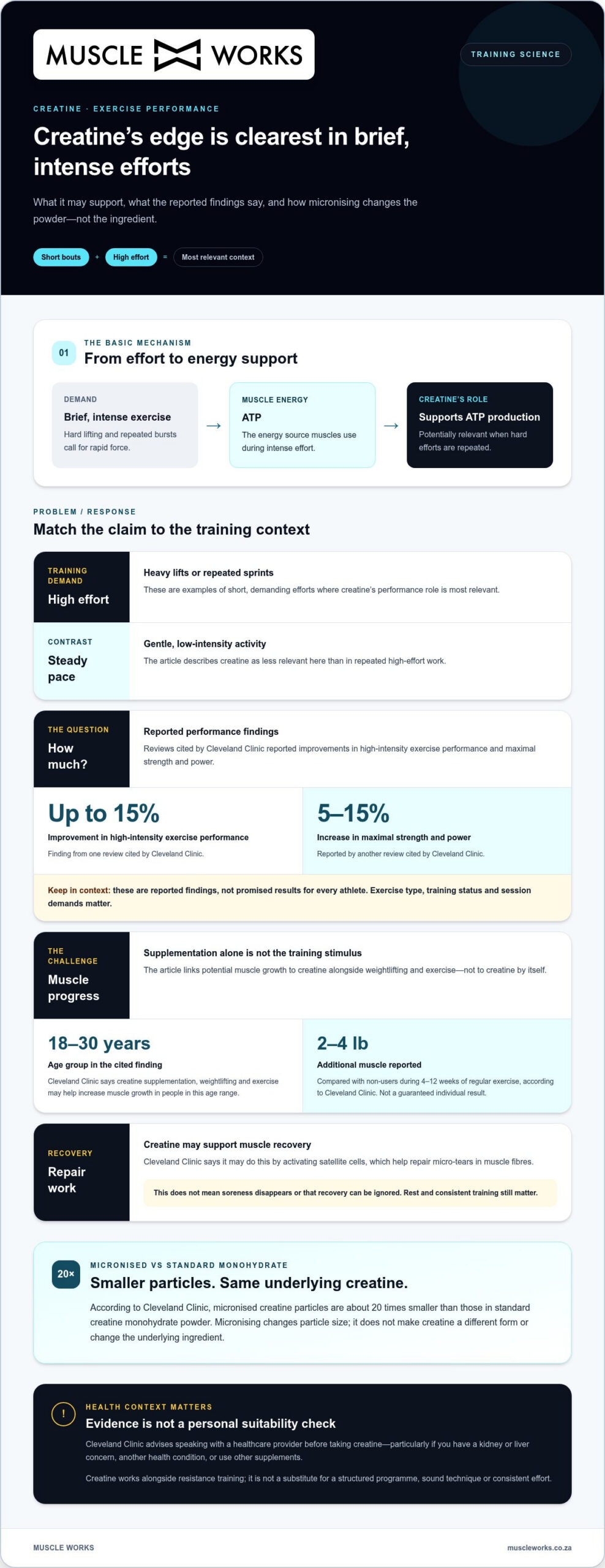
Creatine’s performance edge starts with ATP, the energy source your muscles use during intense effort. Creatine helps support ATP production, making it relevant to short, high-intensity exercise such as hard lifting. The micronized creatine benefits begin with the same creatine monohydrate, ground into particles described as about 20 times smaller than standard powder.
You want a clear answer, not hype: what creatine does, how it supports repeated bursts of effort and what micronising changes. The key distinction is simple. Micronising reduces particle size; it doesn’t change the underlying creatine or make it a different form.
This guide explains creatine’s role in ATP and intense exercise, summarises the evidence on performance and muscle, and compares micronized powder with standard monohydrate. Understand the science, then decide where creatine fits in your training and supplement routine.
Key Takeaways
- Creatine supports ATP availability during brief, intense efforts, making it most relevant to demanding lifting and repeated bursts of exercise.
- Creatine monohydrate is the form linked with exercise-performance benefits. Micronising makes its particles smaller, but doesn’t change the underlying ingredient.
- According to the Cleveland Clinic, micronized creatine particles are about 20 times smaller than those in standard creatine monohydrate powder.
- Creatine works alongside resistance training; it isn’t a substitute for a structured programme or consistent effort.
- The Cleveland Clinic advises speaking with a healthcare provider before taking creatine, particularly when health conditions or other supplements are part of the picture.
Creatine and short-term, high-intensity exercise
Creatine monohydrate is associated with better performance during short, intense resistance exercise. It is most relevant to efforts that demand rapid force, such as heavy lifting or repeated sprints.
Strength and power during intense exercise
Creatine supports the energy supply muscles use during intense exercise, helping sustain powerful efforts. That matters in sessions involving forceful lifts or repeated bursts, rather than steady, low-intensity activity. Cleveland Clinic describes creatine monohydrate as a supplement that can improve performance during short-duration, high-intensity resistance exercise.
The practical focus is training quality. Better strength and power may help you produce more output during demanding work, but creatine doesn’t replace progressive resistance training, sound technique or recovery. A hard set of lifts is a more relevant example than a gentle walk: intensity and duration shape where creatine may contribute.
Performance in short bouts of intense exercise
Creatine supplementation is linked with improved performance in high-intensity exercise, especially work built around brief, demanding efforts. One review cited by Cleveland Clinic found improvements of up to 15% in high-intensity exercise performance. Another reported a 5-15% increase in maximal strength and power with creatine supplementation.
Reported findings are not promised results for every athlete. Exercise type, training status and session demands all matter when interpreting performance. Repeated heavy lifts, for example, challenge muscles differently from sustained, easy-paced activity. Creatine’s potential contribution is most relevant when exercise repeatedly calls for high effort.
Think of creatine as support for the work, not a shortcut around it. Train consistently and judge progress through performance over time, rather than expecting one serving to transform a session. Short, intense efforts provide the clearest context for understanding its role.
Exercise performance and muscle growth
Muscle growth depends on training, and creatine may support progress by helping people perform resistance exercise. Cleveland Clinic says creatine supplementation, weightlifting and exercise may help increase muscle growth in people aged 18 to 30 years. The combination matters: supplementation sits alongside the training stimulus, rather than creating muscle growth by itself.
Cleveland Clinic also reports that creatine users may gain an additional two to four pounds of muscle during four to 12 weeks of regular exercise compared with non-users. Read that finding in context. It describes a comparison during regular exercise, not a guaranteed amount for every person or a substitute for training.
Recovery is part of the same training picture. Cleveland Clinic says creatine may help muscle recovery by activating satellite cells, which help repair micro-tears in muscle fibres. This mechanism relates to repair after strenuous exercise. It doesn’t mean soreness disappears or that you can ignore recovery. Pair demanding sessions with appropriate rest, then assess whether your strength and exercise performance are progressing.
Are creatine supplements recommended for athletes?
Athletes use creatine supplements, but suitability depends on health context and recommended use. In South Africa, a product’s sale alone doesn’t establish independent quality testing. Cleveland Clinic advises consumers to choose supplements tested by an independent party.
If you’re considering creatine, consult a healthcare provider first, as Cleveland Clinic advises. This is especially relevant if you have kidney or liver concerns, an existing health condition or use other supplements.
Kidney function and supplement safety
Kidney-function results need context when assessing supplement use, so tell your healthcare provider if you take creatine. Cleveland Clinic reports no evidence that recommended creatine use harms the kidneys in healthy people. This finding applies to healthy individuals, not automatically to everyone with a renal condition or abnormal test result.
Don’t use a test result in isolation to decide whether creatine suits you. Discuss your use, training and health history with the clinician interpreting your results. This gives them relevant information when considering kidney function and the effects of supplements.
Kidney and liver concerns
For healthy people using creatine as recommended, Cleveland Clinic says there’s no evidence of kidney or liver harm. That distinction matters: evidence about healthy users doesn’t establish suitability for someone with an existing kidney or liver condition.
If you have a diagnosed renal or liver condition, discuss creatine with your healthcare provider before starting. Share the product and how you plan to use it, along with details of any other supplements you take. This is more useful than assuming every creatine supplement has identical effects for everyone.
Safety of long-term use
Longer-term evidence offers useful context for athletes weighing regular use. The Cleveland Clinic reports that clinical trials lasting up to 5 years found no adverse effects from creatine use in healthy individuals. It also notes that more than 700 human-based studies have investigated creatine’s safety and efficacy.
For adults, the Cleveland Clinic states that a daily dose of 3 to 5 grams is safe. Keep the dose and your training routine consistent, and consider the evidence in its proper group: healthy people using creatine as recommended. A long training history doesn’t remove the need to account for personal health.
When to avoid creatine or seek medical advice
Medical advice matters before starting creatine, particularly if you have a health condition or concerns about kidney or liver function. Cleveland Clinic advises consulting a healthcare provider before taking supplements. Bring details of your intended use and other supplements, so the discussion can address your circumstances.
For healthy adults, the available safety findings relate to recommended use, not unlimited intake. Don’t treat higher doses as a shortcut for resistance or intensity exercise. If you’re comparing products, review the creatine supplement options and keep independent testing in mind.
Micronized versus standard creatine monohydrate
Micronized powder is creatine monohydrate processed into smaller particles, not a different creatine compound. When choosing a supplement, prioritise creatine monohydrate and independent testing. Cleveland Clinic recommends choosing supplements tested by an independent party.
How micronization differs from standard monohydrate
The main difference is particle size: according to the Cleveland Clinic, micronized creatine particles are about 20 times smaller than standard creatine monohydrate particles. That distinction describes how finely the powder is processed, not a proven increase in strength or exercise performance.
Both products provide creatine monohydrate. The performance evidence relates to creatine monohydrate itself; micronisation doesn’t change its identity or turn it into another form. When comparing tubs, treat particle size as a processing difference, not proof that one builds more muscle.
Creatine’s role is linked to adenosine triphosphate, or ATP, which muscles use for energy. Creatine helps support ATP availability during intense exercise, while creatine stores build with consistent intake. Particle size doesn’t alter this basic role.
Other forms deserve the same evidence-based scrutiny. Cleveland Clinic says other forms of creatine don’t appear to provide the exercise-performance benefits associated with creatine monohydrate. Don’t assume that a product labelled with a different creatine form is equivalent.
Protein and creatine serve different roles. Protein supplies amino acids used to build and repair body tissue; creatine supports energy processes linked with intense exercise. They aren’t interchangeable, so choose based on what your nutrition routine lacks rather than treating one as a replacement for the other.
Choosing a micronized creatine supplement
Start by checking the ingredient: look for creatine monohydrate, then see whether the product states that it is micronized. Check for independent testing, as Cleveland Clinic advises, and read the serving directions to make sure your intake follows the product label.
For creatine monohydrate, the stated approach is 3-5 grams per day following the loading phase. A loading approach may use approximately 20 grams a day, split into four smaller servings for five to seven days. Loading is an option, not the definition of micronized powder.
Without a loading phase, creatine stores may take up to a month to reach saturation. Consistent daily use matters more than choosing a powder solely because its particles are smaller. Compare the ingredient, testing and directions; don’t mistake a processing claim for evidence of better results.
Creatine, resistance training and age-related muscle loss
For older adults, creatine’s role is best considered alongside resistance training, nutrition and recovery. Studies examine it as support for training, not as a replacement for the work muscles need.
Muscle mass and growth
Muscle mass is the amount of muscle tissue the body carries, and resistance training provides a stimulus to maintain or build it. Age-related muscle loss makes preserving strength and function an important training goal. Creatine may support this effort alongside regular resistance exercise, but it doesn’t build muscle independently of training.
Training needs to challenge the muscles consistently. A session might include resistance exercises for major muscle groups, with the load and effort adjusted to the person’s ability. Nutrition and recovery support the work between sessions. Creatine is one possible part of that wider plan, not a substitute for sufficient food, appropriate rest or regular exercise.
One study found that participants taking creatine gained an average of 4.4 pounds (2 kg) more muscle mass than the control group. This followed a 6-week training regimen and a 3-week detraining period. The result offers a specific example of creatine use alongside resistance training, but it describes those participants and that programme. It should not be treated as a guaranteed outcome for every older adult.
Creatine and muscle growth
Creatine may contribute to muscle growth by supporting the energy system used during resistance exercise. Phosphocreatine helps replenish ATP, which muscles use during effort. This connection explains why studies examine creatine alongside training, rather than as a standalone muscle-building strategy.
Training volume matters because muscle growth follows repeated work against resistance. Maintaining output across challenging sets may help support the training stimulus. Creatine doesn’t replace progressive exercise, nutrition or consistent recovery. Track strength and the work completed over time, rather than expecting an immediate change in muscle mass.
Recovery also affects how consistently a person can train. Cleveland Clinic says creatine may help muscle recovery by activating satellite cells, which help repair micro-tears in muscle fibres. This proposed role doesn’t make rest or nutrition optional. Plan recovery as part of training instead of adding intensity whenever progress feels slow.
Kidney health remains relevant when considering supplements, particularly for people with existing health concerns. Cleveland Clinic reports no evidence that recommended creatine use harms the kidneys in healthy people. This finding concerns healthy individuals; anyone with a kidney condition should discuss supplementation with a healthcare provider before starting.
Creatine and ATP energy production
ATP is the immediate energy currency used by muscle cells during work. Creatine helps restore ATP as intense effort uses it. This explains why creatine is relevant to sports built around explosive output, repeated lifting and short, demanding bursts, rather than equally relevant to every type of exercise.
During muscle contraction, ATP releases energy and becomes ADP. Phosphocreatine can donate a phosphate group to ADP, helping regenerate ATP for another effort. During a heavy lift, muscles need rapid energy to produce force, and this recycling system helps meet that demand. It supports the energy supply; it doesn’t create energy from nothing.
Creatine is stored in the body, with much of it concentrated in skeletal muscle. According to the Cleveland Clinic, about 95% of creatine produced by the body is delivered to skeletal muscles. Those stores include free creatine and phosphocreatine, which serves as a rapidly available phosphate source during intense work.
The body also makes creatine from arginine, glycine and methionine. Food contributes too: according to the Cleveland Clinic, about half of the body’s creatine supply, or 1 to 2 grams per day, comes from food. The balance between production, diet and muscle storage shapes the creatine available for exercise.
Food alone can require a substantial portion to match a supplement serving. According to the Cleveland Clinic, getting roughly 5 grams of creatine from food would require eating roughly 1 kg of raw beef. That comparison helps explain why athletes may consider supplementation, especially when their usual diet contains little meat. It doesn’t mean food has no value.
Supplementation increases the creatine available to replenish muscle stores over time. Without a loading phase, stores may take up to a month to reach saturation. A loading phase can speed up that process, but it isn’t necessary for the underlying ATP mechanism. Consistency and training demands remain central.
For a South African athlete weighing creatine monohydrate, focus on the intended use: support for repeated high-intensity work, not a stimulant effect or a treatment for disease. Explore creatine monohydrate as an option for your training routine, and keep the distinction clear: creatine supports ATP recycling, whilst training supplies the repeated stimulus.
Muscle Works: 100% Whey Protein 1kg
Muscle Works: 100% Whey Protein 1kg is a practical option when you’re looking to add protein to your nutrition routine alongside creatine and resistance training. Creatine supports energy processes during intense exercise; protein provides amino acids the body uses to build and maintain muscle tissue. They serve different roles, so whey doesn’t replace creatine or the training stimulus.
Consider whey if your everyday meals leave a gap in your protein intake. Keep the basics in focus: consistent training, suitable nutrition and recovery. Use supplements to support those foundations, not to replace them.
Visit muscleworks.co.za to explore Muscle Works’ range.
Put your next training block into action
Make your next step deliberate. Choose a training goal, track your sessions and assess where your nutrition needs support. The potential micronized creatine benefits matter most as part of a consistent plan, not as a substitute for disciplined training or sound food choices.
Muscle Works offers options to fit different nutrition routines, including 100% Whey Protein 1kg and SUPER PROTEIN ICE COFFEE – 450g. For a broader performance-bundle option, consider the 21 Day Grow Stack, designed to support specific fitness goals. Choose based on what your routine calls for, and keep your training plan at the centre.
Ready to take the next step? Contact Muscle Works for support and keep building with purpose. Stay consistent, train with intent, and make every session count.
Frequently Asked Questions
What is creatine?
Creatine is a compound the body makes from arginine, glycine and methionine. It helps support energy processes used by muscle cells during demanding activity. About 95% of creatine produced by the body is delivered to skeletal muscles, according to the Cleveland Clinic. Food also contributes creatine, especially animal foods, whilst supplements provide another way to increase intake.
Does creatine help you lose weight?
No. Creatine isn’t a fat-loss supplement, and resistance training combined with creatine supplementation for 5-6 weeks has been shown to have no effect on body-fat levels. The scale may rise instead: some people retain a couple of pounds of fluid during the first week of supplementation. For weight management, assess body composition and training progress rather than treating a short-term scale change as fat gain or loss.
What happens when you start taking creatine?
Creatine stores build with consistent use, while some people retain a couple of pounds of fluid during the first week. This temporary scale change is not the same as gaining body fat. Without loading, stores may take up to a month to reach saturation. A loading approach can build stores sooner, but it isn’t necessary for regular creatine use.
What is the most common type of creatine supplement?
Creatine monohydrate is the standard form most commonly used in supplements. It is also the form associated with exercise-performance benefits. According to Cleveland Clinic, other forms don’t appear to provide the same benefits. When comparing products, focus on the ingredient and independent testing rather than assuming a less familiar form is more effective. Cleveland Clinic advises choosing supplements tested by an independent party.
What is micronized creatine and how does it differ from regular creatine monohydrate?
Micronized creatine is creatine monohydrate processed into smaller particles. According to the Cleveland Clinic, those particles are about 20 times smaller than particles in standard creatine monohydrate powder. The change is particle size, not a different creatine compound. This distinction helps you compare labels accurately: micronized powder remains creatine monohydrate, rather than a separate form with a different active ingredient.
What are the proven benefits of micronized creatine for strength, muscle growth and exercise performance?
Evidence for micronized creatine benefits relates to creatine monohydrate used alongside training. Research links creatine supplementation with improved high-intensity exercise performance, strength and power. Findings on muscle growth also involve regular resistance exercise, not supplementation alone. Micronising changes particle size; it doesn’t establish an additional strength or muscle-building effect beyond the evidence for creatine monohydrate.
Does micronized creatine absorb better or work faster than standard creatine monohydrate?
Smaller particles describe the size of micronized powder, but don’t by themselves demonstrate faster absorption or quicker results. Micronized and standard powders are both creatine monohydrate. Without a loading phase, creatine stores may take up to a month to reach saturation. When comparing the powders, consistent intake is a more practical consideration than the micronized label alone.
What is the recommended creatine dose and is a loading phase necessary?
The stated daily approach for creatine monohydrate is 3-5 grams per day following the loading phase. A loading approach may use approximately 20 grams a day, split into four smaller servings for five to seven days. Loading can build stores sooner, but it isn’t essential. Without it, reaching saturation may take up to a month. Follow product directions and seek medical advice before use.