

What if the smartest supplement plan after 50 is the one with fewer products, not more? Muscle building supplements for men over 50 can help fill gaps, but no powder or capsule replaces consistent resistance training and a diet you can stick to.
If you’re unsure whether to prioritise protein, creatine or a bigger stack, start by looking at your routine. Age-related changes can make building and maintaining muscle feel more demanding, while bold claims make it harder to separate useful options from unnecessary extras. Review your training, eating habits and personal needs first, then choose supplements only where they support that foundation.
This guide compares the main categories to consider, including protein and creatine, and explains how to weigh dairy-based options such as whey against plant-based protein. You’ll learn what to prioritise, what to keep in perspective and how to make a practical, safety-conscious plan without buying products you may not need. Muscle Works offers whey and plant protein, standalone creatine monohydrate and other supplement options. Keep the plan focused and build around the work you can sustain.
Key Takeaways
- Match each supplement category to a clear purpose, and weigh its potential role against its cautions rather than treating every option as equally necessary.
- Compare dairy-based and plant-based protein options against your eating habits and personal needs.
- Assess muscle building supplements for men over 50 with a step-by-step checklist, from defining your goal to reviewing your diet and training.
- Read product labels carefully, including ingredient lists, allergens, directions and relevant warnings, before making a choice.
- Build a focused shortlist from options that suit you, such as whey or plant protein, without assuming you need a larger stack.
Muscle building after 50: what supplements can, and cannot, do
Building or preserving strength after 50 is a worthwhile goal. A useful plan fits your routine, food preferences and recovery, and gives you a way to keep training consistently. Age can influence how your body responds, but it doesn’t set a single limit for every man or mean that you need supplements.
Think of dietary supplements as optional additions to training, food and recovery, not replacements for them. The US National Institutes of Health Office of Dietary Supplements explains that supplements are intended to add to the diet, rather than replace food. Its consumer guidance offers a useful foundation. A practical rule follows: supplements may help address a specific gap, but they don’t replace the training stimulus that challenges your muscles.
What changes with age, and what does not?
Muscle mass, strength and recovery can change with age, but population-level patterns don’t predict one individual’s results. Health, training history, sleep, nutrition and consistency all shape what progress may look like. Don’t assume that building muscle is impossible after 50, or that a supplement can guarantee it.
The fundamentals stay firm: progressive resistance training gives muscles a reason to adapt, while adequate nutrition and recovery support the work. Keep a simple training record of your exercises and how they feel, then progress the challenge at a pace that suits your ability and circumstances. If a health concern affects your training or diet, get advice from a qualified health professional before making significant changes.
Can supplements build muscle without training?
No. Supplements don’t replace a structured resistance-training programme. A protein powder may make it easier to add protein to your diet if food alone isn’t meeting your needs; creatine is a separate supplement category to assess for personal suitability. Neither product makes up for a lack of regular, appropriately challenging training.
Results depend on more than one product. Training quality, overall food intake, rest, health and consistency all matter. Use muscle building supplements for men over 50 to support a clear need, not as a shortcut or a guarantee. Start by identifying what your current plan is missing: for example, whether your usual meals leave a practical gap or whether you’re considering a supplement alongside regular training. If there isn’t a clear need, keep your focus on the foundations.
How protein and creatine fit into a muscle-building plan after 50
Protein and creatine are often mentioned together, but they aren’t interchangeable. Protein helps you meet your dietary needs; creatine is a separate supplement category to consider in relation to training. Neither replaces a varied diet, progressive resistance training or recovery. The National Institutes of Health Office of Dietary Supplements explains that supplements are intended to complement, not replace, a healthy diet in its What You Need to Know about Dietary Supplements guide.
Protein contributes to your body’s supply of nutrients needed to build and repair muscle, whilst creatine may support performance during repeated, short bursts of high-intensity activity. That distinction reflects guidance from the NIH Office of Dietary Supplements, which covers protein and creatine separately in its exercise and athletic performance fact sheet. Your results still depend on the wider plan, not one ingredient.
Protein powder: whey or plant protein?
Choose a protein source that fits your diet and that you’ll use consistently. Whey is dairy-based, so it may not suit someone avoiding dairy or with a milk allergy. Plant protein offers a non-dairy option, but preferences around taste, texture and how it fits into meals matter too. Compare labels for ingredients and allergens, and consider whether the product is convenient to use as part of your usual routine. Neither source is automatically the best choice for every man.
Muscle Works offers 100% Whey Protein 1kg and Iso-Tech Whey for readers considering whey, and Plant Protein 1.2kg for those who prefer a plant-based option. These are options to assess against your food intake and preferences, not age-specific solutions. If your meals already meet your needs, powder may add convenience without being essential. If your eating patterns leave a gap, it can be one practical way to supplement your diet.
Creatine monohydrate: a separate decision from protein
Protein helps supply a dietary nutrient; creatine is not a protein source. Consider creatine on its own merits and in the context of your training, health and personal suitability. Muscle Works Creatine monohydrate is an example of this standalone category. Read and follow the product label, and don’t assume adding it is necessary for progress.
If you have a health condition or take medicines, seek advice from a qualified health professional before using creatine or changing your supplement routine. The same needs-first approach applies to all muscle building supplements for men over 50: check whether a product serves a clear purpose, then keep the rest of your nutrition anchored in balanced meals. To compare the available categories, explore Muscle Works protein and creatine options.
Compare muscle-building supplements for men over 50 by purpose
Compare products by the job you need them to do, not by the size of the stack or the strength of the marketing. Protein powder, creatine monohydrate and amino-acid products are different categories. They don’t have equal evidence, and none is automatically necessary. The NIH Office of Dietary Supplements reviews protein, creatine and other performance supplements separately in its exercise and athletic performance fact sheet.
| Category | Potential role | Best-fit situation | Key caution |
|---|---|---|---|
| Protein powder | A convenient way to add protein to your diet. | Meals don’t practically meet your nutrition needs, or a shake better suits your routine. | Check the source, ingredients and allergens. It complements food, not replaces a balanced diet. |
| Creatine monohydrate | A distinct category that may support exercise performance. | You’re considering a supplement alongside regular resistance training and have assessed personal suitability. | It isn’t protein. Seek qualified advice if you have a health condition or take medicines. |
| Amino-acid products | Provide specific amino acids, depending on the product. | You have a clear reason to consider that product category. | Check the label and don’t assume it’s necessary or equivalent to protein or creatine. |
When might a protein powder be useful?
Start with your usual meals. If time, appetite or food preferences make it difficult to meet your practical nutrition needs, powder can offer convenience. Whey is dairy-based; a plant-based option may suit someone avoiding dairy. Compare ingredient and allergen information, taste and ease of fitting the product into your day. Muscle Works examples include 100% Whey Protein 1kg and Plant Protein 1.2kg. For more on the whey option, see the guide to 100% Whey Protein 1kg.
When might creatine or amino acids be considered?
Creatine and amino acids aren’t interchangeable. Creatine monohydrate is a separate supplement category, while products such as Beef Aminos and L-Glutamine sit within the amino-acid category. Their purpose and evidence shouldn’t be treated as identical. Review the product label, your diet and your training before deciding. Explore the guides to creatine monohydrate and amino-acid supplements for more category detail.
Bundles can make selection more convenient, but combining products isn’t an automatic upgrade. Compare the individual categories first and choose only what serves a clear purpose. A focused plan is easier to assess and adjust than a stack built on assumption.
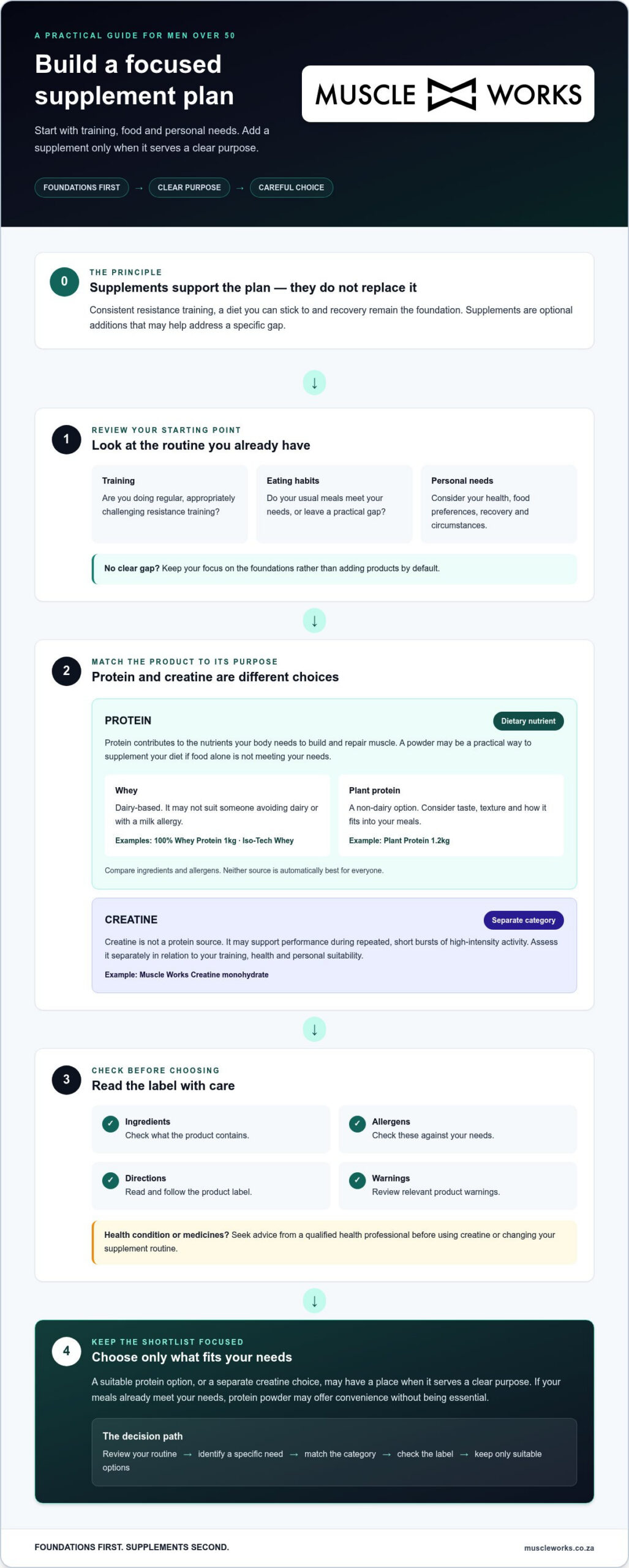
Choose muscle-building supplements after 50 with a practical checklist
Use this process to decide whether a product belongs in your plan. A supplement can’t compensate for inconsistent training, poor nutrition or inadequate recovery. Build the routine first, then look for a specific gap a product may help address.
- Define your goal. Be clear about what you want to support, such as making it easier to meet your dietary needs or considering a supplement alongside resistance training.
- Review your diet. Look at the meals and snacks you usually eat. Identify a practical shortfall before adding a product, rather than assuming you need a powder or stack.
- Assess your training. Consider whether you train consistently and progress the challenge appropriately. If training is irregular, prioritise building a routine before buying more supplements.
- Compare labels. Check ingredients, serving directions, allergen information and relevant warnings. Compare products by their contents and intended use, not by bold claims or complicated marketing.
- Decide, then review. Choose only if the product fits a clear need. Keep a record of your training and eating routine, and review whether the choice remains useful before considering anything else.
What should you check on a supplement label?
Read the full ingredient list, not just the front of the pack. Check serving directions, allergens and any warnings that may apply to you. Compare the details that matter for your intended use, and don’t assume that a longer ingredient list or louder claim means a better fit. If a detail is unclear, don’t guess about what the product contains or how to use it.
How do you avoid buying more than you need?
Start with one clearly defined need, not a complex stack. Give yourself time to follow your training and eating routine consistently before adding another product. More supplements can make it harder to judge what’s useful, and bundles are a convenience choice, not an automatic upgrade.
If you have a health condition or take medicines, seek advice from a qualified health professional before starting a supplement. That step matters when assessing muscle building supplements for men over 50, because suitability depends on personal circumstances as well as the product label. For a focused look at one category, explore our amino-acid supplement guide.
Ready to compare options against your needs? Explore Muscle Works supplement options and keep your shortlist focused.
Build a focused supplement shortlist with Muscle Works
Your shortlist may be one product, or none. Start with the need you’ve identified: if your usual meals make it difficult to meet your nutrition needs, consider a protein option; if you’re considering creatine alongside training, assess that category separately. If neither addresses a clear need, you don’t have to add a supplement. This needs-first approach keeps muscle building supplements for men over 50 practical, rather than turning your routine into an oversized stack.
Match a Muscle Works protein option to your preferences
Choose by dietary preference, tolerance and the current product label. Muscle Works offers 100% Whey Protein 1kg and Iso-Tech Whey as whey options, plus Plant Protein 1.2kg for those who prefer plant-based protein. Whey is dairy-based; a plant-based choice may suit someone avoiding dairy. Check the ingredient and allergen information, then consider which option fits comfortably into your meals and routine. These products aren’t presented as age-specific formulas, and the right fit depends on your circumstances.
If you’re comparing whey products, read the label and use the whey protein isolate guide for more context on that category. Don’t infer a product’s specific protein type or contents from its name alone. The current label is the guide to ingredients, directions and warnings.
Keep the next step simple and deliberate
Choose one starting point and follow its product directions. Creatine monohydrate may be relevant if you’ve decided to consider creatine; Beef Aminos or L-Glutamine are amino-acid category examples for readers with a specific reason to assess those products. None is an automatic add-on. If you have a health condition or take medicines, seek advice from a qualified health professional before starting a supplement.
Assess your choice alongside consistent training, food and recovery. Avoid adding more products just because progress feels slow; first review how reliably you’re following your plan. No supplement guarantees a result, but a focused choice can make your routine easier to manage.
Explore Muscle Works supplements and choose the category that fits your needs.
Build your next step around what you need
The strongest supplement plan is focused, not crowded. Start with consistent resistance training, balanced meals and recovery, then consider a product only if it serves a clear purpose. Protein powder may offer a convenient option when your eating routine needs support; creatine is a separate category to assess for personal suitability. Neither guarantees results or replaces the foundations.
For men comparing muscle building supplements for men over 50, the right shortlist may include whey or plant-based protein, creatine monohydrate, another relevant category, or no supplement at all. Muscle Works offers whey and plant-based protein options, creatine monohydrate, amino-acid products and performance bundles, alongside individual supplements. Use the product label and your needs to guide your choice, rather than assuming a bigger stack is better.
Explore Muscle Works supplements and choose a practical starting point. Keep your training consistent, make deliberate decisions and stay focused on progress you can sustain.
Frequently Asked Questions
Is whey protein suitable for men over 50?
Whey protein can be suitable for men over 50, but suitability depends on dietary needs, tolerance, health circumstances and the product label. It’s a convenient way to add protein when ordinary meals don’t meet practical needs, not a requirement or an age-specific treatment. Check the label for milk and other allergens. If you have a health condition or take medicines, seek qualified advice before use.
Can men over 50 build muscle with supplements?
Supplements may support a muscle-building plan, but they don’t build muscle independently. Progressive resistance training provides the stimulus; suitable nutrition and recovery support the work. A supplement might help address a specific dietary or performance need, but it can’t replace consistent training or adequate rest. Outcomes vary with individual health, training experience, diet and routine, so no product can guarantee muscle gain.
How much protein should a man over 50 take to build muscle?
There isn’t one protein amount that suits every man over 50. Needs can vary with body size, overall diet, training demands and health status, so a universal target may not fit your circumstances. Review your usual food intake and training before setting a goal. For a personalised protein target, especially if you have a health condition, consult a registered dietitian or qualified healthcare professional.
Is creatine safe for men over 50?
Creatine’s suitability depends on personal health circumstances, the product directions and any medicines you take, so a blanket safety claim isn’t appropriate. If you have a health condition or use medicines, discuss creatine with a qualified healthcare professional before starting. Review current evidence and the product label, and follow its directions. Treat creatine as an optional category to assess alongside your training plan, not as a required supplement.
What is the best supplement for building muscle after 50?
There’s no single best choice among muscle building supplements for men over 50. Protein powder can offer a convenient way to add dietary protein, while creatine is a different category with a potential role in training. Assess your resistance-training routine, usual diet, preferences and health circumstances before buying. Compare ingredients, allergens, directions and warnings on the current product label. The best choice may be one category, another option or no supplement.
Can plant protein help men over 50 build muscle?
Plant protein can be a dietary protein option for men over 50 and may fit a muscle-building plan when it suits their needs. Its usefulness depends on the specific product, your overall diet and personal preferences. Don’t assume every plant protein product has the same ingredients or nutritional profile. Check the label, including allergens and directions, and pair your nutrition plan with consistent resistance training.
Do men over 50 need a supplement stack to gain muscle?
No, a supplement stack isn’t automatically necessary to gain muscle. Identify a specific need before adding products, and keep progressive resistance training, suitable food and recovery at the centre of your plan. Bundles may offer convenience, but they don’t guarantee better results than selecting individual supplements. Start with a focused choice, follow product directions and consider adding anything else only if it serves a clear purpose.