

“SANAS-approved” on a supplement label sounds like a decisive quality signal. It isn’t. The phrase SANAS approved supplement brands can mislead: SANAS accredits the technical competence of testing laboratories and other bodies, not supplement brands or products. What matters is the evidence behind a product’s testing, not a badge-like claim.
It’s sensible to look for evidence before adding a supplement to your training routine. But accreditation, product registration and independent quality testing are different things, and marketing can blur the distinction. A confident claim alone doesn’t tell you what was tested, which laboratory did the work or whether the test relates to the product claim.
This guide gives you a practical framework for checking supplement quality in South Africa. You’ll learn what SANAS accreditation does and doesn’t establish, how to assess testing claims and understand the separate role of SAHPRA, then compare product categories with your training goal and routine. Whether you’re considering whey or plant protein, creatine monohydrate or another category, start with the evidence and choose what fits your needs.
Key Takeaways
- When searching for SANAS approved supplement brands, focus on verifiable testing evidence rather than a brand-level approval claim.
- Match any SANAS accreditation claim to the named laboratory or assessment body and the relevant scope.
- Read test reports carefully: they relate to the samples and parameters tested, not every aspect of product quality.
- Compare claims with supporting documents, then note what the evidence still doesn’t establish.
- Define your training goal first, then assess relevant categories such as Iso-Tech Whey, Plant Protein 1.2kg or Creatine monohydrate for fit and available evidence.
SANAS approved supplement brands: what the phrase really means
Searching for SANAS approved supplement brands can start with a common assumption: SANAS reviews supplements and gives successful brands an approval stamp. That’s not what accreditation means. SANAS assesses the competence of conformity assessment bodies, such as testing laboratories, certification bodies and inspection bodies. Accrediting a laboratory doesn’t mean SANAS approves every product that laboratory tests.
That distinction matters when you’re comparing products. A SANAS reference can be relevant evidence, but it must relate to a specific organisation, activity and scope. A logo or phrase on packaging, without a clear explanation of what was accredited, doesn’t establish brand-wide approval or prove every quality claim.
What does SANAS accreditation apply to?
Accreditation is formal recognition that a conformity assessment body is competent to carry out specified work. The South African National Accreditation System (SANAS) describes the national system behind that recognition. The key word is “specified”: accreditation applies to a defined scope, not automatically to every test, service or product linked to an organisation.
For example, a hypothetical laboratory could be accredited for a particular method of measuring protein content in a sample. That wouldn’t automatically mean it’s accredited for every other analysis, or that every product it has handled is approved. Look for the named body and the activity covered by its accreditation.
Does SANAS approve supplement brands or products?
No. Don’t treat a supplement brand or product as SANAS approved based on a logo or phrase alone. A laboratory’s accreditation concerns its competence for work within its scope. A test report records results for the sample and parameters tested. Neither, by itself, amounts to approval of a brand’s whole range or a regulator’s decision about a product.
Keep these terms separate:
- Accreditation: Recognition of a conformity assessment body’s competence for specified activities.
- Testing: Examination of a sample against particular parameters, using a stated method.
- Product registration or regulatory status: A separate matter governed by applicable South African requirements and the responsible regulator. SANAS accreditation alone doesn’t establish it.
- Brand quality claim: A claim that needs its own supporting evidence. One accredited test doesn’t verify every product, batch or quality attribute.
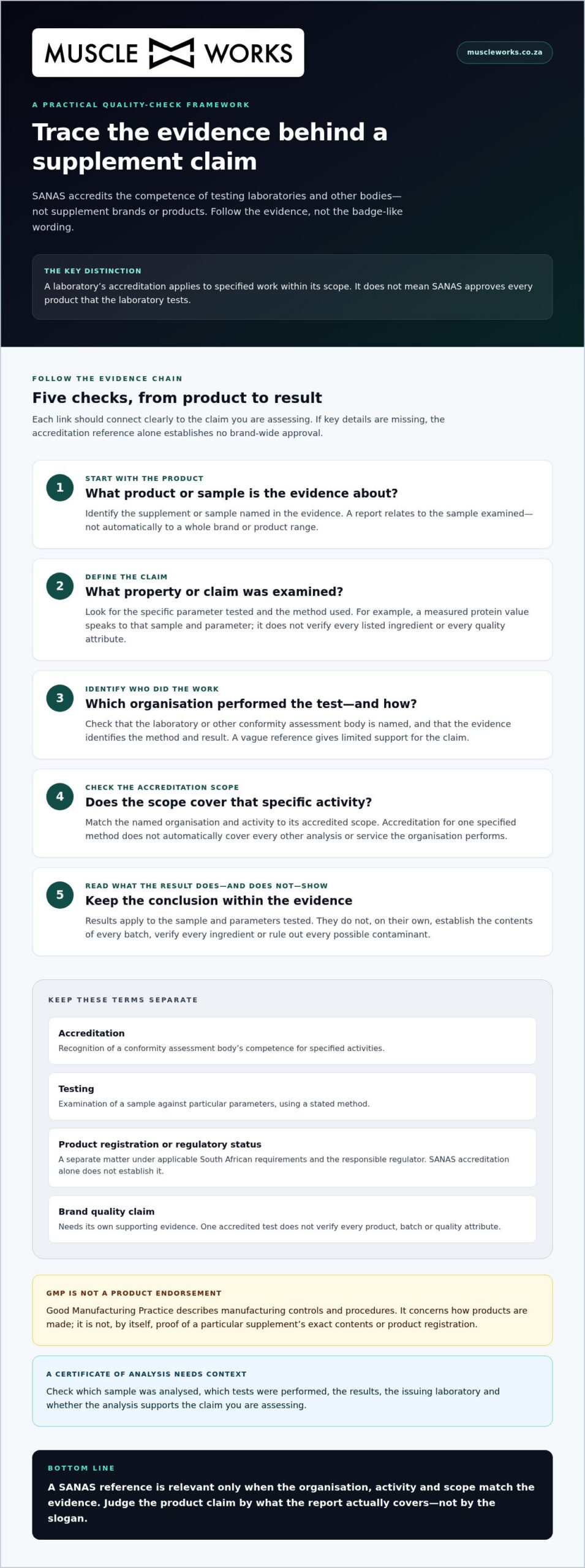
Use a precise test: Which organisation was accredited? What activity does its scope cover? Does the evidence relate to the product and claim in front of you? If those details aren’t clear, the SANAS reference alone establishes no brand-wide approval. Judge the evidence, not the slogan.
How SANAS accreditation connects to supplement testing and quality
Accreditation is one link in an evidence chain, not a shortcut to a blanket quality verdict. Start with the product and the specific claim being made. Then identify the test or assessment, the laboratory or other conformity assessment body that performed it, and whether that activity falls within the body’s accredited scope. The resulting report is evidence about that work, not automatic proof of every claim on the label.
For example, a report might record a measured protein value for a particular sample. That result speaks to the sample and parameter tested. It doesn’t, on its own, establish the contents of every batch, verify every listed ingredient or rule out every possible contaminant. Check what the analysis actually covered before deciding what it tells you.
SANAS accreditation is relevant when the organisation, method and scope match the evidence being presented. The official SANAS website explains its accreditation role and provides scope information. Don’t infer that a laboratory’s accreditation covers every service it performs. Likewise, a test performed by an accredited laboratory doesn’t make the product itself accredited.
- Product: Which supplement or sample does the evidence concern?
- Test or assessment: What property or claim was examined?
- Organisation and method: Who performed the work, and how?
- Accreditation scope: Does the body’s scope cover that activity?
- Evidence: What do the results show, and what do they leave unanswered?
This is the practical filter for anyone searching for SANAS approved supplement brands. A convincing quality claim should connect those points clearly. If a report doesn’t identify the sample, method or result, it offers limited evidence for judging that particular claim.
GMP, Certificates of Analysis and product claims
Good Manufacturing Practice (GMP) describes controls and procedures for manufacturing. It concerns how products are made, not an endorsement of a particular supplement or proof of its exact contents. Regulatory descriptions and requirements can depend on product classification and current South African rules, so don’t treat a general GMP claim as proof of product registration or a specific regulatory status.
A Certificate of Analysis (CoA) may state which sample was analysed, the tests performed and the results. Its usefulness depends on those details, the issuing laboratory and whether the analysis supports the claim you’re assessing. A CoA alone doesn’t demonstrate that every batch was tested or that every ingredient, manufacturing control or safety concern was covered.
GMP describes manufacturing controls; a product-specific analytical report records results for the sample and tests identified. They can complement each other, but answer different questions. Apply the same discipline when comparing products by category. If you’re weighing up options such as whey or creatine supplements, begin with your training goal, then assess the label and available evidence without treating a general quality phrase as a test result.
Compare supplement brands using evidence, not an accreditation slogan
Use the same evidence test for every product on your shortlist. Separate claims about manufacturing, ingredients, laboratory testing and regulatory status. Each needs different support. A document supporting one claim can’t automatically answer the others, and a polished logo is no substitute for records you can interpret.
The comparison below shows what to look for and where the limits lie. Treat an unsupported use of “approved” as unverified, not as proof that a product is approved or proof that it isn’t. Identify the organisation and evidence behind the wording before drawing a conclusion.
Claim: “Tested by a SANAS-accredited laboratory.”
Supporting document: A test report naming the laboratory, sample, method and results, alongside accreditation details.
May show: Results for the stated sample and tests, if the laboratory’s relevant scope covers the work.
Still unknown: Whether other batches, ingredients or quality attributes were assessed.
Claim: “Made under GMP.”
Supporting document: Relevant manufacturing records or evidence describing the applicable quality system.
May show: Manufacturing controls and procedures are in place.
Still unknown: The exact analytical results for a particular product or batch.
Claim: “Contains the ingredients or amounts stated on the label.”
Supporting document: Product- or batch-relevant analysis with identified tests and results.
May show: Whether the tested sample was analysed for the stated ingredients or parameters.
Still unknown: Anything not included in the analysis, or whether results apply to other batches.
Claim: “Registered” or “compliant.”
Supporting document: Relevant regulatory documentation for the specific product or activity, where applicable.
May show: A particular regulatory status, if the record clearly identifies what it covers.
Still unknown: Laboratory competence or independent verification of every label claim.
A practical checklist for checking an accreditation claim
Start with the exact wording. Note the named laboratory or assessment body and any accreditation number shown. Then use SANAS’s official directory or records to look up the organisation and review its current status and scope. Match the scope to the claimed test or assessment, not just to the organisation’s name. If the evidence doesn’t identify the body or activity clearly, you can’t reliably connect the claim to accredited work.
Which product-quality documents deserve attention?
Look for documentation that relates to the product or batch you’re considering, such as a dated Certificate of Analysis. Check that it identifies the sample, relevant tests or methods, and results in clear terms. A generic certificate may not establish that a particular batch was analysed. Documents not published online don’t, by themselves, prove that a product is unsafe or poor quality; they simply leave you with less public evidence to assess.
For anyone comparing SANAS approved supplement brands, keep the checks distinct: manufacturing evidence describes process controls, analytical evidence reports test findings, and regulatory records address a separate status. Judge each claim by the document that actually supports it.
Choose a supplement by evidence and training goal
Quality evidence helps you assess a product, but it doesn’t decide whether that product belongs in your routine. Start with the outcome you’re working towards, then choose a category that makes sense for your diet, training and day-to-day habits. Only then compare labels and supporting information. This keeps the decision practical, rather than driven by a certification phrase or a promise of guaranteed results.
Use this sequence:
- Define your goal. Be specific about what you want the supplement to help you do.
- Select a relevant category. Consider protein, creatine or amino acid products according to their intended use.
- Inspect the evidence. Read the label and assess available documents for the claims they actually support.
- Compare practical fit. Consider serving directions, ingredients, dietary preferences and whether the product fits your routine.
Supplements don’t replace consistent training, a suitable overall diet or individual medical advice. If you have a health condition, take medication or are unsure whether an ingredient is appropriate for you, seek advice from a qualified health professional.
Match the supplement category to your objective
Protein powders, including whey protein and plant protein, are categories to consider when you’re looking at ways to supplement dietary protein. Compare the product’s ingredients and serving directions with your own needs. For more detail on the protein category, explore this 100% Whey Protein 1kg guide.
Creatine monohydrate is a distinct category, not a substitute for protein. Amino acid products are another category, with their own ingredients and intended use. Don’t assume a product suits your goal just because it sits in a performance range. Review the label and use the relevant creatine monohydrate guide or amino acid supplements guide to compare categories.
Compare the label and evidence before choosing
Read the full label, not just the front-panel headline. Check the ingredient list, serving directions, warnings and product identity. Then compare the stated purpose with your objective. A document may support one specific claim without establishing every attribute of the product, and evidence requirements can differ depending on what’s being claimed.
- Ingredient fit: Do the listed ingredients align with the category and your dietary preferences?
- Clear directions: Are serving instructions and warnings easy to find and understand?
- Relevant evidence: Does any available analysis identify the product or sample, the tests performed and the results?
- Claim boundaries: Does the evidence support the exact claim, rather than a broader promise?
A suitable product category is a matter of fit. It isn’t proof of accreditation, a safety guarantee or a promise of results. If you’re comparing options, explore supplement categories at Muscle Works and assess each against your goal, label and available evidence, not the phrase “SANAS approved supplement brands”.
How to assess Muscle Works supplements with the same framework
Apply the same standard to every brand, including Muscle Works: begin with your training objective, identify the product category, read the label, then assess any supporting evidence against the claims being made. This gives you a consistent way to compare options. It doesn’t assume a product has a particular accreditation or certification, and it doesn’t treat a slogan as proof.
Keep the questions distinct. Does the category fit what you’re looking for? Does the label clearly explain the ingredients and directions? Does any document support the specific claim you want to assess? A document about one test or manufacturing process doesn’t automatically answer every question about a product.
Compare Muscle Works product categories by intended use
Muscle Works offers different categories to consider against your own priorities. Iso-Tech Whey is a whey protein option; Plant Protein 1.2kg is a plant protein option. Compare their labels and serving directions with your dietary preferences and routine rather than assuming the categories are interchangeable.
Creatine monohydrate is a separate category. Beef Aminos and L-Glutamine are listed as amino acid products. Treat each as a distinct option, and assess its ingredients and label information on their own terms. A category name alone doesn’t establish superiority, purity, independent testing, individual suitability or a guaranteed training outcome.
Take the next step with a clear standard
Before choosing, use this quick check:
- Objective: Identify the role you want a supplement to play in your routine.
- Category: Compare protein, creatine or amino acid options according to that objective.
- Label: Review product identity, ingredients, serving directions and warnings.
- Evidence: Check what any available documentation covers, and don’t stretch its meaning beyond the stated tests or claims.
That last step matters. If a product claim refers to testing or accreditation, establish exactly what organisation, activity, sample or product the evidence concerns. The words “SANAS approved supplement brands” don’t replace that check, and the presence or absence of public documentation alone shouldn’t be treated as a complete verdict on product quality.
Choose with discipline: compare the label and relevant evidence against your priorities, then decide whether the category fits your training goal and routine. Explore the Muscle Works online range to compare its protein, amino acid and creatine options, and make your selection on product fit rather than an accreditation slogan.
Make your next supplement choice count
Build a buying standard you can use beyond this search. Decide what role a supplement should play in your routine, then choose based on clear product information and evidence that genuinely relates to the claim. That approach cuts through persuasive wording and keeps your attention on what matters for your training.
The phrase SANAS approved supplement brands may attract attention, but it shouldn’t make the decision for you. Look for specifics, weigh what the available documents establish, and choose a category that fits your objective and preferences. Consistency in training, nutrition and sensible choices matters more than chasing a badge.
Muscle Works is a South African sports supplement brand serving customers nationally, with whey and plant protein, amino acids, creatine and performance bundles in its range. Explore the options, compare their product information with your priorities, and take the next step with purpose.
Explore the Muscle Works supplement range and choose your next move with confidence.
Frequently Asked Questions
Are there any SANAS approved supplement brands in South Africa?
Not in the sense of brands formally approved by SANAS. The phrase “SANAS approved supplement brands” confuses accreditation with product or brand approval. SANAS accredits conformity assessment bodies for specified activities; it doesn’t endorse a supplement brand’s entire range. If a brand refers to SANAS, look for the named organisation and the evidence behind the claim. Then check exactly what that evidence covers before using it to compare products.
Does SANAS approve or register dietary supplements?
No. SANAS accreditation and supplement regulatory status are separate matters. SANAS assesses the competence of conformity assessment bodies, whilst South African health-product regulation is handled by the relevant regulator, including SAHPRA where applicable. Don’t assume that a laboratory’s accreditation means a supplement is registered, or that a product’s regulatory status proves a specific test result. For a particular product, check current official regulatory information and the precise category or claim involved.
How can I check whether a supplement laboratory is SANAS accredited?
Search the SANAS directory or official records using the laboratory’s exact legal or trading name. Compare the listing with the details shown on the test report, and check that the accreditation is current and its scope includes the relevant test or method. A laboratory may hold accreditation for some activities but not others. If the report names a different organisation, verify that body separately rather than relying on the supplement seller’s wording.
Is a Certificate of Analysis proof that a supplement is safe?
No. A Certificate of Analysis (CoA) can provide useful results for the sample and tests it identifies, but it isn’t a universal safety guarantee. Check whether the document identifies the product or batch, date, tests and results. For example, a report measuring one ingredient doesn’t necessarily assess allergens, contaminants or other ingredients. A CoA also can’t establish that a different batch has the same results unless that batch was assessed.
Are GMP and SANAS accreditation the same thing?
No. Good Manufacturing Practice (GMP) concerns procedures and controls used during manufacturing. SANAS accreditation concerns a conformity assessment body’s competence for specified activities. One relates to how a product is made; the other relates to the body performing an assessment or test. A manufacturer’s GMP claim doesn’t itself verify a product’s exact composition, whilst a laboratory’s accreditation doesn’t establish how a supplement was manufactured.
Can an imported supplement be trusted if it is sold in South Africa?
Not on that fact alone. A product’s country of origin or presence on a local sales platform doesn’t establish its contents or suitability. Check that the packaging is intact and the product identity, ingredients, batch details and expiry information are clear. Look for a traceable manufacturer or importer and documentation that relates to the product in hand. If you’re unsure about an ingredient or health risk, seek advice from a qualified health professional.
What should I check on a supplement label before buying?
Check the product name and type first, then read the full ingredient list rather than relying on front-label claims. Review serving directions, warnings, allergen information where provided, and batch or expiry details. Compare the stated serving with how you plan to use the product, and consider whether the ingredients fit your dietary needs. If a label makes a testing or accreditation claim, look for specific supporting information rather than treating the wording as proof.