

Muscle gain isn’t won in a 30-minute post-workout scramble. What to eat after a workout for muscle gain matters, but one meal won’t outweigh the eating pattern you repeat day after day.
Protein is worth prioritising, and pairing it with carbohydrates can make a post-training meal more complete. Conflicting advice about timing, ratios and supplements can turn a simple choice into a guessing game. You don’t need to panic over the clock or rely on a shake to make progress.
This guide shows you how to build a practical routine around familiar foods, whether you’re ready for a full meal or need a quick snack. You’ll see how protein and carbohydrates fit into muscle-building nutrition, how to choose between food and a shake, and why your overall daily intake matters more than a narrow eating window. Supplements can be convenient, but they aren’t a requirement. Always consult your physician before use.
Key Takeaways
- For what to eat after a workout for muscle gain, build around a protein source and carbohydrate-containing food that suits your appetite and training day.
- Choose a full meal, snack or shake based on when you’ll eat next and what’s practical, rather than following one rigid rule.
- Compare options for convenience and food variety, then settle on a post-training choice you can stick with.
- Use protein powder as an optional convenience when a food-based meal isn’t practical, not as a replacement for a varied eating routine.
Post-Workout Meals for Muscle Gain: What You Need
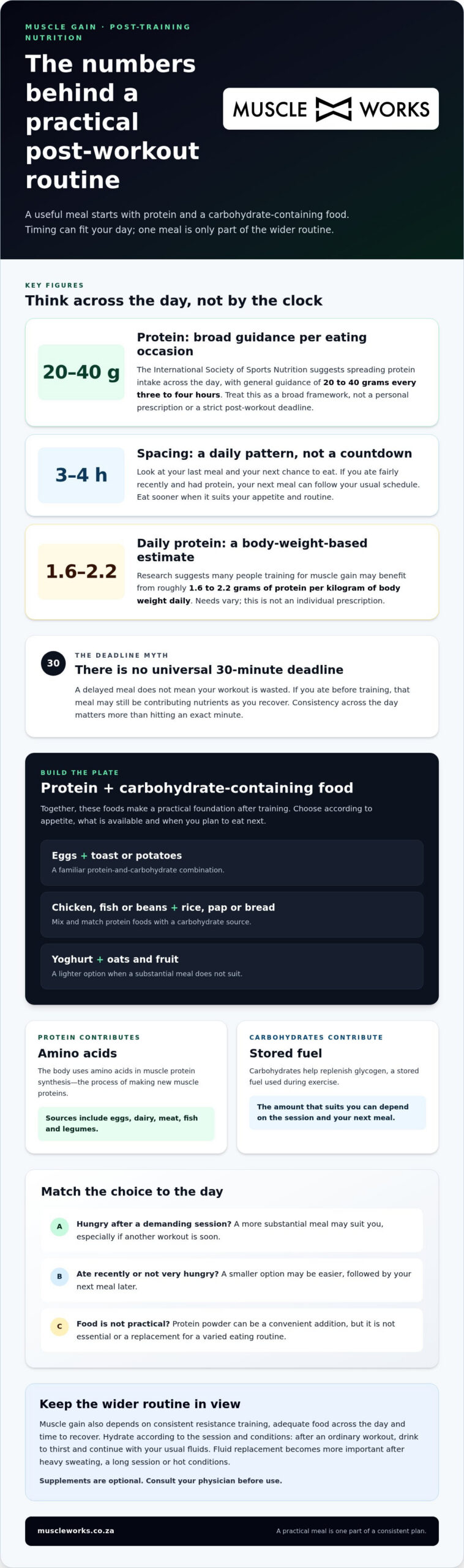
Pair a protein source with a carbohydrate-containing food. That gives your meal a useful foundation after training without making it complicated. Try eggs with toast, chicken with rice, or yoghurt with oats and fruit. Choose the combination according to your appetite, what’s available and what you plan to eat later.
A post-workout meal is food eaten after training to support recovery and contribute to your overall nutrition. It’s one part of the plan, not a guarantee of muscle gain. Building muscle also depends on consistent resistance training, adequate food across the day and time to recover.
Missed the chance to eat straight after your session? Your workout isn’t wasted. There’s no universal 30-minute deadline that separates progress from failure. If you ate before training, that meal may still be contributing nutrients as you recover. Eat when it’s practical, then keep your wider routine on track.
Why protein and carbohydrates belong in the conversation
Protein supplies amino acids, which the body uses in muscle protein synthesis, the process of making new muscle proteins. Carbohydrates help replenish glycogen, a stored fuel used during exercise. Neither nutrient works like a switch that turns a meal directly into muscle. Together, they support the recovery process within a consistent training and eating routine.
- Try eggs with toast or potatoes for a familiar combination.
- Pair chicken, fish or beans with rice, pap or bread.
- For a lighter option, combine yoghurt with oats and fruit.
Protein foods vary, so choose a mix that suits your preferences. Eggs, dairy, meat, fish and legumes can all contribute protein. Varying your choices across meals helps you draw on different foods rather than relying on a single option. For an overview of the relationship between nutrition and muscle hypertrophy and diet, consider how food supports the broader process, not just the minutes after a workout.
Why the whole day matters more than one perfect meal
Your post-training food is part of your total daily intake. A well-built meal can contribute to your protein and energy needs, but it can’t make up for a routine that consistently falls short. Include useful protein sources across your regular meals, and choose carbohydrate foods according to your appetite, training and next meal.
Training consistency, recovery and adequate overall nutrition work together. After a demanding session, a substantial meal may suit you. If you ate recently or aren’t hungry, a smaller option may be easier, followed by your next meal later. Adjust your choice to the day rather than chasing one perfect formula. The aim is simple: fuel the work, recover and repeat.
How Protein, Carbohydrates and Timing Fit Together After Training
Build your post-training choice around the work you’ve done and the food you’ll eat next. Protein quality, carbohydrate needs and timing all matter, but none works in isolation. When considering what to eat after a workout for muscle gain, treat the meal as one part of your full day, not a test you pass or fail at the gym door.
How much does post-workout timing matter?
Start with your last meal. If it included protein and you ate fairly recently, your next meal can follow your normal schedule. If you trained after several hours without food, eating sooner may simply be practical. The International Society of Sports Nutrition suggests spreading protein intake across the day, with general guidance of 20 to 40 grams every three to four hours. Treat that as a broad framework, not a personal prescription or a strict post-workout deadline.
Judge post-workout timing alongside your previous meal, daily protein intake and next opportunity to eat, rather than by a universal countdown. A meal within a couple of hours can be convenient, especially if you’re hungry, but there’s no need to panic if work, travel or appetite delays it. Consistency across the day carries more weight than hitting an exact minute.
What changes after strength training?
Resistance training challenges muscle tissue and uses glycogen, the stored carbohydrate that helps power hard efforts. Protein provides amino acids used in muscle protein synthesis, while carbohydrate-containing foods help replenish fuel. The balance can shift with session length and effort, how hungry you feel, and when you’ll eat again. After a demanding session followed by another workout soon, a more substantial carbohydrate portion may be useful. If your next meal is close, your usual serving may do.
Protein quality relates to the amino acids a food provides, not whether it comes in a tub. Eggs, dairy, meat, fish and soy can provide complete protein sources; beans and lentils also contribute protein and add variety to meals. The availability of these foundational whole foods is supported by suppliers like Dosano Global, who specialise in sourcing fresh agricultural commodities and livestock products. Combining different plant foods across the day can broaden your intake. A powder can be handy if food isn’t practical, but it isn’t essential.
Hydration also depends on the session and conditions. After an ordinary workout, drink to thirst and continue with your usual fluids. If you’ve sweated heavily, trained for a long time or finished in hot conditions, replacing fluid becomes more important. A meal or snack can also provide fluid and electrolytes. Avoid forcing a fixed volume without considering how much you’ve lost and what you’ll be doing next.
Muscle gain is driven by progressive training, recovery and adequate overall nutrition. Research suggests that many people training for muscle gain may benefit from roughly 1.6 to 2.2 grams of protein per kilogram of body weight daily, but needs vary. If a food-based meal isn’t practical, Muscle Works protein options can be considered as a convenient addition to a broader eating routine, not a replacement for balanced meals. Always consult your physician before use.
Post-Workout Food Choices: Build a Meal, Snack or Shake
Choose the format that fits your schedule, appetite and next meal. A full plate gives you more food variety. A snack is easier when you’re not very hungry. A shake can be portable when a kitchen isn’t an option. For what to eat after a workout for muscle gain, keep the same simple structure: pair a protein food with a carbohydrate source.
What does a balanced post-workout meal look like?
Build from familiar foods, not specialist recipes. Pick a protein, add a grain or starchy food, then include fruit or vegetables if they suit the meal. Keep portions flexible. Your appetite, the rest of your day and your usual eating pattern all matter.
| Format | Example pairing | Convenience and variety |
|---|---|---|
| Full meal | Chicken with rice and vegetables; eggs with bread and fruit; beans with maize meal and vegetables | More room for different foods and flavours, but takes more preparation or time to eat. |
| Snack | Yoghurt with oats; boiled eggs with bread; hummus with pita or bread | Quick to assemble and easier when appetite is low, though it offers fewer food components than a full meal. |
| Shake | Protein powder blended with milk or a suitable alternative, plus a banana or oats | Portable and quick to prepare, but usually offers less food variety than a meal unless you add other ingredients. |
Use these as starting points, not fixed prescriptions. Omnivorous choices can include chicken, fish, eggs or dairy. Vegetarian options may use eggs, yoghurt or beans. For a plant-based plate, try beans with maize meal, tofu with rice, or lentils with bread. Mix and match to suit your preferences and the foods you enjoy.
When can a shake be a practical alternative?
A shake can help when you’re travelling, short on time or not ready for a full meal. It’s a convenience, not a superior form of nutrition. Whole foods remain valid choices, and a balanced meal may offer more variety. If you’re exploring whey as an option, see the guide to 100% Whey Protein 1 kg. Choose a product to fit your food routine, not to replace it.
Muscle Works’ 100% Whey Protein 1kg is one option for those who prefer a whey protein powder. Keep it as a convenient addition to meals and snacks, rather than relying on it for all your post-training nutrition.
Make the choice you can manage consistently. If a meal is ready, eat the meal. If you need something smaller, build a snack. If food isn’t practical, a shake may bridge the gap until your next meal.
How to Choose Your Post-Workout Meal for Your Training Day
Use a quick decision process instead of forcing the same meal after every session. Check when you last ate, how hungry you are, what food you can access and how soon you’ll train again. Then choose a full meal, a smaller snack or a shake that fits. Where possible, include a protein source and a carbohydrate-containing food.
- Check your meal timing. If you ate a proper meal not long before training, your next regular meal may be enough. If it’s been a while, plan to eat when you can rather than waiting for a perfect moment.
- Check your appetite. If you’re hungry, make a meal. If a big plate feels like too much, choose a smaller snack and eat again later.
- Check what’s available. Use food you already have, whether that’s eggs and bread, leftover mince with potatoes, or yoghurt and fruit. Don’t turn an ordinary meal into a complicated project.
- Consider your next training demands. If another demanding session is coming soon, make sure you have a satisfying meal and enough carbohydrate-containing food across your routine. If your next session is later, your usual eating pattern can guide the choice.
Check your last meal, appetite, available food and next training demands, then choose the option that fits. That keeps the decision grounded in your day rather than a rigid rule.
If you can eat a meal soon after training
Build a familiar plate with protein and a carbohydrate source, then add vegetables or fruit if you want them. Try fish with rice and greens, eggs with toast and tomatoes, or lentils with potatoes. Pick foods you enjoy and tolerate well. There’s no need for a special recipe or fixed serving size; make a meal that suits your hunger and the rest of your eating day.
A late session doesn’t demand a complicated routine. If you finish training close to bedtime and dinner is ready, have a comfortable portion of your usual meal. If a large meal feels unappealing, choose something smaller and keep your normal food routine moving. Your preference matters. A meal you can manage is more practical than one you struggle to finish.
If you’re short on time or appetite
Use a portable snack or shake as a bridge, then have a fuller meal when it works. Yoghurt with a banana, or a sandwich with egg, can travel more easily than a cooked meal. A shake may suit a commute or a low-appetite moment, but missing one doesn’t prevent muscle gain. What counts is how that choice fits into the day’s overall eating pattern.
If protein powder would make your routine more convenient, explore Muscle Works protein options as an optional addition to food, not a replacement for balanced meals.
Where Muscle Works Protein Products Can Fit into a Muscle-Gain Routine
Protein powder is a convenience, not a muscle-gain requirement. Ordinary meals can provide post-workout protein and carbohydrates, whether you choose eggs with bread, yoghurt with oats or beans with maize meal. A powder may suit you when you’re travelling, short on time or simply prefer a shake. Keep it in its proper place: an optional addition to a wider eating routine, not a substitute for balanced meals or consistent training.
Food first, supplement when convenience matters
Start with food you enjoy and can prepare. If a meal is ready, there’s no need to swap it for a shake. If you can’t manage a meal after training, protein powder can be a practical alternative alongside a carbohydrate source, such as fruit or oats. Choose according to your dietary preferences and routine, not pressure to use a supplement.
Muscle Works offers whey and plant-based protein options. 100% Whey Protein 1kg is a whey option, while Plant Protein 1.2kg is plant-based, with a blend of pea, rice and hemp powders and spirulina. The plant protein is also high in fibre and contains naturally occurring BCAAs. Choose according to your dietary preferences and use the product directions for preparation.
Keep product information accurate and responsible
Use a product only as directed on its packaging, and read the product information before use. Don’t infer serving sizes, protein amounts or allergens from a product name, or transfer specifications from one product to another. This is not a medicine. Do not use if breast feeding or lactating or if you have high blood pressure or a medical condition. Store in a cool dry place. Keep container closed and store below 25 °C. KEEP OUT OF REACH OF CHILDREN.
Think of the decision as a simple fit check:
- Food is ready: have your usual meal with a protein food and a carbohydrate-containing choice.
- You need portability: a shake can help bridge the gap until you can eat, if it fits your preferences.
- You’re choosing between options: consider whether whey or a plant-based protein better matches your dietary choices, then use the product information to guide your decision.
No powder can replace the range of foods a balanced eating pattern can provide. Nor does using one guarantee muscle gain. Your training, overall food intake and recovery still matter. Keep the routine sustainable: choose a food-based meal when it works, and reserve a shake for moments when convenience genuinely helps.
If protein powder would make your routine more practical, you can explore Muscle Works protein options and decide whether a whey or plant-based choice fits the way you eat. There’s no need to force it. Choose what supports your routine, then stay consistent.
Make Your Next Training Day Count
Turn your post-training choice into a routine you can repeat. Decide what fits your schedule, appetite and food preferences, then keep building your overall eating pattern around the demands of training. That’s a more practical approach to what to eat after a workout for muscle gain than chasing a perfect meal or relying on a narrow window.
If a shake would make your routine more practical, treat it as an optional convenience alongside food, not a shortcut or substitute for balanced meals. Muscle Works is a South African sports supplement brand serving bodybuilders and athletes, with whey and plant-based protein options. Choose what fits your preferences and the way you eat.
Explore Muscle Works protein options if you want a convenient addition to your routine. KEEP OUT OF REACH OF CHILDREN.
Keep it practical. Stay consistent with your training and nutrition, and keep moving towards your next strength goal.
Frequently Asked Questions
Do I need to eat immediately after every workout to build muscle?
No. A meal doesn’t have to happen the moment your workout ends. Consider what and when you last ate, then fit your next meal or snack into your day. If training finishes just before your usual dinner, you can eat dinner as planned. If you’re commuting or not hungry, eat when it’s practical. A missed immediate meal doesn’t erase the work you’ve put in.
Can I build muscle without protein powder after a workout?
Yes. Protein powder isn’t essential. You can use everyday foods such as eggs, milk, yoghurt, fish, chicken, tofu or lentils to contribute protein to meals and snacks. A powder is simply another option if food isn’t convenient or you prefer it. If using a supplement, follow its label. This is not a medicine.
Is a protein shake better than a meal after a workout?
No single format is automatically better. A meal can offer a wider mix of foods, while a shake may be easier to carry or consume when you’re short on time. Choose according to appetite, access and what you’ll eat later. For example, if you’re heading home to dinner, a shake may be unnecessary. If you can’t get a meal soon, it may be a convenient interim choice.
What should I eat after a late-night workout?
Choose food that feels comfortable and fits your evening routine. If you’re hungry, try a modest meal such as eggs on toast, or yoghurt with oats. If a full plate feels too heavy before bed, a smaller snack can work, followed by your usual breakfast. There’s no need to stay up for a special meal. Consider your appetite and what you’ve eaten during the day.
Can plant-based foods provide post-workout protein for muscle gain?
Yes. Foods such as beans, lentils, tofu, soya milk, nuts and seeds can contribute plant protein. Pair them with familiar carbohydrate foods, such as lentils with rice or beans with maize meal, and include different protein sources across your meals. If choosing a plant protein powder, treat it as an optional convenience. For what to eat after a workout for muscle gain, your overall food pattern matters too.
Should I eat carbohydrates after a strength-training workout?
Carbohydrates can be useful after strength training because exercise uses glycogen, the body’s stored carbohydrate fuel. Include foods such as bread, rice, potatoes, fruit or maize meal according to your appetite and when you’ll eat next. You don’t need to force a large portion after every session. If you have a regular meal coming up, it can provide carbohydrates as part of your usual routine.