

Chugging raw powder twenty minutes before gripping a barbell won’t instantly power your heavy working sets. Acute bloodstream spikes don’t fuel explosive contractions; chronic intramuscular saturation does. If you demand peak physical performance, knowing when is the best time to take creatine separates wasted scoops from relentless progression on the platform.
You’ve likely waded through endless forum threads debating pre- versus post-workout timing. You’re sick of conflicting bro-science, terrified of wasting supplements through poor absorption, and fed up with stomach-churning cramps caused by reckless dosing. It stops now. You’re about to discover the exact scientific timing protocols needed to maximise cellular uptake, sustain peak intramuscular saturation, and trigger explosive lifts without digestive distress.
From insulin-mediated transport mechanics to definitive daily dosing schedules for both training sessions and rest days, this is your uncompromising guide to accelerated recovery, dense lean mass, and raw strength.
Key Takeaways
- Chronic intramuscular saturation dictates raw power output, making daily cellular replenishment far more critical than treating the compound as an acute stimulant.
- Clinical evidence confirms post-workout ingestion exploits exercise-induced hyperaemia and insulin spikes, driving superior muscular uptake compared to pre-training dosing.
- Discover precisely when is the best time to take creatine across training sessions and rest intervals to eliminate guesswork and prevent digestive distress.
- Master whether an aggressive five-to-seven-day loading phase or a steady maintenance protocol fits your specific muscle-building timeline.
- Pair pure micronised creatine monohydrate with rapid-acting proteins to trigger immediate cellular transport and accelerate lean tissue repair.
The Science of Creatine: Why Daily Cellular Saturation Trumps Acute Timing
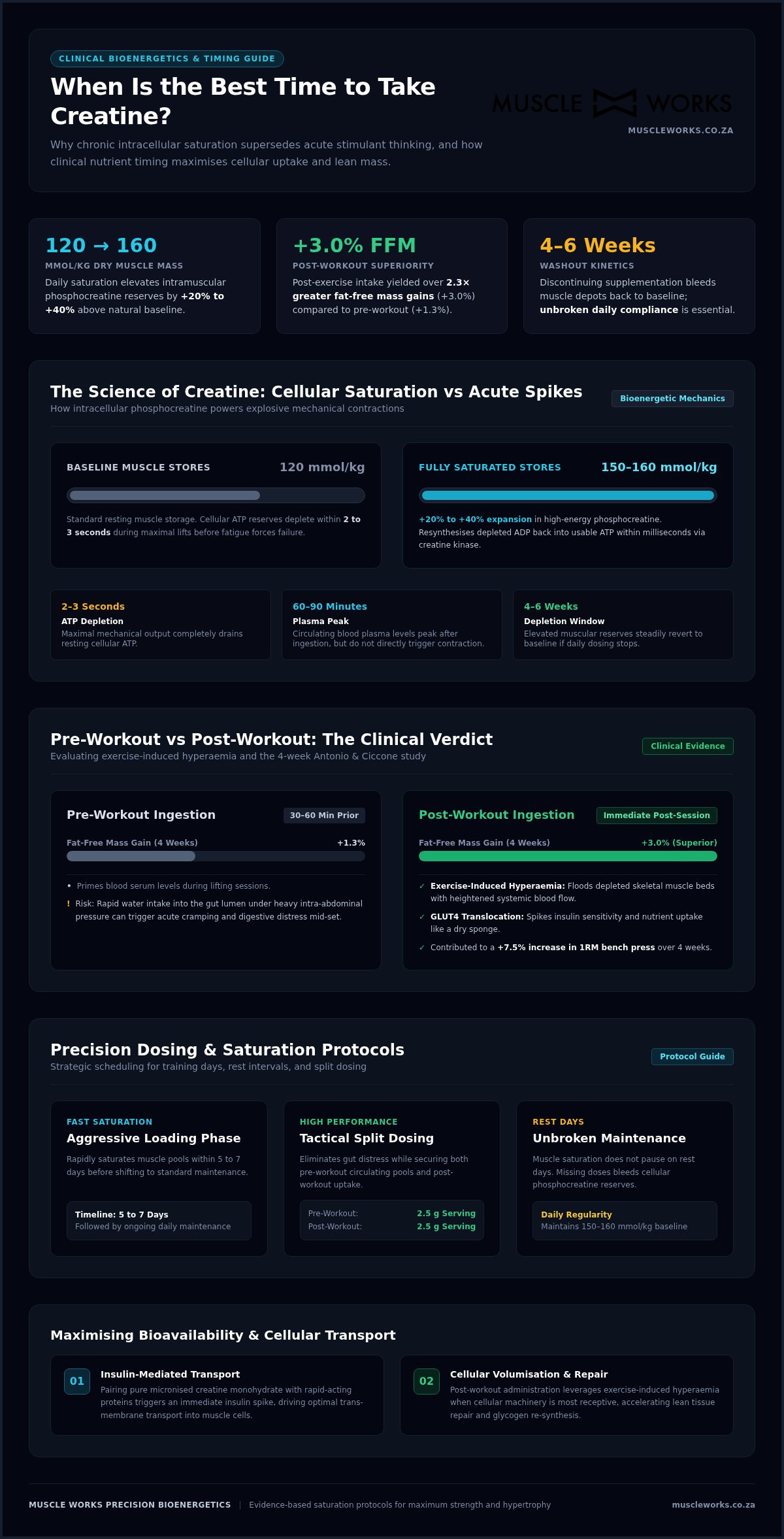
Athletes obsess over when is the best time to take creatine, yet most completely misunderstand the underlying bioenergetics. Creatine is not an acute stimulant; it is an intracellular fuel reserve. Your skeletal muscle tissue holds roughly 120 mmol/kg dry muscle mass at baseline. Daily supplementation elevates this pool up to 150 to 160 mmol/kg, unlocking a 20% to 40% surge in cellular energy potential. Missing doses bleeds this reserve dry. Acute nutrient timing provides an elite finishing edge, but absolute intramuscular saturation does the heavy lifting.
How Phosphocreatine Powers Explosive Muscular Contractions
Heavy iron drains cellular adenosine triphosphate (ATP) within two to three seconds of maximal mechanical effort. Once ATP cleaves a phosphate group to become adenosine diphosphate (ADP), muscular contraction stalls. Intracellular phosphocreatine donates a high-energy phosphate molecule via the creatine kinase reaction, resynthesising depleted ADP back into usable cellular ATP within milliseconds. Scientific analysis of cellular energy and phosphocreatine synthesis proves that elevated resting stores directly dictate training density. Expanding these cellular depots yields immediate mechanical dividends: grinding out two extra reps on heavy squats, sustaining peak power across brutal working sets, and forcing greater hypertrophic adaptations.
Cumulative Saturation Versus Immediate Acute Stimulation
Creatine yields zero acute central nervous system stimulation. It delivers no sudden vascular pump, no skin-crawling beta-alanine tingle, and no caffeine-driven adrenal spike. Circulating blood plasma levels peak roughly 60 to 90 minutes after ingestion, but serum creatine cannot contract a muscle fibre. Performance gains demand deep, chronic intracellular retention.
Evaluating when is the best time to take creatine is pointless if your daily dosing habits are erratic. Consider these physiological facts:
- Intracellular storage: Performance correlates with tissue saturation, not circulating plasma spikes.
- Washout kinetics: Discontinuing intake drains elevated phosphocreatine reserves back to baseline within four to six weeks.
- Daily compliance: Unbroken daily intake maintains saturated muscular depots regardless of whether you train that afternoon or rest.
Pre-Workout vs Post-Workout: Analysing the Anabolic Window
Pinpointing when is the best time to take creatine around your lifting sessions comes down to raw physiological mechanics. While saturation dictates baseline efficacy, post-exercise administration consistently delivers an edge in clinical literature. Exhausted muscle fibres act like dry sponges. Resistance training triggers robust exercise-induced hyperaemia, flooding skeletal muscle beds with elevated blood flow. This systemic rush shuttles circulating compounds directly into depleted tissue beds when cellular machinery is most receptive.
The Argument for Post-Workout Ingestion
Mechanical tension and glycogen depletion translocate GLUT4 transporters to the muscle cell surface. This spike in insulin sensitivity creates an optimal window for nutrient uptake. Clinical findings highlighted in the International Society of Sports Nutrition position stand on creatine validate that post-workout co-ingestion enhances tissue retention. Research by Antonio and Ciccone demonstrated that consuming creatine immediately post-workout yielded superior body composition outcomes (+3.0% fat-free mass versus +1.3% pre-workout) and a 7.5% increase in 1RM bench press over four weeks. Ingesting creatine straight after a brutal session leverages systemic blood flow, driving rapid cellular volumisation.
Evaluating the Pre-Workout Dosing Strategy
Ingesting powder thirty to sixty minutes before hitting the floor ensures peak serum levels during training. Some lifters prefer this routine for mental focus. However, downing heavy, unbuffered doses right before heavy compound movements poses distinct risks. Drawing water rapidly into the gut lumen under heavy intra-abdominal pressure frequently triggers acute cramping and digestive distress mid-set.
Split Dosing for High-Performance Athletes
Athletes seeking maximum physical output often divide their serving into two tactical doses:
- Pre-Workout (2.5 g): Primes circulating pools without placing undue stress on the gastrointestinal tract.
- Post-Workout (2.5 g): Exploits heightened hyperaemic blood flow and post-lift insulin sensitivity.
- Gastrointestinal relief: Halving the single-serving volume eradicates osmotic stomach upset completely.
Splitting your intake resolves the debate over when is the best time to take creatine by capturing both vascular advantages. If you want a performance formula engineered to support rigorous lifting capacity and explosive output around your training window, consider adding Creabolic to your daily stack.
Dosing Protocols: Loading Phases, Maintenance, and Rest Day Timing
Determining your protocol dictates how fast you hit absolute muscle saturation. Clinical research on pre- versus post-workout creatine intake clarifies the acute edges, but your broader schedule governs systemic retention. You have two distinct pathways to saturate tissue reserves: aggressive rapid loading or gradual daily maintenance. Both deliver equivalent cellular concentrations over time. Your choice depends entirely on how quickly you demand results in the gym.
Executing a High-Efficiency Loading Protocol
The standard loading protocol requires ingesting approximately 0.3 grams per kilogram of body mass daily, equating to twenty grams per day split into four five-gram doses for five to seven consecutive days. Spacing your doses prevents gastrointestinal distress. Take five grams at breakfast, five grams with lunch, five grams post-workout, and five grams with dinner. Consume each serving alongside 300 to 500 ml of water. This protocol forces intramuscular depots to hit total saturation within a single week, unlocking immediate strength gains.
Steady-State Daily Maintenance Protocol
If you prefer avoiding high initial water shifts, skip the loading phase. Ingesting three to five grams of pure pharmaceutical-grade creatine monohydrate daily achieves identical intramuscular saturation within 21 to 28 days. This approach bypasses stomach distress entirely while establishing a sustainable, long-term habit.
Rest Day Supplementation Strategy
Never skip intake on non-training days. Cellular phosphocreatine continuously degrades into creatinine through basal metabolic turnover at a rate of roughly 1% to 2% daily. If you pause supplementation during rest periods, your cellular depots steadily deplete back to baseline levels over four to six weeks.
Athletes frequently ask when is the best time to take creatine when they aren’t lifting. The answer is simple:
- Morning Co-Ingestion: Take your 3 to 5 g maintenance dose directly with breakfast to leverage natural morning nutrient uptake.
- Meal Composition: Pair the powder with whole foods containing both protein and carbohydrates to trigger an initial insulin response.
- Total Consistency: Clockwork timing on recovery days ensures peak intramuscular concentrations remain locked in before your next heavy session.
Mastering when is the best time to take creatine on non-training days is about strict adherence, not gym schedules. Take your dose without fail.
Maximising Bioavailability: What to Take With Your Creatine
Co-ingestion mechanics dictate how much creatine actually penetrates the sarcolemma. Gulping powder down with plain tap water works, but pairing it with strategic macronutrients accelerates transport kinetics. If you want definitive answers on when is the best time to take creatine, you must also master what enters your digestive tract alongside it.
The Carbohydrate and Insulin Transport Mechanism
Carbohydrates provoke rapid systemic insulin secretion. When circulating insulin concentrations cross the 50 µIU/mL threshold, they activate sodium-dependent creatine transporters (CreaT) located along the muscle cell membrane. Ingesting 5 g of creatine alongside approximately 50 g of protein and 47 g of simple carbohydrates enhances whole-body creatine retention by roughly 25% compared to taking creatine alone. Fast-acting carbohydrates like dextrose, maltodextrin, or fruit juices elevate plasma insulin rapidly, shuttling the compound straight into muscular depots.
Stacking Creatine with High-Grade Protein
Spiking insulin does not require excessive sugar loads. Blending your daily scoop into 100% Whey Protein 1kg produces a potent insulin surge whilst flooding exhausted muscle fibres with branched-chain amino acids to ignite protein synthesis. This post-workout shake acts as an immediate anabolic trigger. Serious athletes running structured phases like the 21 Day Grow Stack depend on this nutrient synergy to force rapid lean mass gains. Take your training recovery to absolute peak capacity and order performance nutrition from Muscle Works to fuel your platform performance.
Hydration Demands and Intracellular Osmolality
Creatine acts as an intracellular osmolyte. It draws vital fluids directly into the muscle architecture, expanding cell volume. This osmotic swelling triggers cellular signalling that boosts protein retention and limits muscle breakdown. Failing to match this fluid demand blunts raw power and causes debilitating cramps during heavy working sets.
Adhere strictly to these fluid rules:
- Daily baseline: Drink at least three to four litres of fresh water every single day.
- Per-dose fluid: Mix every five-gram serving into a minimum of 300 to 500 ml of liquid to avoid osmotic stomach cramping.
- Electrolyte balance: Sufficient cellular hydration guarantees maximum muscle fullness, sustaining torque across your entire session.
Aligning your nutrient shake with the post-lift anabolic window settles the debate regarding when is the best time to take creatine for ultimate muscular retention.
The Muscle Works Precision Routine: Engineering Unstoppable Power
Pinpointing the clock face won’t compensate for low-grade raw materials. Once you master when is the best time to take creatine, the decisive factor shifts to raw ingredient purity and deliberate stack architecture. Serious iron athletes don’t settle for unverified fillers or gritty powders that sit heavy in the gut. You need an unyielding standard of manufacturing to turn cellular saturation into measurable barbell velocity.
Selecting Uncompromising Creatine Quality
Low-grade powders suffer from incomplete processing. Coarse crystals fail to dissolve properly in shaker cups, leaving active compound clinging to plastic edges instead of entering your digestive system. That unabsorbed residue pulls excessive fluid into the lower bowel, sparking sudden gastrointestinal distress during training. Muscle Works engineers pure micronised formulations that shatter this limitation. Micronisation slashes standard particle dimensions, forcing immediate fluid dissolution in cold water, electrolyte solutions, or post-workout shakes for seamless absorption across the intestinal wall.
Building an Unrivalled Performance Stack
Creatine represents your non-negotiable baseline for explosive energy resynthesis. Elite athletes reinforce that base by layering targeted compounds to support tissue repair and prevent catabolic breakdown under maximal workloads.
Construct your protocol around proven, battle-tested pillars:
- Intracellular Foundation: Anchor daily habits with pure Creatine Monohydrate or the specialised matrix in Creabolic.
- Muscle Preservation: Integrate proven amino acid supplements or dense Beef Aminos to preserve lean tissue during brutal training volumes.
- Systemic Recovery: Introduce L-Glutamine directly alongside high-potency companion proteins like Iso-Tech Whey to accelerate tissue remodelling.
- Metric Tracking: Log working weights, rest intervals, and total volume weekly to ensure saturated intramuscular stores yield true progressive overload.
Nailing when is the best time to take creatine gives you a tactical edge; demanding uncompromising formulation standards makes that edge permanent. Stop cutting corners on your training fuel. Lock in your protocol, demand pharmaceutical precision, and Order pure performance supplements directly from Muscle Works.
Lock In Your Protocol and Unleash Absolute Strength
Intramuscular phosphocreatine drives raw muscular power. While clinical evidence proves that post-training co-ingestion provides a measurable edge for nutrient uptake and lean tissue growth, total saturation remains your primary objective. Stop second-guessing when is the best time to take creatine and commit to ruthless daily execution. Missing doses drains your intracellular reserves, leaving hard-earned platform gains behind.
Fuel your heavy sessions with uncompromised formulation standards. Muscle Works delivers pharmaceutical-grade micronised Creatine Monohydrate, formulated specifically for elite bodybuilders and competitive strength athletes who refuse to tolerate second best. Backed by reliable nationwide supplement delivery across South Africa, your cellular pipeline never runs dry. Take complete command of your recovery kinetics and muscular output today. Dominate your training with high-potency Creatine Monohydrate from Muscle Works and crush every personal record standing in your path.
Frequently Asked Questions
Is it better to take creatine before or after a workout?
Post-workout ingestion offers superior hypertrophic and absorption benefits over pre-workout timing. Exercise-induced hyperaemia enhances muscular blood flow, whilst post-exercise insulin sensitivity accelerates transport across the cell membrane. Although daily saturation remains the baseline requirement, consuming your dose alongside a post-training shake creates an optimal anabolic environment for recovery and lean mass accrual. Determining when is the best time to take creatine points decisively to the immediate post-lift window.
Can you take creatine on an empty stomach without issues?
Taking creatine on an empty stomach is physically safe, but it significantly increases the risk of gastrointestinal distress and cramping. Without food, high concentrations of unbuffered powder draw water into the intestinal tract via osmotic action. Co-ingesting your serving alongside a whole-food meal or a liquid recovery shake buffers gastric transit and triggers insulin release. This protects your digestive comfort whilst improving cellular transport into skeletal muscle fibres.
How much creatine should a strength athlete take per day?
Strength athletes require three to five grams daily for long-term maintenance, though larger lifters with substantial lean mass may utilise up to ten grams. The European Food Safety Authority establishes three grams as the minimum threshold to increase physical performance in successive bursts of short-term, high-intensity exercise. Heavy athletes carrying significant muscle architecture often benefit from five to eight grams daily to ensure complete tissue saturation and sustain intracellular phosphocreatine reserves under punishing training regimes.
What happens if you miss a dose of creatine?
Missing a single dose of creatine will not immediately compromise your performance or drain muscle reserves. Phosphocreatine stores deplete slowly at roughly one to two per cent daily, taking four to six weeks to return completely to baseline levels. Don’t panic or double your serving the following morning. Simply resume your standard three to five-gram daily schedule immediately. Total long-term adherence matters far more than obsessing over an isolated missed serving.
Can you mix creatine with hot coffee or warm liquids?
Yes, you can mix creatine monohydrate into warm liquids or coffee without degrading the compound. Creatine only breaks down into inactive creatinine under sustained boiling temperatures over extended durations. Mild heat actually improves powder solubility, eliminating grittiness and assisting gastric emptying. Just ensure you drink sufficient additional fluids throughout the day. Caffeine acts as a mild diuretic, so maintain high water intake to support cellular volumisation.
Is a loading phase strictly mandatory when starting creatine?
A loading phase is not mandatory to achieve full intramuscular saturation. Consuming twenty grams daily split across four doses saturates muscle stores within five to seven days, delivering rapid power gains. Alternatively, a steady daily dose of three to five grams achieves identical cellular levels within 28 days without the risk of osmotic gut distress. When evaluating when is the best time to take creatine, choose a timeline that fits your specific athletic goals.
Does creatine cause water retention under the skin?
Creatine causes intracellular water retention inside muscle fibres, not subcutaneous bloating beneath the skin. As an intracellular osmolyte, the compound pulls fluids directly into skeletal muscle cells, expanding cellular volume and triggering anabolic signalling pathways. This creates denser, fuller muscle bellies rather than a soft, watery appearance. Subcutaneous fluid retention typically stems from poor dietary habits, excessive sodium shifts, or elevated cortisol rather than pure micronised creatine supplementation.