

What if adding more weight is the wrong move? If you’re asking, “why am I not getting stronger in the gym?”, you’re not alone. Training consistently without seeing your lifts improve can be frustrating, especially when it’s unclear whether your programme, technique, recovery or nutrition is holding you back.
A strength plateau isn’t a verdict on your effort. It’s a reason to review your training before adding weight or extra sessions. You may need a clearer progression plan, more consistent technique, better recovery or enough food to support hard training.
This guide will help you identify common, potentially fixable reasons for stalled strength. Use your training records and performance patterns to find a likely bottleneck, then make a practical plan for your next phase. Rather than making several changes at once, look at how you train, recover and fuel, and choose your next step based on what the evidence suggests.
Key Takeaways
- A flat session or two doesn’t prove you’ve hit a plateau; look for a sustained stall in measurable performance.
- If you’re asking “why am I not getting stronger in the gym?”, review progression and technique before adding more weight or training days.
- Compare your training records with effort, sleep and eating patterns to identify a likely bottleneck, rather than drawing conclusions from one clue.
- Test one change at a time. Keep exercises and measurements consistent so you can judge whether the adjustment is working.
- Support strength progress with adequate food and protein. Supplements can add convenience, but they can’t replace sound training and recovery.
Why am I not getting stronger in the gym? First understand what a plateau means
It’s frustrating to show up, put in the work and leave without a clear win. But one poor session, or even a couple, doesn’t automatically mean your strength has stalled. You might be tired, distracted or simply having an off day. Before changing your programme, look for a repeated pattern in the lifts and measures that matter.
A strength plateau is a sustained lack of progress across comparable sessions, not one workout where the bar feels heavy. Strength progress is broader than adding weight to the bar. You might lift the same load for more repetitions, control each rep better or perform consistently with cleaner technique. These improvements count even if your body weight, appearance or energy levels haven’t changed.
Keep the measures separate. Scale weight reflects more than strength, and changes in appearance can be slow or hard to judge from day to day. Energy is useful context, but a low-energy afternoon doesn’t prove your muscles have lost capacity. Strength training relies on progressive challenge and sound form, among other principles of strength training. Judge performance, rather than one feeling or number in isolation.
What counts as a real strength plateau?
Start with a lift you repeat regularly, such as a squat or bench press. Record the load, repetitions and how controlled the reps felt. If you’re doing the same weight for more reps, or completing the same work with more consistent form, that’s progress. A plateau is more likely when the same measures stay flat across repeated sessions despite comparable effort and conditions.
Compare like with like. If you changed the exercise, shortened the range of motion or rushed your rest, the numbers may not tell a fair story. Track the same lifts and use a consistent setup before drawing conclusions. A single missed target is a data point, not a verdict.
Why can strength fluctuate from one workout to another?
Performance isn’t identical every day. Poor sleep, stress, eating less than usual or accumulated fatigue can make a familiar load feel harder. Changes to exercise order, warm-ups or rest periods can have an effect too. If you normally bench first but move it after demanding work, a lower result may reflect the session’s setup rather than a loss of strength.
That’s why records need context. Note the lift, load, reps, rest and any major changes in sleep, stress or eating. Compare several reasonably similar sessions, rather than treating one difficult workout as proof that you’ve gone backwards. If your performance dips once, return to your usual setup and collect more evidence. The pattern should guide your next decision.
The main reasons your gym strength may have stopped progressing
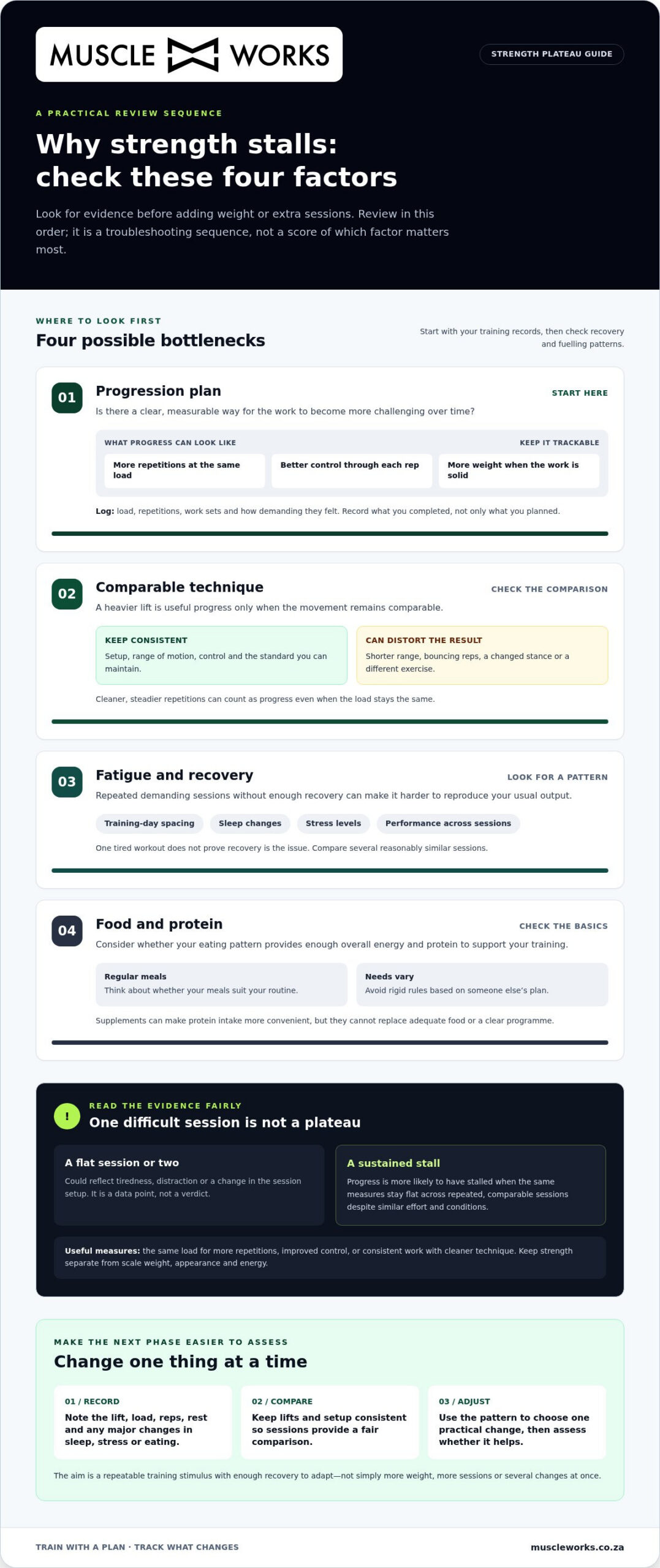
If you’re wondering why am I not getting stronger in the gym, don’t assume the answer is to train harder. A stall can have several possible causes: an unclear progression plan, changes in technique, accumulating fatigue or eating patterns that don’t support your workload. These are possible contributors, not automatic diagnoses. Look for evidence before changing everything at once.
Strength depends on a repeatable training stimulus and enough recovery to adapt to it. If either side is missing, effort alone may not move your numbers.
Is your programme giving you a measurable reason to get stronger?
Progressive overload means gradually increasing the challenge in a trackable way. That might mean adding a repetition at the same load, improving control or increasing the weight when your current work is solid. It doesn’t mean forcing a heavier lift every session. If your plan has no clear way to progress, you may be repeating hard work without a measurable target.
Frequent programme changes can make progress harder to assess. Swap exercises, sets and rep ranges every week, and it becomes difficult to tell whether your performance is improving. Keep a simple log of each main lift:
- Load and repetitions: Record what you actually completed, not what you planned.
- Sets and effort: Note the number of work sets and how demanding they felt.
- Technique: Flag any change in range, control or setup that affects comparison.
Consistent records turn “I think I’m stuck” into something you can assess.
Could technique be hiding progress?
A heavier lift only counts as useful progress if the movement remains comparable. Shortening the range, bouncing through a repetition or changing your stance can make a set look stronger on paper whilst changing the task. The reverse is also true: cleaner reps and steadier control can be real progress, even if the load stays the same. Use a repeatable setup and a standard you can maintain from set to set.
Are fatigue or fuelling affecting your performance?
Hard training creates fatigue. Repeated demanding sessions without enough recovery can make it harder to reproduce your usual output. Review how training days are spaced, whether performance dips across several sessions, and whether sleep or general stress has changed. Don’t treat one tired workout as proof that recovery is the problem. Look for a pattern.
Then check the basics of fuelling. Are you eating regular meals that suit your routine? Are they providing enough overall energy and protein for your training? Needs vary, so avoid rigid rules based on someone else’s plan. Supplements can make protein intake more convenient, but they can’t replace adequate food or a clear programme. Muscle Works offers protein options, including Iso-Tech Whey and Plant Protein, as well as creatine monohydrate. These can complement consistent training and recovery.
How to find the bottleneck instead of simply training harder
If you’re asking why am I not getting stronger in the gym, use your records to investigate before adding weight, sets or supplements. More work isn’t automatically better. A log can show whether the issue appears related to progression, technique or recovery, but it can’t diagnose the cause on its own. Treat patterns as clues, then test one sensible change at a time.
What your training log can reveal about stalled lifts
Review several weeks of comparable sessions, or enough repeat exposures to see a pattern. Check whether you’ve recorded the same lifts, loads, sets and repetitions consistently. Note exercise variations and perceived effort too. Repeatedly missing a target, declining across sessions or completing the same work at a similar effort may point to different factors. Inconsistent records make those patterns harder to trust.
Use this as a starting point, not a diagnosis:
| What you notice | Possible clue to investigate |
|---|---|
| Loads and reps stay flat, but effort feels manageable | Your plan may lack a clear progression target. |
| Performance falls across several sessions | Review training workload, sleep, stress and routine changes. |
| The same lift feels different from session to session | Check setup, range of motion, exercise order and rest periods. |
| Hard sessions coincide with irregular meals | Consider whether your eating pattern supports your training demands. |
When technique is hard to assess, a video of a set can help you compare your setup and movement over time. Feedback from a suitably qualified coach can offer another perspective. Don’t chase a heavier number if the lift has changed so much that it’s no longer a fair comparison.
How to separate a training issue from a recovery issue
Compare your performance notes with changes in workload, sleep, stress and daily routine. If lifts dip after you add demanding sessions or lose sleep, the timing is worth investigating, but it doesn’t prove a single cause. One hard workout isn’t evidence of overtraining. Look for a consistent relationship across your log, then adjust one factor and observe what follows.
Before adding volume, ask whether your current plan has a clear progression target and leaves enough space to recover. More sets may add fatigue without fixing a technique or fuelling issue. Supplements aren’t a shortcut to identifying the bottleneck either. Persistent pain, unusual weakness or other concerning symptoms call for advice from a qualified medical professional, not a guess based on your training log.
A practical reset plan for getting stronger in the gym
Once you have a likely bottleneck, resist the urge to overhaul your entire routine. If you’re asking why am I not getting stronger in the gym, a controlled test is more useful than adding weight, sets and supplements all at once. Establish what’s happening, make one change, then review the evidence.
- Establish a baseline. Choose the lifts you want to assess. Record load, sets, repetitions, rest periods, technique and perceived effort across comparable sessions. Note relevant changes in sleep, stress or routine too.
- Pick one adjustment. Use your records to choose the most plausible factor. If your technique varies, standardise your setup. If you’re missing planned reps, adjust the progression target rather than forcing heavier loads. If fatigue is building, consider reducing workload or improving recovery before adding volume.
- Keep the test consistent. Hold exercise selection, order and measurement steady. Change only the variable you’re testing, such as repetitions, load, rest or weekly workload. This makes it easier to tell whether the change helped.
- Record and review. Log each comparable session and look for a trend, not a one-day result. Review after enough repeat exposures to see whether performance, effort or technique is moving in the right direction.
How to make one controlled change to your training
Choose the adjustment that best matches your evidence, not the one that sounds toughest. For example, if your reps fall off because rest periods vary, make rest more consistent before adding sets. If you repeatedly miss your target reps with sound technique, reconsider the load or progression step. Keep the movement controlled and comparable; otherwise, you won’t know whether the adjustment worked or the lift simply changed.
More training isn’t always the answer. If your log shows performance slipping alongside a demanding workload or poor rest, reducing fatigue may be more useful than increasing volume. Protect recovery, keep your usual training structure stable and see whether your output improves. Don’t change several variables at once, even if you’re eager to break the stall.
When should you review the plan or ask for support?
Set a review point that fits your programme and how often you train each lift. If you repeat a movement regularly, you can review sooner than if you perform it less often, but wait for comparable sessions rather than expecting a fixed result by a particular date. If technique or progression still feels unclear, a qualified coach can help assess your approach. Seek medical advice for persistent pain or unexplained changes in strength.
Nutrition is one part of the reset, not a replacement for it. If protein is difficult to fit into regular meals, Muscle Works offers whey and plant-based protein options to complement your nutrition plan. Keep the priority clear: consistent training, recovery and adequate food come first.
Fuel strength progress with consistent nutrition and smart support
Training gives your body a reason to adapt. Food and recovery help it meet the demands of that work. If your intake is too low for your activity, or meals are inconsistent, hard sessions may feel harder and recovery may suffer. Nutrition isn’t a single switch that explains every stall, though. Needs vary with body size, training, goals, appetite and health.
How nutrition supports strength training
Build your routine around enough overall energy and regular meals that include protein. Protein supplies amino acids used to repair and build tissue after training; spreading it across meals can make daily intake easier to manage. A general range for strength athletes is 1.6 to 2.2 g of protein per kilogram of body weight per day. That’s a guide, not a prescription for every person. For example, at 70 kg, the range works out to 112 to 154 g daily. Personal needs can differ.
Don’t put all the pressure on a post-workout meal. One meal doesn’t determine your strength progress. Your overall pattern across the day, alongside a suitable training plan and recovery, matters more. Start by noticing whether you eat regularly and include protein sources in meals. If you struggle to meet your needs through food, a protein powder can be a convenient option. It’s optional, not compulsory.
Where supplements fit, and where they do not
Protein powder can make a nutrition plan easier to follow, but it can’t compensate for inadequate overall food intake or an ineffective programme. Whey and plant proteins offer different options; choose support that fits your dietary preferences and routine. Creatine monohydrate is a well-studied supplement used to support repeated high-intensity exercise, including resistance training. It isn’t a fix for poor programming, and its effects shouldn’t be treated as guaranteed. If you have a medical condition, take medication or are unsure whether it’s suitable for you, seek advice from a healthcare professional before using it.
Keep the priority order clear: consistent training, adequate food, recovery, then optional support. Supplements don’t replace any of the foundations. For a closer look at convenient protein, read this 100% Whey Protein guide. If you’re researching creatine, explore the creatine monohydrate guide for more context. Explore Muscle Works products and choose support that fits your plan, rather than relying on a supplement to solve a training problem.
Make your next training block a deliberate one
Your next phase doesn’t need a dramatic overhaul. Choose one clear adjustment, give it a fair test and let your records guide the next move. That’s a stronger response to “why am I not getting stronger in the gym” than chasing a quick fix. Progress is built through decisions you can repeat and evaluate.
Keep nutrition practical too. Muscle Works offers whey and plant-based protein options, plus creatine monohydrate for athletes considering targeted support. These products can complement a sound plan, but progress still depends on consistent training, adequate food and recovery.
Explore Muscle Works sports supplements and choose protein or performance support that fits your routine. Then return to training with a clear target and a plan you can stick to.
Frequently Asked Questions
How long should I wait before calling it a strength plateau?
Wait until you’ve seen a repeated stall across several comparable sessions, rather than judging by a set number of days. Check the same lift, range of motion and effort, and note whether you’re completing the planned repetitions. If you train a lift infrequently, it may take longer to gather useful comparisons. There’s no universal deadline: the quality and consistency of your records matter more than the calendar.
Can I get stronger without adding weight to the bar every week?
Yes. Strength can improve through better control, more repetitions at the same load or more consistent execution. For example, completing all your planned reps with steadier form is a useful step before increasing the weight. You can also progress by adjusting sets or rest, depending on your programme. Keep changes small enough to maintain good technique, and don’t treat weekly load increases as the only evidence of progress.
Is it normal to feel weaker in some gym sessions?
Yes, occasional dips happen and don’t automatically mean you’ve lost strength. A late night, a stressful day, unfamiliar equipment or a longer gap between meals can affect how a session feels. Use your warm-up to gauge readiness, then avoid forcing a personal best if your usual working weight feels unusually difficult. If weakness persists, worsens or feels unexplained, seek appropriate medical advice rather than pushing through blindly.
Should I change my whole workout programme when my lifts stall?
No, a full programme reset is rarely the first move to make. Start by checking whether the stalled lift has a clear progression target and whether you’ve followed the plan consistently. If the rest of your training is moving forward, changing everything could disrupt what’s working. Test one targeted adjustment first. If the programme has no structure or you can’t identify a sensible next step, qualified coaching input may help.
Can creatine help if I am not getting stronger in the gym?
Creatine monohydrate may support performance in repeated high-intensity exercise, but it won’t correct an unsuitable programme or poor recovery. Research findings don’t guarantee an individual result. If you’re considering it, follow the product label and speak with a healthcare professional first if you have a medical condition, take medication or have concerns about suitability. Treat it as optional support, not the answer to every strength stall.
How much protein do I need to build strength?
A general range for strength athletes is 1.6 to 2.2 g of protein per kilogram of body weight per day. At 70 kg, that works out to 112 to 154 g daily. It’s a useful planning range, not a personal prescription; dietary needs vary. Estimate your intake across a typical day before changing it. If food alone makes your target difficult to meet, a protein powder can offer a convenient option.
Can poor sleep stop me getting stronger?
Poor sleep can make training feel harder and leave you less ready to repeat demanding sessions, which may interfere with progress if it becomes a pattern. Track sleep alongside workout performance for a couple of weeks; note bedtime, wake time and how rested you feel. Look for practical disruptions, such as late caffeine or an inconsistent routine, and address what you can. Persistent sleep problems are worth discussing with a healthcare professional.